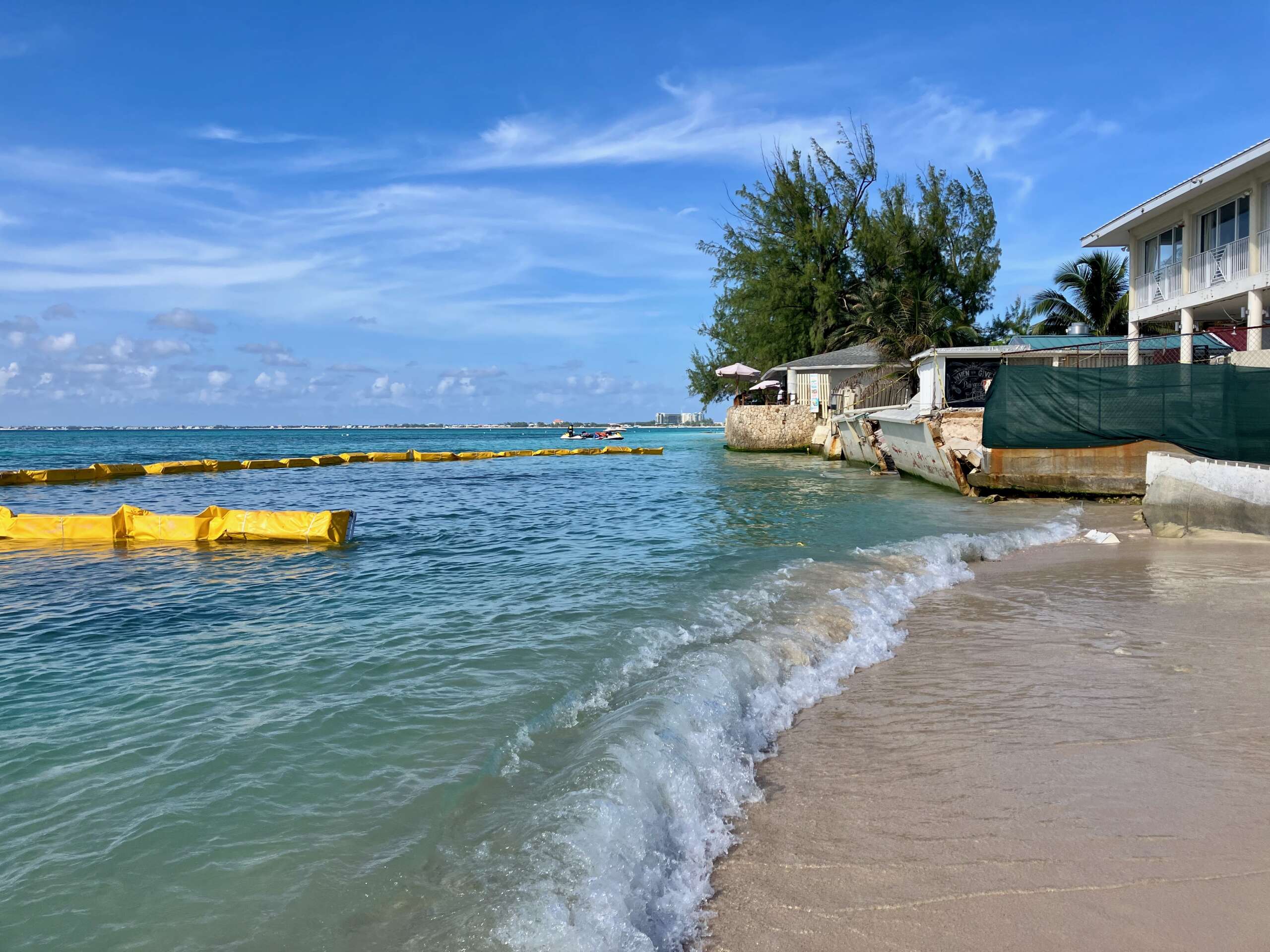
Work is under way to clean up debris around the crumbling sea wall on the edge of Royal Palms, while coastal engineers have recommended the site be demolished.
Emergency work to clear rubble and stabilise structures damaged in recent storms began Thursday.
The derelict bar has become an eyesore at the southern end of the beach and a report for the Department of Environment has recommended the buildings be demolished and built further back from the water.
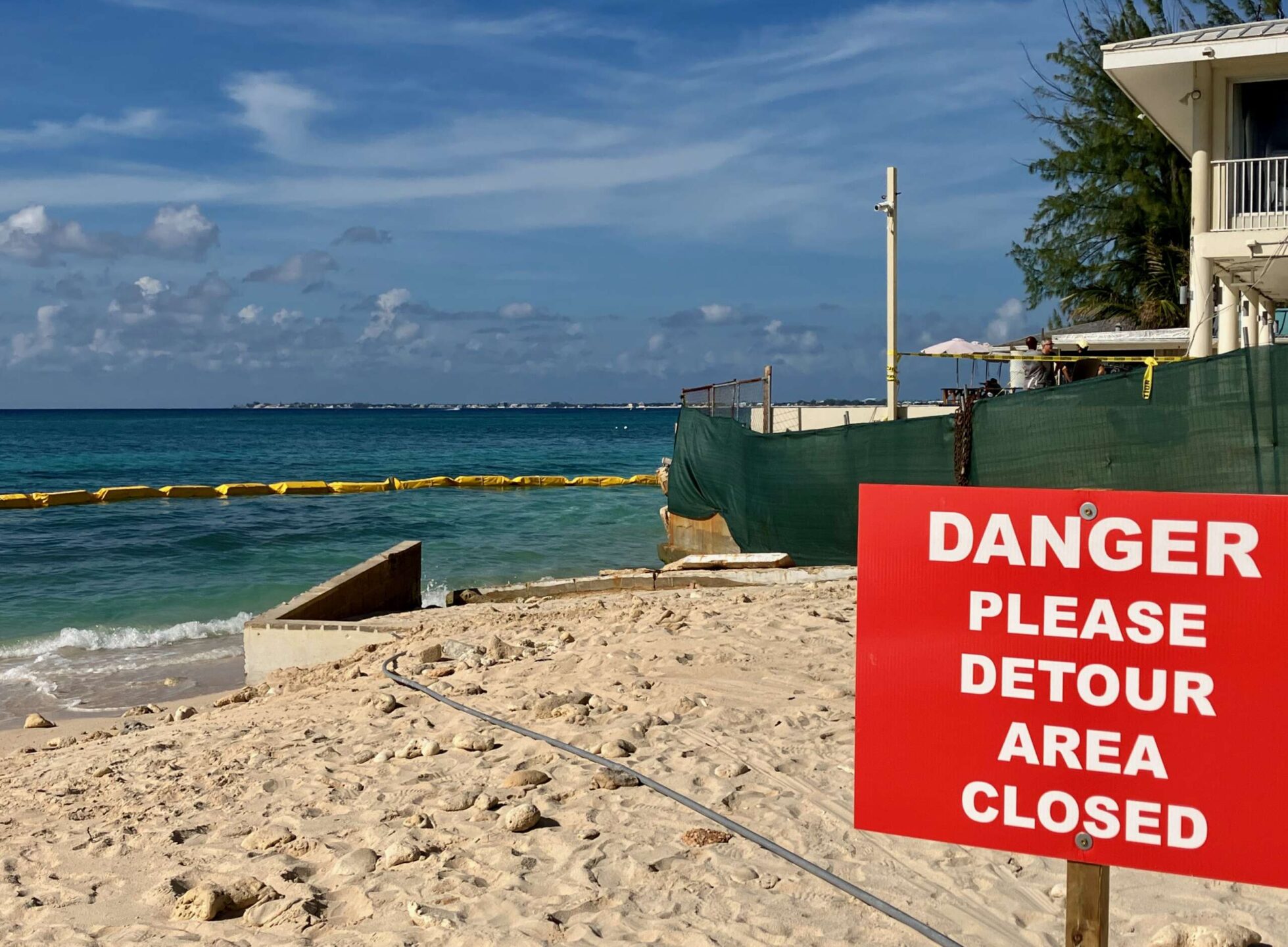
Erosion along that part of the coastline has eaten away at the shoreline, compounding problems with the bar deck and sea wall. The crumbling structures are now spilling into the water.
Dart’s planned work is a temporary measure aimed at making the site less hazardous. The company has not announced any long term plans.
The bar area was cordoned off on Thursday and surrounded by warning signs, diverting people away from the location.
The wall appeared to be in poor shape, with the decrepit structure crumbling into the water.
Dart says its plan for the “careful clean-up of debris and stabilisation of structures” was developed in collaboration with the Department of Environment and Department of Planning.
Gary Gibbs, senior vice president, design and construction, for Dart, told the Compass in a statement that the work was likely to take up to two weeks.
“Since Hurricane Ian’s sea surges exacerbated erosion on the southern end of Seven Mile Beach and damaged beachfront structures, Dart has been working with governmental authorities on remediation of the westernmost structures on the Royal Palms property.”

Silt screens were being put in place Thursday to help prevent any impact to the marine environment.
“We will closely monitor weather and turbidity and will follow guidelines provided by the DoE team during both its detailed review process and following onsite inspections,” he said.
Relocation and ‘managed retreat’ recommended
Dart hasn’t yet confirmed its long term plans for the site, though a previous proposal involved situating a new hotel on top of its overpass, which crosses West Bay Road.
The DoE is recommending the existing properties be demolished in an effort to restore the beach – an idea that could potentially align with the developer’s ambitions for a new resort at the location.
Director Gina Ebanks-Petrie said the site is a prime candidate for ‘managed retreat’ in order to build resiliency against storm impacts and climate change.
A report from coastal engineer Dr. Kevin Bodge, of Olsen Associates, suggests the location represents an ideal opportunity to rebuild with greater coastal setbacks.
He wrote that the property line would ideally be located at least 16 meters further inland – where the current buildings are located. That would mean the bar and deck, seaward of the pool, would need to be demolished.
“This would better ensure a reliable recreational beach along the entirety of the shorefront,” he wrote.
‘Excellent opportunity’ to restore beach
Noting that the bar had been closed for two-and-a-half years and that there was a large area of land, currently encompassing a car park, that could be used for redevelopment, Bodge said relocating the buildings could be a win-win for Dart and the Cayman Islands.
“The Royal Palms site presents an excellent opportunity – probably the most ideal contemporary example along south Seven Mile Beach – to restore reliable sand beach at a developed property through a landward relocation of a seawall/hardscape,” he wrote.
“The overall site is being currently master-planned for a new resort, per my understanding. Factors such as these rarely co-align to allow for re-thinking the shorefront of an existing/future development in order to mitigate a chronic beach erosion problem – where the existence of a reliable and suitably wide dry sand beach is of central economic value to the development.”
Current clean-up
Ebanks-Petrie, director of the Department of Environment, said officials had approved Dart’s initial methodology statement for removing the broken wall and removing the fill material between the outer wall and the deck of the pool bar.
She said the wall was damaged and falling into the sea and for safety reasons, as well as to prevent the fill from leaching into the water, it made sense to remove it.
Ebanks-Petrie said Dart had since come back with proposals to remediate part of the wall, using boulders – a process the DoE does not support.
The company has the green light to remove the wall and clear the debris, using silt screens, to prevent any debris filtering into the ocean.
The Dart group acquired the property in 2017.
The beach bar closed when the island shut its doors to tourists as COVID hit and has not reopened.
The building and surrounding infrastructure has fallen into disrepair, causing safety and aesthetic concerns, while the erosion of the beach has exacerbated structural issues.
Related Videos