
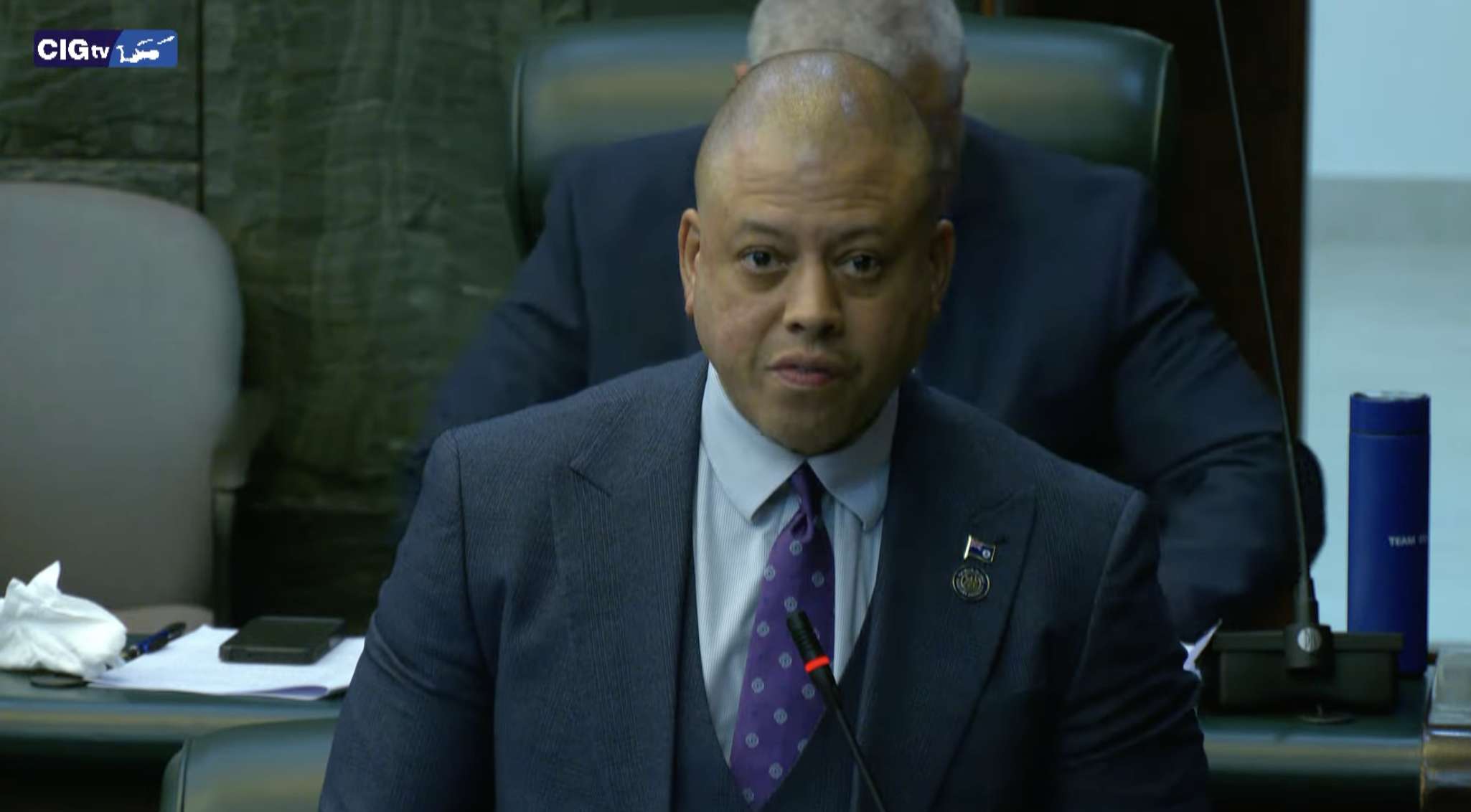
The Cayman Islands government is aiming to bring forward a draft legislative framework for artificial intelligence by the second quarter of 2027, Premier and Minister for Financial Services and Commerce André Ebanks told Parliament last week.
Responding to a question during the 6 March sitting, Ebanks said the rapid pace of AI development makes it critical for the Cayman Islands to begin putting safeguards in place while still allowing innovation to flourish.
“AI is developing at a phenomenal pace,” Ebanks said. “We must therefore act in a way that both safeguards the health, safety and fundamental rights of Caymanians and enables responsible innovation that improves public services and strengthens our economy.”
Ebanks advised that the government has already established a National Digital Transformation Task Force “to provide expert advice and coordinated leadership on the opportunities and the challenges as we approach digital transformation in the country, including the responsible use of AI across government and the wider economy”.
The taskforce, which was launched in October, is chaired by Cristina Spratt, former country manager for Flow and founder of Tidal Edge Consulting. The other committee members are Jeff Goddard, Kaitlyn Elphinstone, Jason Nehra, Alexandra Forsell, Lucy Frew, Tamsin Deasey, Lucia Gallardo and James McFee.
That task force is expected to deliver its recommendations by the end of May. According to previous reports, guidance will be grounded on the pillars of digital trust, intelligence and transformation, and digital assets and economic growth.
“That report will be central to informing the decisions we have to take on suitable AI governance approach and legal framework for our islands,” Ebanks told the MPs.
The premier advised that those findings would help to determine whether Cayman ultimately introduces a standalone AI law or amends existing legislation – such as data protection or sector-specific legislation – to regulate the technology.
While legislation may still be several years away, Ebanks said the government has already begun developing internal rules governing the use of artificial intelligence.
“In the meantime … a great deal of effective AI governance can and is being put in place immediately through policy, standards and regulatory guidance under existing legislation and regulations,” he said.
Government’s first-ever AI policy
A first version of the Cayman Islands government’s internal AI policy has been drafted and is currently in the final stages of approval. Once adopted, it will apply across the civil service.
“As of this month, March 2026, the Cayman Islands Civil Service has formally developed its first AI policy version 1.0,” Ebanks said. “This policy is in its final stages of sign off with the Office of the Deputy Governor with the aim to be deployed across the breadth of CIG.”
Ebanks said the policy will establish oversight and risk management requirements for any AI systems used by government agencies.
“This policy establishes mandatory governance, risk management, transparency, accountability and oversight requirements across the entire civil service,” he told MPs.
Ebanks added that government teams are also examining how artificial intelligence could be used in specific sectors, including education and healthcare.
Under the new framework, government entities will not be able to independently adopt AI tools without undergoing a formal review process designed to address security, legal and technical risks.
“Under the AI policy framework, AI systems cannot be procured, piloted, or deployed without coordinated review for cybersecurity, legal compliance, data protection, risk assessment and architectural alignment,” Ebanks said.
The policy also places explicit limits on how artificial intelligence can be used within government operations.
“The policy expressly prohibits unauthorised deployment, the misuse of sensitive data, unlawful or harmful use of AI, and the use of high-risk applications without proper approvals,” he said.
Ebanks emphasised that the use of artificial intelligence within government is already subject to existing Cayman Islands legislation and regulatory structures.
He cautioned that designing effective legislation for such a rapidly evolving technology requires careful consultation.
“It would be premature to give this House a guaranteed commencement date for AI legislation,” he said.
“Once we receive the task force recommendations, complete consultation, and settle key policy choices, any guaranteed date would risk being either unrealistic or not aligned with the best protections for the country. That said, we must work purposefully towards an express target timeframe, so our minds remain focused and driven.”
Related Videos