Personality Parade
About the article
This is a digitised version of an article from The Cayman Compass's print archive. Occasionally, the digitisation process introduces transcription errors, or other problems.
See the article in its original context from April 1966.
Brought to you by

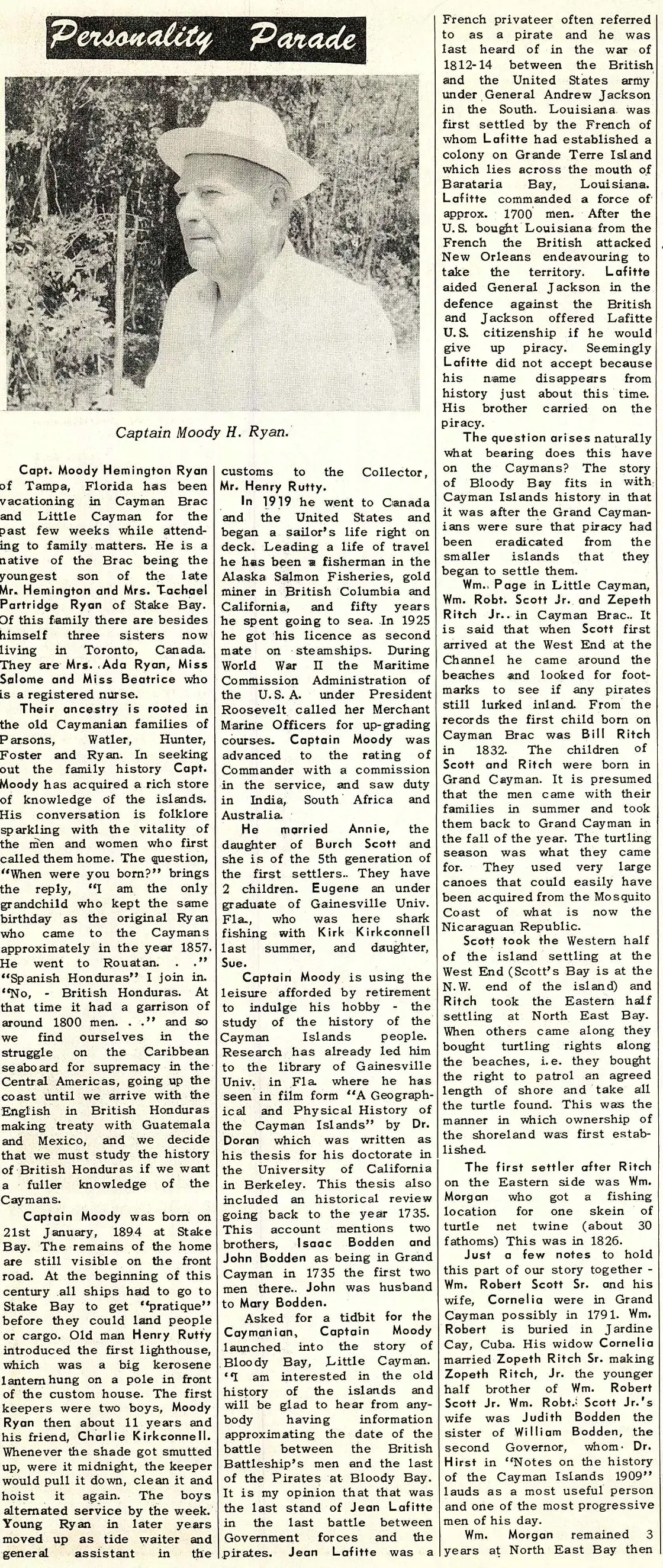
Their ancestry is rooted in the old Caymanian families of Parsons, Watler, Hunter, Foster and Ryan. In seeking out the family history Capt. Moody has acquired a rich store of knowledge of the islands. His conversation is folklore sparkling with the vitality of the men and women who first called them home. The question, "When were you born?" brings the reply, “I am the only grandchild who kept the same birthday as the original Ryan who came to the Caymans approximately in the year 1857. He went to Rouatan. . .”. "Spanish Honduras" I join in. "No, - British Honduras. At that time it had a garrison of around 1800 men. . .” and so we find ourselves in the struggle on the Caribbean seaboard for supremacy in the Central Americas, going up the coast until we arrive with the English in British Honduras making treaty with Guatemala and Mexico, and we decide that we must study the history of British Honduras if we want a fuller knowledge of the Caymans. Captain Moody was born on 21st January, 1894 at Stake Bay. The remains of the home are still visible on the front road. At the beginning of this century all ships had to go to Stake Bay to get "pratique" before they could land people or cargo. Old man Henry Rutty introduced the first lighthouse, which was a big kerosene lantern hung on a pole in front of the custom house. The first keepers were two boys, Moody Ryan then about 11 years and his friend, Charlie Kirkconnell.
Whenever the shade got smutted up, were it midnight, the keeper would pull it down, clean it and hoist it again. The boys alternated service by the week. Young Ryan in later years moved up as tide waiter and general assistant in the customs to the Collector, Mr. Henry Rutty.
In 1919 he went to Canada and the United States and began a sailor's life right on deck. Leading a life of travel he has been a fisherman in the Alaska Salmon Fisheries, gold miner in British Columbia and California, and fifty years he spent going to sea. In 1925 he got his licence as second mate on steamships. During World War II the Maritime Commission Administration of the U.S.A. under President Roosevelt called her Merchant Marine Officers for up-grading courses. Captain Moody was advanced to the rating of Commander with a commission in the service, and saw duty in India, South Africa and Australia.
He married Annie, the daughter of Burch Scott and she is of the 5th generation of the first settlers. They have 2 children. Eugene an undergraduate of Gainesville Univ. Fla., who was here shark fishing with Kirk Kirkconnell last summer, and daughter, Sue, Captain Moody is using the leisure afforded by retirement to indulge his hobby the study of the history of the Cayman Islands people.
Research has already led him to the library of Gainesville Univ. in Fla. where he has seen in film form "A Geographical and Physical History of the Cayman Islands" by Dr. Doran which was written as his thesis for his doctorate in the University of California in Berkeley. This thesis also included an historical review going back to the year 1735. This account mentions two brothers, Isaac Bodden and John Bodden as being in Grand Cayman in 1735 the first two men there.. John was husband to Mary Bodden.
Asked for a tidbit for the Caymanian, Captain Moody launched into the story of Bloody Bay, Little Cayman. "I am interested in the old history of the islands and will be glad to hear from anybody having information approximating the date of the battle between the British Battleship's men and the last of the Pirates at Bloody Bay. It is my opinion that that was the last stand of Jean Lafitte in the last battle between Government forces and the pirates. Jean Lafitte was a French privateer often referred to as a pirate and he was last heard of in the war of 1812-14 between the British and the United States army under General Andrew Jackson in the South. Louisiana was first settled by the French of whom Lafitte had established a colony on Grande Terre Island which lies across the mouth of Barataria Bay, Louisiana.
Lafitte commanded a force of approx. 1700 men. After the U.S. bought Louisiana from the French the British attacked New Orleans endeavouring to take the territory. Lafitte aided General Jackson in the defence against the British and Jackson offered Lafitte U.S. citizenship if he would give up piracy. Seemingly Lafitte did not accept because his name disappears from history just about this time. His brother carried on the piracy. The question arises naturally what bearing does this have on the Caymans? The story of Bloody Bay fits in with Cayman Islands history in that it was after the Grand Caymanians were sure that piracy had been eradicated from the smaller islands that they began to settle them.
Wm.. Page in Little Cayman, Wm. Robt. Scott Jr. and Zepeth Ritch Jr.. in Cayman Brac.. It is said that when Scott first arrived at the West End at the Channel he came around the beaches and looked for footmarks to see if any pirates still lurked inland. From the records the first child born on Cayman Brac was Bill Ritch in 1832. The children of Scott and Ritch were born in Grand Cayman. It is presumed that the men came with their families in summer and took them back to Grand Cayman in the fall of the year. The turtling season was what they came for. They used very large canoes that could easily have been acquired from the Mosquito Coast of what is now the Nicaraguan Republic.
Scott took the Western half of the island settling at the West End (Scott's Bay is at the N.W. end of the island) and Ritch took the Eastern half settling at North East Bay. When others came along they bought turtling rights along the beaches, i.e. they bought the right to patrol an agreed length of shore and take all the turtle found. This was the manner in which ownership of the shoreland was first established. The first settler after Ritch on the Eastern side was Wm. Morgan who got a fishing location for one skein of turtle net twine (about 30 fathoms) This was in 1826.
Just a few notes to hold this part of our story together - Wm. Robert Scott Sr. and his wife, Cornelia were in Grand Cayman possibly in 1791. Wm. Robert is buried in Jardine Cay, Cuba. His widow Cornelia married Zopeth Ritch Sr. making Zopeth Ritch, Jr. the younger half brother of Wm. Robert Scott Jr. Wm. Robt. Scott Jr.'s wife was Judith Bodden the sister of William Bodden, the second Governor, whom. Dr. Hirst in "Notes on the history of the Cayman Islands 1909" lauds as a most useful person and one of the most progressive men of his day.
Wm. Morgan remained 3 years at North East Bay then