PAGE 4 THE CAYMAN COMPASS MARCH 22, 1973 Tennis Rift Healed: NOW FOR WIMBLEDON
About the article
This is a digitised version of an article from The Cayman Compass's print archive. Occasionally, the digitisation process introduces transcription errors, or other problems.
See the article in its original context from March 1973.
Brought to you by

FORMER LEADING SPORTS COLUMNIST OF THE 'DAILY MIRROR', LONDON IT is good news for all lawn tennis fans that the International Lawn Tennis Federation (ILTF) — the governing body of the sport all over the world — and World Championship Tennis (WCT), which has so many of the world's top men under contract, have come to terms. Incidentally, it is worth recalling that this re-marriage, after the "divorce" of last year which prevented so many of the top names from playing in some of the greatest tournaments - including Wimbledon, the greatest - was achieved by the President of the ILTF. He is Allan Heyman, a Dane, but one who lives in England and is one of the only two foreign-born Queen's Counsel practising in Britain. What in effect is now happening is that until the end of April the WCT will have two separate groups, each comprising 32 players, playing all over the world.
LEADING CIRCUITS
Group "A" includes the immortal Rod Laver; Stan Smith, the 1972 Wimbledon champion, chief architect of the United States' Davis Cup victory and WCT's greatest acquisition: South Africa's Cliff Drysdale; Cliff Richey and Bob Lutz, both of the United States.
Roy Emerson and John Alexander from Australia, the Puerto Rican born Charlie Pasarell, Nikki Pilic, the Yugoslav, and Bob Hewitt, another South African. They began their circuit at Miami, went on to San Diego in California, and from there will proceed to Philadelphia; Toronto; Atlanta, Georgia; St. Louis, Missouri; Munich; Brussels; Johannesburg, and Gothenburg, Sweden. Meanwhile Group "B" has an entirely different itinerary. Its stars include the seemingly everlasting Ken Rosewall, Tom Okker of the Netherlands, Arthur Ashe and Marty Riessen of the United States, Jan Kodes of Czechoslovakia, the two leading British players, Roger Taylor and Mark Cox, two more Americans, Tom Gorman and Jeff Borowiak, and a strange capture for the largely American dominated WCT - Alex Metreveli of the Soviet Union. The most famous British sports writer, who has seen nearly every Wimbledon Championship since 1929, sets the scene of world tennis, leading up to the greatest tournament of them all at Wimbledon in London next June. Group "B" has already appeared in Britain at Deeside, North Wales, and at the Royal Albert Hall, London. From there the players go on to Milan; Copenhagen; Cologne; Chicago; Washington; Vancouver; Houston, Texas; Cleveland, Ohio; Charlotte, North Carolina, and Denver, Colorado. Finally, the leaders from both groups get together for the final stages of their doubles matches at Montreal from 30 April to 6 May and at last for the great singles bonanza at Dallas, Texas, from 9 to 13 May.
THE 'BIG FOUR'
The first of the ILTF Grand Prix tournaments overlaps the WCT finals at Dallas, when the British Hard Court Championships are held at Bournemouth, Southern England, from 7 to 12 May. From 14 to 20 May, the third round of the European Zone of the Davis Cup will be played and at the same time a tournament organised by the newly formed Players' Association will be held at Las Vegas, for those stars who are not involved in the European competition. Next comes the second of the traditional "Big Four" tournaments - the first, the Australian, has already been decided. The second is the one which most p'ayers trying for the "Grand Slam" of Australia, France, Wimbledon and the United States championships have found the hardest to win because the French championships, which take place in Paris from 21 May to 3 June, are played on clay courts, as opposed to the grass of Australia, Wimbledon and Forest Hills.
CROWDED JUNE
After Paris comes Rome, which coincides with Berlin, the two of them lasting until June 10. The following week is a crowded one with major tournaments at Bristol in western England, Hamburg and Brussels. Queen's Club, London, is the traditional run-up to the Championships at Wimbledon, which this year last from 25 June to 7 July. The European Grand Prix men's tournaments continue at Baastad, Sweden; Gstaad, Switzerland; Newport, Wales; Kitzbuhl, Austria, and Hilversum, the Netherlands. While the last two are being played, the semifinal round of the Davis Cup (European Zone) will also be decided. You get some idea of the amount of money involved in "big time" lawn tennis these days when you realise that on the European circuit alone, discounting whatever may be paid to stars for competing in the Davis Cup. 14 tournaments.
some of course overlapping, are able to offer total prize money of just over £281,000 ($562,000)!
ATTENDANCE RECORD
I must say I have rarely looked forward to a Wimbledon more than I do to this year's championships - and I have seen every final, bar two, since 1929. Everyone prophesied gloom and disaster in 1972 when the WCT stars were excluded.
In fact during the championships, the attendance record was very nearly beaten, and,
Contd. on P. 13 Col. 1 TENNIS contd. from P. 4 in the end, we had a final between Stan Smith (USA) and Ilie Nastase (Romania) which was the best I have seen since Jack Crawford.
the Australian, beat Ellsworth Vines, the mighty hitter from the United States, in 1933. Now that Smith has finished his Army service and has joined WCT, the only "independent" player with a real chance of capturing any of the top tournaments — and the money that goes with them — is, of course, Nastase. Last year he lost the Wimbledon final and, even more shatteringly for him, the first Davis Cup Challenge round ever to be played in Romania, to Smith. On the credit side he won the U.S. championships, the Commercial Union Grand Prix (worth £21,000 - $42,000 to him) and the Commercial Union Masters Tournament (another £6,000 - $12,000).
Altogether the "hippy" Romanian whom the teenagers love - and whom some of the older and more conservative love to hate! collected, during the year, £90,000 ($180,000), three motor cars and a truly lovely (and wealthy!) young wife. So shall we see another Smith-Nastase final at Wimbledon? Or will one of the older "masters" return to the pinnacle of the profession? Surely — alas! Ken Rosewall, now in his 39th year, has left it too late. And can even the miraculous Rod Laver, who will be nearly 35 by Wimbledon finals day, regain the title which he first won, as an amateur, back in 1961?
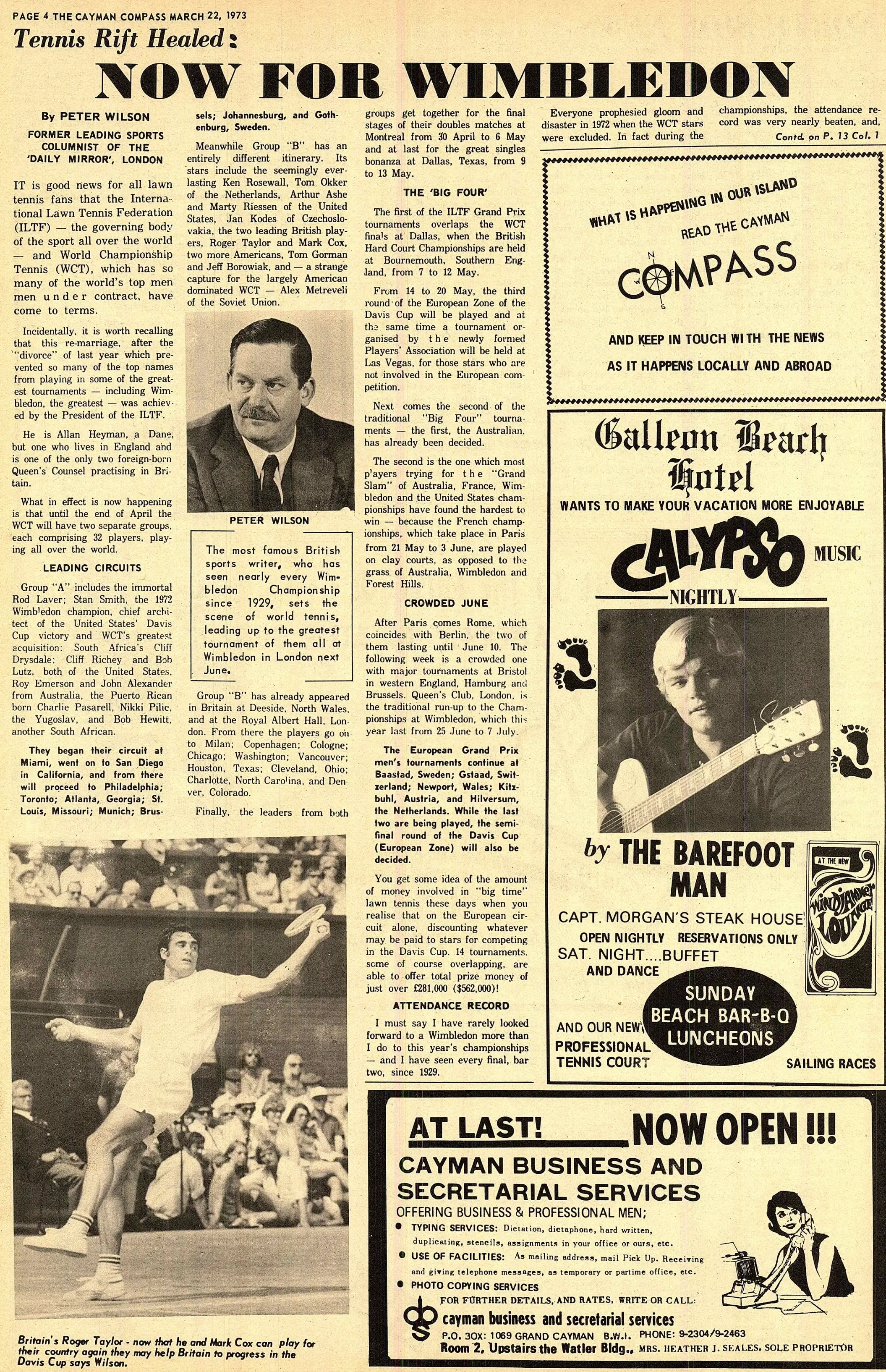
Perhaps a better bet among the former titleholders would be John Newcombe, 29 next May, winner in 1967, 1970 and 1971. Or shall we see a completely new man champion – not counting Nastase? I very much doubt it. Lawn tennis is the most predictable of the major sports — which explains why, since full "seeding" was introduced in 1927, no "unseeded" player has ever won and fewer than half-a-dozen have even reached the final. One good thing about the nexus between WCT and other players, from a British point of view, is that we shall be able to see our own top two male stars, Roger Taylor and Mark Cox, competing for their country again, giving us a chance at least of progressing to a respectable stage in the Davis Cup.