After the Fall Jean Doucet's Banks Collapse, Underscoring Risks of a Tax Haven
About the article
This is a digitised version of an article from The Cayman Compass's print archive. Occasionally, the digitisation process introduces transcription errors, or other problems.
See the article in its original context from February 1975.
Brought to you by

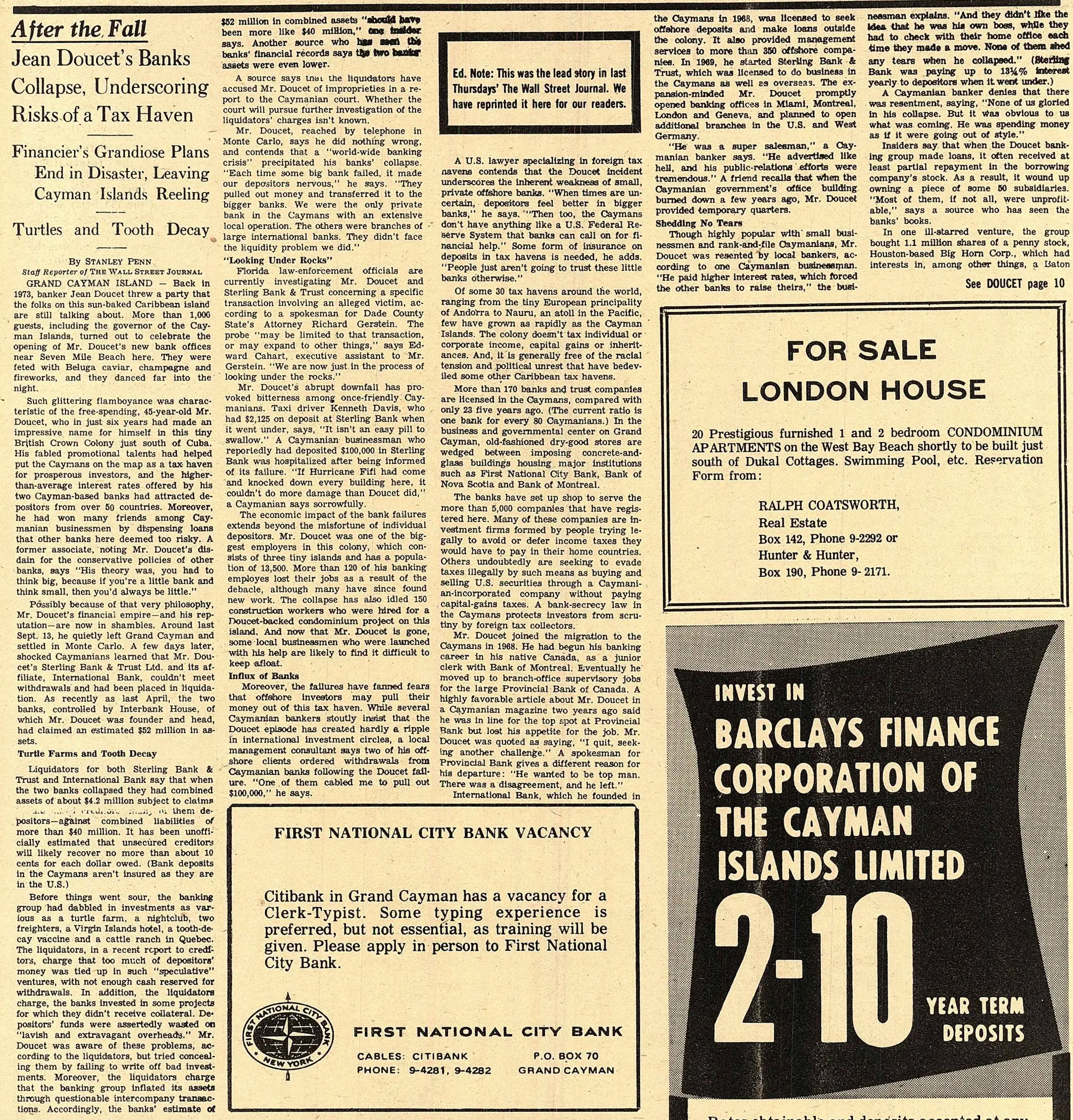
GRAND CAYMAN ISLAND - Back in 1973, banker Jean Doucet threw a party that the folks on this sun-baked Caribbean island are still talking about. More than 1,000 guests, including the governor of the Cayman Islands, turned out to celebrate the opening of Mr. Doucet's new bank offices near Seven Mile Beach here. They were feted with Beluga caviar, champagne and fireworks, and they danced far into the night. Such glittering flamboyance was characteristic of the free-spending, 45-year-old Mr. Doucet, who in just six years had made an impressive name for himself in this tiny British Crown Colony just south of Cuba. His fabled promotional talents had helped put the Caymans on the map as a tax haven for prosperous investors, and the higher-than-average interest rates offered by his two Cayman-based banks had attracted depositors from over 50 countries. Moreover, he had won many friends among Caymanian businessmen by dispensing loans that other banks here deemed too risky. A former associate, noting Mr. Doucet's disdain for the conservative policies of other banks, says "His theory was, you had to think big, because if you're a little bank and think small, then you'd always be little."
Possibly because of that very philosophy, Mr. Doucet's financial empire-and his reputation-are now in shambles. Around last Sept. 13, he quietly left Grand Cayman and settled in Monte Carlo. A few days later, shocked Caymanians learned that Mr. Doucet's Sterling Bank & Trust Ltd. and its affiliate, International Bank, couldn't meet withdrawals and had been placed in liquidation. As recently as last April, the two banks, controlled by Interbank House, of which Mr. Doucet was founder and head, had claimed an estimated $52 million in assets.
Turtle Farms and Tooth Decay Liquidators for both Sterling Bank & Trust and International Bank say that when the two banks collapsed they had combined assets of about $4.2 million subject to claims them depositors-against combined liabilities of more than $40 million. It has been unofficially estimated that unsecured creditors will likely recover no more than about 10 cents for each dollar owed. (Bank deposits in the Caymans aren't insured as they are in the U.S.) Before things went sour, the banking group had dabbled in investments as various as a turtle farm, a nightclub, two freighters, a Virgin Islands hotel, a toothdecay vaccine and a cattle ranch in Quebec.
The liquidators, in a recent report to creditor's, charge that too much of depositors' money was tied up in such "speculative" ventures, with not enough cash reserved for withdrawals. In addition, the liquidators charge, the banks invested in some projects for which they didn't receive collateral. Depositors' funds were assertedly wasted on "lavish and extravagant overheads." Mr. Doucet was aware of these problems, according to the liquidators, but tried concealing them by failing to write off bad investments. Moreover, the liquidators charge that the banking group inflated its assets through questionable intercompany transactions. Accordingly, the banks' estimate of $52 million in combined assets "should have been more like $40 million," one insider says. Another source who has seen the banks' financial records says the two banks assets were even lower. A source says that the liquidators have accused Mr. Doucet of improprieties in a report to the Caymanian court. Whether the court will pursue further investigation of the liquidators' charges isn't known.
Mr. Doucet, reached by telephone in Monte Carlo, says he did nothing wrong, and contends that a "worldwide banking crisis" precipitated his banks' collapse. "Each time some big bank failed, it made our depositors nervous," he says. "They pulled out money and transferred it to the bigger banks. We were the only private bank in the Caymans with an extensive local operation. The others were branches of large international banks. They didn't face the liquidity problem we did."
"Looking Under Rocks"
Florida law-enforcement officials are currently investigating Mr. Doucet and Sterling Bank & Trust concerning a specific transaction involving an alleged victim, according to a spokesman for Dade County State's Attorney Richard Gerstein. The probe "may be limited to that transaction, or may expand to other things," says Edward Cahart, executive assistant to Mr. Gerstein. "We are now just in the process of looking under the rocks."
Mr. Doucet's abrupt downfall has provoked bitterness among once-friendly Caymanians. Taxi driver Kenneth Davis, who had $2,125 on deposit at Sterling Bank when it went under, says, "It isn't an easy pill to swallow." A Caymanian businessman who reportedly had deposited $100,000 in Sterling Bank was hospitalized after being informed of its failure. "If Hurricane Fifi had come and knocked down every building here, it couldn't do more damage than Doucet did," a Caymanian says sorrowfully.
The economic impact of the bank failures extends beyond the misfortune of individual depositors. Mr. Doucet was one of the biggest employers in this colony, which consists of three tiny islands and has a population of 13,500. More than 120 of his banking employes lost their jobs as a result of the debacle, although many have since found new work. The collapse has also idled 150 construction workers who were hired for a Doucet-backed condominium project on this island. And now that Mr. Doucet is gone, some local businessmen who were launched with his help are likely to find it difficult to keep afloat.
Influx of Banks
Moreover, the failures have fanned fears that offshore investors may pull their money out of this tax haven. While several Caymanian bankers stoutly insist that the Doucet episode has created hardly a ripple in international investment circles, a local management consultant says two of his offshore clients ordered withdrawals from Caymanian banks following the Doucet failure. "One of them cabled me to pull out $100,000," he says. Ed. Note: This was the lead story in last Thursdays' The Wall Street Journal. We have reprinted it here for our readers. A U.S. lawyer specializing in foreign tax navens contends that the Doucet incident underscores the inherent weakness of small, private offshore banks. "When times are uncertain, depositors feel better in bigger banks," he says. "Then too, the Caymans don't have anything like a U.S. Federal Reserve System that banks can call on for financial help." Some form of insurance on deposits in tax havens is needed, he adds. "People just aren't going to trust these little banks otherwise."
Of some 30 tax havens around the world, ranging from the tiny European principality of Andorra to Nauru, an atoll in the Pacific, few have grown as rapidly as the Cayman Islands. The colony doesn't tax individual or corporate income, capital gains or inheritances. And, it is generally free of the racial tension and political unrest that have bedeviled some other Caribbean tax havens.
More than 170 banks and trust companies are licensed in the Caymans, compared with only 23 five years ago. (The current ratio is one bank for every 80 Caymanians.) In the business and governmental center on Grand Cayman, old-fashioned dry-good stores are wedged between imposing concrete-and-glass buildings housing major institutions such as First National City Bank, Bank of Nova Scotia and Bank of Montreal.
The banks have set up shop to serve the more than 5,000 companies that have registered here. Many of these companies are investment firms formed by people trying legally to avoid or defer income taxes they would have to pay in their home countries. Others undoubtedly are seeking to evade taxes illegally by such means as buying and selling U.S. securities through a Caymanian-incorporated company without paying capital-gains taxes. A bank-secrecy law in the Caymans protects investors from scrutiny by foreign tax collectors.
Mr. Doucet joined the migration to the Caymans in 1968. He had begun his banking career in his native Canada, as a junior clerk with Bank of Montreal. Eventually he moved up to branch-office supervisory jobs for the large Provincial Bank of Canada. A highly favorable article about Mr. Doucet in a Caymanian magazine two years ago said he was in line for the top spot at Provincial Bank but lost his appetite for the job. Mr. Doucet was quoted as saying, "I quit, seeking another challenge." A spokesman for Provincial Bank gives a different reason for his departure: "He wanted to be top man. There was a disagreement, and he left." International Bank, which he founded in the Caymans in 1968, was licensed to seek offshore deposits and make loans outside the colony. It also provided management services to more than 350 offshore companies. In 1969, he started Sterling Bank & Trust, which was licensed to do business in the Caymans as well as overseas. The expansion-minded Mr. Doucet promptly opened banking offices in Miami, Montreal, London and Geneva, and planned to open additional branches in the U.S. and West Germany.
"He was a super salesman," a Caymanian banker says. "He advertised like hell, and his public-relations efforts were tremendous." A friend recalls that when the Caymanian government's office building burned down a few years ago, Mr. Doucet provided temporary quarters.
Shedding No Tears Though highly popular with small businessmen and rank-and-file Caymanians, Mr. Doucet was resented by local bankers, according to one Caymanian businessman. "He paid higher interest rates, which forced the other banks to raise theirs," the businessman explains. "And they didn't like the ides that he was his own boss, while they had to check with their home office each time they made a move. None of them shed any tears when he collapsed." (Sterling Bank was paying up to 134% Interest yearly to depositors when it went under.)
A Caymanian banker denies that there was resentment, saying, "None of us gloried in his collapse. But it was obvious to us what was coming. He was spending money as if it were going out of style."
Insiders say that when the Doucet banking group made loans, it often received at least partial repayment in the borrowing company's stock. As a result, it wound up owning a piece of some 50 subsidiaries. "Most of them, if not all, were unprofitable," says a source who has seen the banks' books.
In one ill-starred venture, the group bought 1.1 million shares of a penny stock, Houston-based Big Horn Corp., which had interests in, among other things, a Baton Rouge, La., auto racetrack. Big Horn was unprofitable at the time Doucet acquired the shares and remains unprofitable to this day, according to a Big Horn spokesman.
(Big Horn didn't fare too well itself in the deal; it exchanged its 1.1 million shares for stock in the Doucet banks.) It's a Boy!
The Doucet group also paid $75,000 for 70% of a Canadian subsidiary of New York-based Patents International affiliates, which holds the rights to a device that supposedly can identify the sex of an unborn child when placed on a pregnant woman's tongue. Although a June 1973 Doucet brochure stated that a Johnson & Johnson subsidiary intended to market "Pre-na-tell," as the device is called, a Johnson & Johnson spokesman says the company abandoned the project towards the end of 1972.
The Doucet group later recovered its $75,000 by selling back most of its interest in the Canadian subsidiary to Patents International. "Pre-na-tell" hasn't yet been marketed and the Canadian subsidiary has been dissolved, a Patents International spokesman says.
The June 1973 brochure held news of another Doucet pharmaceutical venture, a vaccine against tooth decay "now being marketed by Dento Enzyme Pharmaceutical Corp., set up for this purpose," from an invention held by Patents International Affiliates. According to the brochure, Sterling Bank and Trust had joined "16 international banking and financing companies" to underwrite a new Dento Enzyme Pharmaceutical issue. Though "viable," according to a Patents International spokesman, the vaccine hasn't been marketed. Efforts to determine the whereabouts of Dento Enzyme Pharmaceutical have been unsuccessful.
"He Gave Us Nothing"
But of all the Doucet group's blunders, critics charge the most costly was a real-estate investment. The group spent over $2 million for a planned $10 million, 64-townhouse condominium project on Grand Cayman Island. But about the only structure to have gone up so far is the shell of what would have been a lavish home for Mr. Doucet and his family. It is uncertain whether Additionally, the Doucet group shelled out $750,000 for land surveys in connection with its efforts to acquire 4,000 acres in the British Virgin Islands. Negotiations collapsed when the Doucet banks went under. "Doucet was depending on a continuing inflow of new money to fund all these schemes of his," a former executive with the Doucet group says. "He didn't make any normal allowance for reserves to protect against even modest withdrawals."
Mr. Doucet defends the way depositors' money was invested. "They were long-terminvestments," he says. "They take time."
A Sterling Bank & Trust depositor recently charged in a federal district court in Miami that the Doucet banking group published false and misleading statements, citing a May 1974 claim by Sterling that its assets might climb to $50 million by the end of that year from nearly $20.5 million as of Dec. 31, 1973. In his "class action" suit against Mr. Doucet and others, depositor John Edwin Findlay Lyon of Costa Rica alleges that Sterling Bank's $20.5 million was wasted through actions involving a breach of fiduciary trust. Mr. Lyon seeks recovery of $59,581 that he says he deposited in Sterling Bank last May.
In better days, Mr. Doucet received an annual salary of about $40,000 as head of the banking group, a former colleague says. Rent on his Grand Cayman home, travel and entertainment expenses were also assertedly paid by the banking group. How much Mr. Doucet managed to save-and other details of his current financial condition-are unknown. But he always spent lavishly and lived well. "He fancied gourmet cooking, vintage wines and expensive restaurants," a Caymanian friend recalls. And a former colleague claims that Mr. Doucet ordered a circular bed imported from Europe and barstools costing $200 apiece for his new home.
Mr. Doucet's comedown reminds one disenchanted Caymanian of a story: "There's this cow that gives a big bucket of wonderful milk. Suddenly it kicks over the bucket, and no more milk. That was Doucet. In the end, he gave us nothing."