NICK PRESS TO DIRECT PLAY
About the article
This is a digitised version of an article from The Cayman Compass's print archive. Occasionally, the digitisation process introduces transcription errors, or other problems.
See the article in its original context from April 1975.
Brought to you by

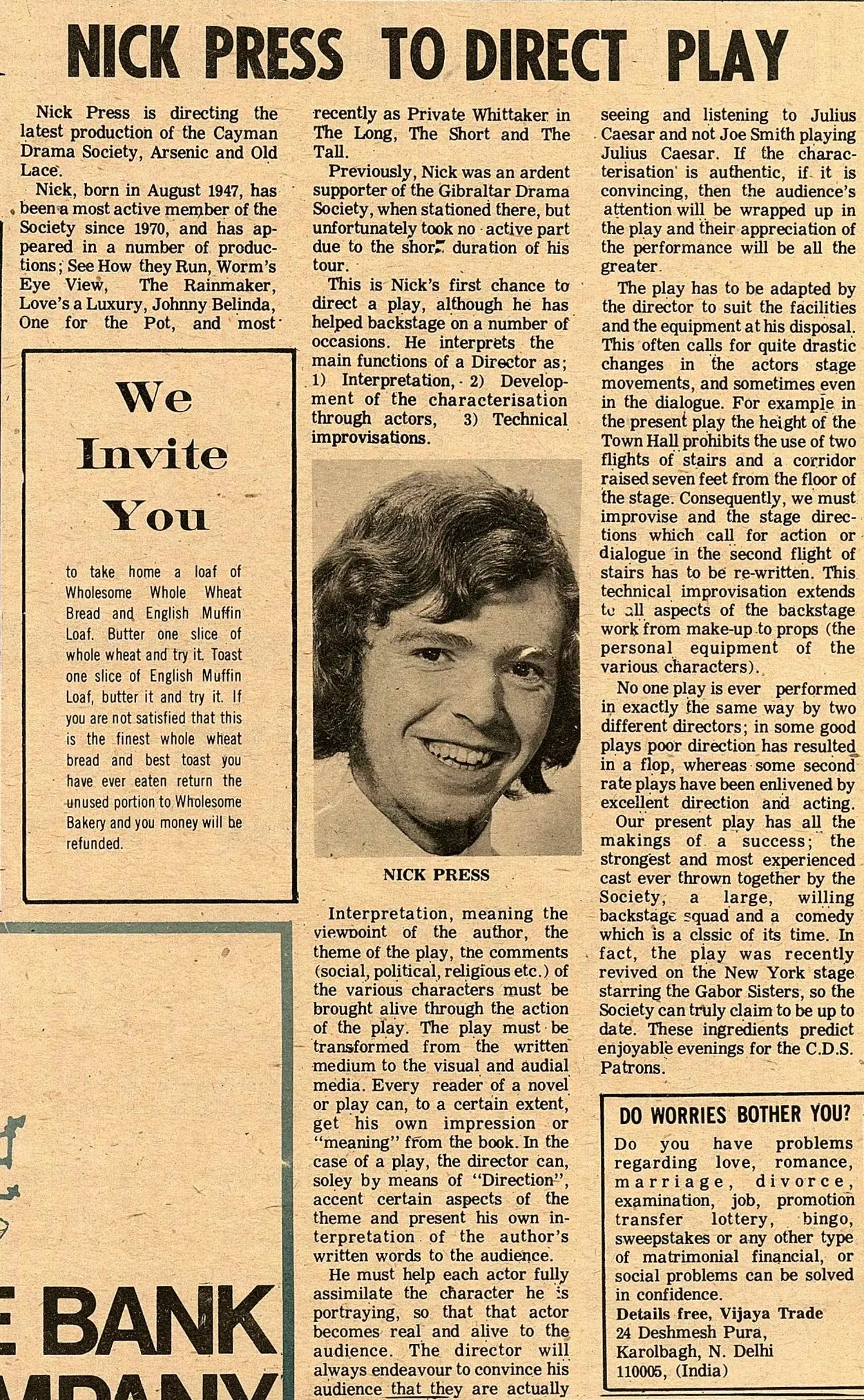
Nick, born in August 1947, has been a most active member of the Society since 1970, and has appeared in a number of productions; See How they Run, Worm's Eye View, The Rainmaker, Love's a Luxury, Johnny Belinda, One for the Pot, and most recently as Private Whittaker in The Long, The Short and The Tall.
Previously, Nick was an ardent supporter of the Gibraltar Drama Society, when stationed there, but unfortunately took no active part due to the short duration of his tour. This is Nick's first chance to direct a play, although he has helped backstage on a number of occasions. He interprets the main functions of a Director as; 1) Interpretation, 2) Development of the characterisation through actors, 3) Technical improvisations. Interpretation, meaning the viewpoint of the author, the theme of the play, the comments (social, political, religious etc.) of the various characters must be brought alive through the action of the play. The play must be transformed from the written medium to the visual and audial media. Every reader of a novel or play can, to a certain extent, get his own impression or "meaning" from the book. In the case of a play, the director can, soley by means of "Direction", accent certain aspects of the theme and present his own interpretation of the author's written words to the audience.
He must help each actor fully assimilate the character he is portraying, so that that actor becomes real and alive to the audience. The director will always endeavour to convince his audience that they are actually seeing and listening to Julius Caesar and not Joe Smith playing Julius Caesar. If the characterisation is authentic, if it is convincing, then the audience's attention will be wrapped up in the play and their appreciation of the performance will be all the greater.
The play has to be adapted by the director to suit the facilities and the equipment at his disposal. This often calls for quite drastic changes in the actors stage movements, and sometimes even in the dialogue. For example in the present play the height of the Town Hall prohibits the use of two flights of stairs and a corridor raised seven feet from the floor of the stage. Consequently, we must improvise and the stage directions which call for action or dialogue in the second flight of stairs has to be rewritten. This technical improvisation extends to all aspects of the backstage work from make-up to props (the personal equipment of the various characters).
No one play is ever performed in exactly the same way by two different directors; in some good plays poor direction has resulted in a flop, whereas some second rate plays have been enlivened by excellent direction and acting. Our present play has all the makings of a success; the strongest and most experienced cast ever thrown together by the Society, a large, willing backstage squad and a comedy which is a classic of its time. In fact, the play was recently revived on the New York stage starring the Gabor Sisters, so the Society can truly claim to be up to date. These ingredients predict enjoyable evenings for the C.D.S. Patrons.