Society offers splendourous star-studded performance, but play hangs too heavy for local theatre zeal
About the article
This is a digitised version of an article from The Cayman Compass's print archive. Occasionally, the digitisation process introduces transcription errors, or other problems.
See the article in its original context from April 1978.
Brought to you by

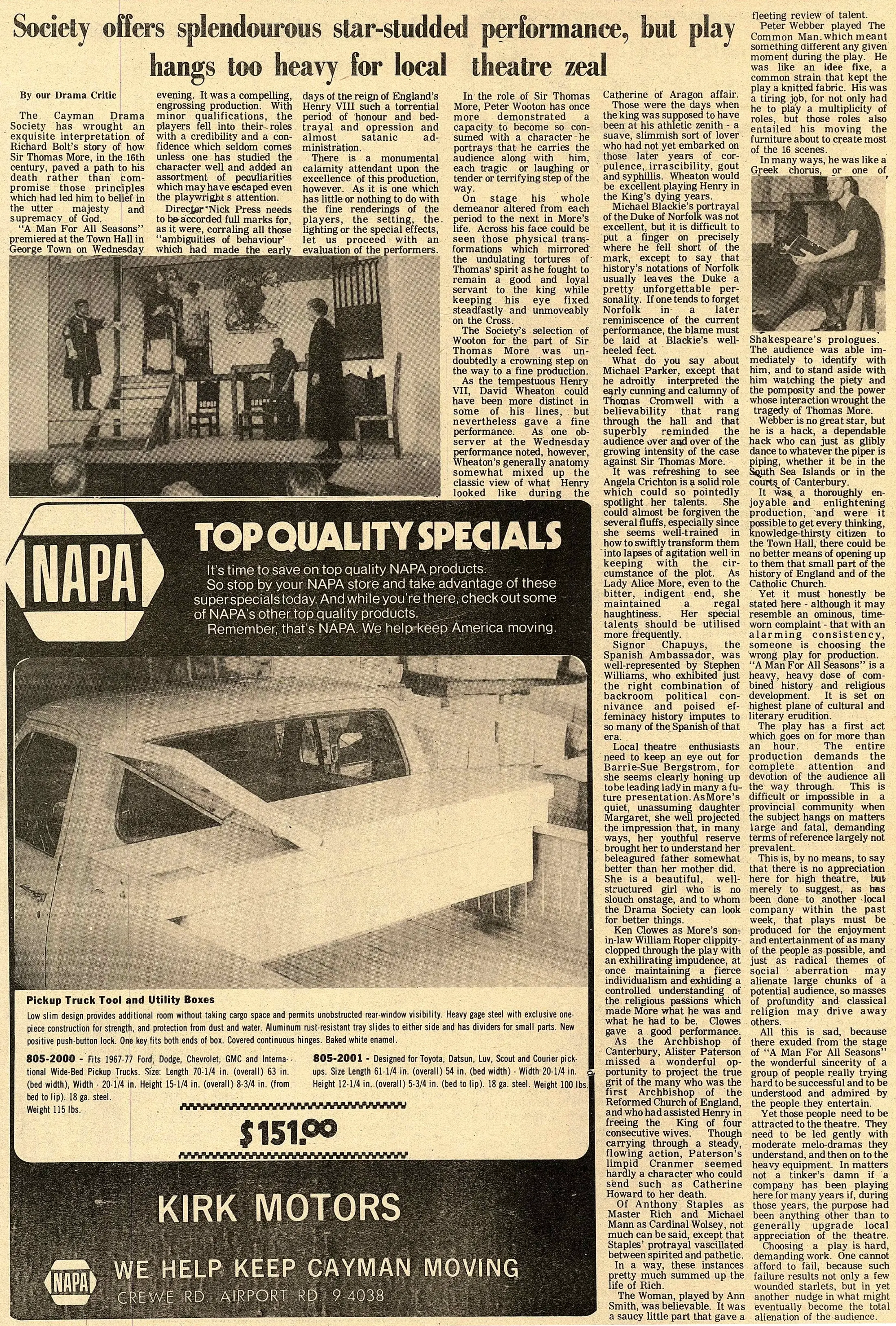
"A Man For All Seasons" premiered at the Town Hall in George Town on Wednesday. evening. It was a compelling, engrossing production. With minor qualifications, the players fell into their roles with a credibility and a confidence which seldom comes unless one has studied the character well and added an assortment of peculiarities which may have escaped even the playwrights attention.
Director Nick Press needs to be accorded full marks for, as it were, corraling all those "ambiguities of behaviour' which had made the early days of the reign of England's Henry VIII such a torrential period of honour and betrayal and opression and almost satanic administration.
There is a monumental calamity attendant upon the excellence of this production, however. As it is one which has little or nothing to do with the fine renderings of the players, the setting, the lighting or the special effects, let us proceed with an evaluation of the performers. In the role of Sir Thomas More, Peter Wooton has once more demonstrated a capacity to become so consumed with a character-he portrays that he carries the audience along with him, each tragic or laughing or tender or terrifying step of the way.
On stage his whole demeanor altered from each period to the next in More's life. Across his face could be seen those physical transformations which mirrored the undulating tortures of Thomas' spirit as he fought to remain a good and loyal servant to the king while keeping his eye fixed steadfastly and unmoveably on the Cross.
The Society's selection of Wooton for the part of Sir Thomas More was undoubtedly a crowning step on the way to a fine production. As the tempestuous Henry VII, David Wheaton could have been more distinct in some of his lines, but nevertheless gave a fine performance. As one observer at the Wednesday performance noted, however, Wheaton's generally anatomy somewhat mixed up the classic view of what Henry looked like during the Catherine of Aragon affair. Those were the days when the king was supposed to have been at his athletic zenith - a suave, slimmish sort of lover who had not yet embarked on those later years of corpulence, irrascibility, gout and syphillis. Wheaton would be excellent playing Henry in the King's dying years.
Michael Blackie's portrayal of the Duke of Norfolk was not excellent, but it is difficult to put a finger on precisely where he fell short of the mark, except to say that history's notations of Norfolk usually leaves the Duke a pretty unforgettable personality. If one tends to forget Norfolk in a later reminiscence of the current performance, the blame must be laid at Blackie's well-heeled feet.
What do you say about Michael Parker, except that he adroitly interpreted the early cunning and calumny of Thomas Cromwell with a believability that rang through the hall and that superbly reminded the audience over and over of the growing intensity of the case against Sir Thomas More.
It was refreshing to see Angela Crichton is a solid role which could so pointedly spotlight her talents. She could almost be forgiven the several fluffs, especially since she seems well-trained in how to swiftly transform them into lapses of agitation well in keeping with the circumstance of the plot. As Lady Alice More, even to the bitter, indigent end, she maintained a regal haughtiness. Her special talents should be utilised more frequently.
Signor Chapuys, the Spanish Ambassador, was well-represented by Stephen Williams, who exhibited just the right combination of backroom political connivance and poised effeminacy history imputes to so many of the Spanish of that era.
Local theatre enthusiasts need to keep an eye out for Barrie-Sue Bergstrom, for she seems clearly honing up to be leading lady in many a future presentation. As More's quiet, unassuming daughter Margaret, she well projected the impression that, in many ways, her youthful reserve brought her to understand her beleagured father somewhat better than her mother did. She is a beautiful, well-structured girl who is no slouch onstage, and to whom the Drama Society can look for better things.
Ken Clowes as More's son-in-law William Roper clippity-clopped through the play with an exhilirating impudence, at once maintaining a fierce individualism and exhuding a controlled understanding of the religious passions which made More what he was and what he had to be. Clowes gave a good performance. As the Archbishop of Canterbury, Alister Paterson missed a wonderful opportunity to project the true grit of the many who was the first Archbishop of the Reformed Church of England, and who had assisted Henry in freeing the King of four consecutive wives. Though carrying through a steady, flowing action, Paterson's limpid Cranmer seemed hardly a character who could send such as Catherine Howard to her death.
Of Anthony Staples as Master Rich and Michael Mann as Cardinal Wolsey, not much can be said, except that Staples' protrayal vascillated between spirited and pathetic. In a way, these instances pretty much summed up the life of Rich. The Woman, played by Ann Smith, was believable. It was a saucy little part that gave a fleeting review of talent. Peter Webber played The Common Man. which meant something different any given moment during the play. He was like an idee fixe, a common strain that kept the play a knitted fabric. His was a tiring job, for not only had he to play a multiplicity of roles, but those roles also entailed his moving the furniture about to create most of the 16 scenes.
In many ways, he was like a Greek chorus, or one of Shakespeare's prologues. The audience was able immediately to identify with him, and to stand aside with him watching the piety and the pomposity and the power whose interaction wrought the tragedy of Thomas More.
Webber is no great star, but he is a hack, a dependable hack who can just as glibly dance to whatever the piper is piping, whether it be in the South Sea Islands or in the courts of Canterbury. It was a thoroughly enjoyable and enlightening production, and were it possible to get every thinking, knowledge-thirsty citizen to the Town Hall, there could be no better means of opening up to them that small part of the history of England and of the Catholic Church.
Yet it must honestly be stated here although it may resemble an ominous, time-worn complaint that with an alarming consistency, someone is choosing the wrong play for production. "A Man For All Seasons" is a heavy, heavy dose of combined history and religious development. It is set on highest plane of cultural and literary erudition.
The play has a first act which goes on for more than an hour. The entire production demands the complete attention and devotion of the audience all the way through. This is difficult or impossible in a provincial community when the subject hangs on matters large and fatal, demanding terms of reference largely not prevalent.
This is, by no means, to say that there is no appreciation here for high theatre, but merely to suggest, as has been done to another local company within the past week, that plays must be produced for the enjoyment and entertainment of as many of the people as possible, and just as radical themes of social aberration may alienate large chunks of a potential audience, so masses of profundity and classical religion may drive away others.
All this is sad, because there exuded from the stage of "A Man For All Seasons" the wonderful sincerity of a group of people really trying hard to be successful and to be understood and admired by the people they entertain. Yet those people need to be attracted to the theatre. They need to be led gently with moderate melodramas they understand, and then on to the heavy equipment. In matters not a tinker's damn if a company has been playing here for many years if, during those years, the purpose had been anything other than to generally upgrade local appreciation of the theatre.
Choosing a play is hard, demanding work. One cannot afford to fail, because such failure results not only a few wounded starlets, but in yet another nudge in what might eventually become the total alienation of the audience.