Los Angeles Superior Court extends receivership over the "Worldwide Church of God"
About the article
This is a digitised version of an article from The Cayman Compass's print archive. Occasionally, the digitisation process introduces transcription errors, or other problems.
See the article in its original context from January 1979.
Brought to you by

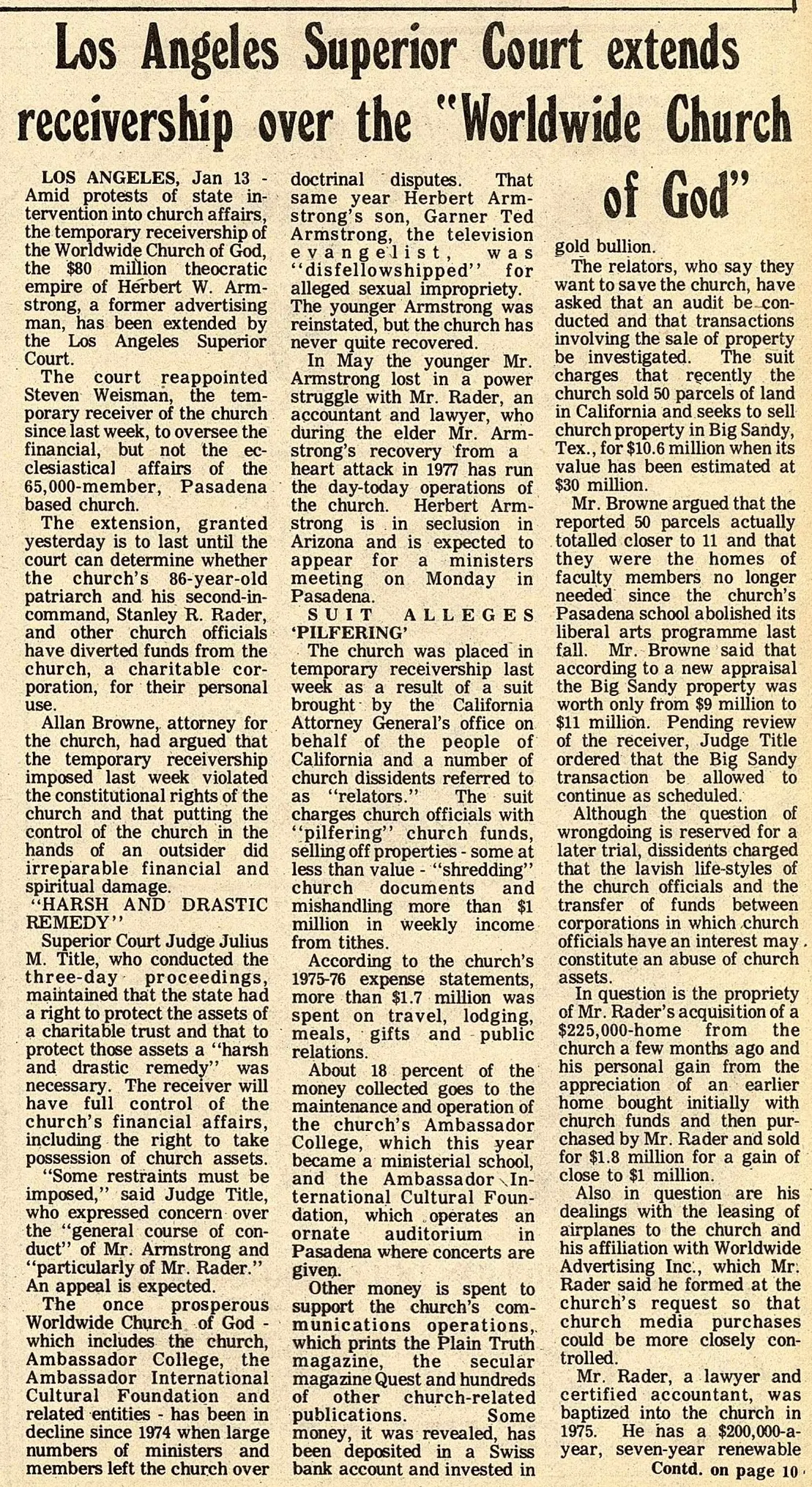
The court reappointed Steven Weisman, the temporary receiver of the church since last week, to oversee the financial, but not the ecclesiastical affairs of the 65,000-member, Pasadena based church.
The extension, granted yesterday is to last until the court can determine whether the church's 86-year-old patriarch and his second-in-command, Stanley R. Rader, and other church officials have diverted funds from the church, a charitable corporation, for their personal use. Allan Browne, attorney for the church, had argued that the temporary receivership imposed last week violated the constitutional rights of the church and that putting the control of the church in the hands of an outsider did irreparable financial and spiritual damage. "HARSH AND DRASTIC REMEDY"
Superior Court Judge Julius M. Title, who conducted the three-day proceedings, maintained that the state had a right to protect the assets of a charitable trust and that to protect those assets a "harsh and drastic remedy" was necessary. The receiver will have full control of the church's financial affairs, including the right to take possession of church assets. "Some restraints must be imposed," said Judge Title, who expressed concern over the "general course of conduct" of Mr. Armstrong and "particularly of Mr. Rader." An appeal is expected.
The once prosperous Worldwide Church of God - which includes the church, Ambassador College, the Ambassador International Cultural Foundation and related entities - has been in decline since 1974 when large numbers of ministers and members left the church over doctrinal disputes. That same year Herbert Armstrong's son, Garner Ted Armstrong, the television evangelist, was "disfellowshipped" for alleged sexual impropriety. The younger Armstrong was reinstated, but the church has never quite recovered.
In May the younger Mr. Armstrong lost in a power struggle with Mr. Rader, an accountant and lawyer, who during the elder Mr. Armstrong's recovery from a heart attack in 1977 has run the day-today operations of the church. Herbert Armstrong is in seclusion in Arizona and is expected to appear for a ministers meeting on Monday in Pasadena.
SUIT ALLEGES 'PILFERING' The church was placed in temporary receivership last week as a result of a suit brought by the California Attorney General's office on behalf of the people of California and a number of church dissidents referred to as "relators." The suit charges church officials with "pilfering" church funds, selling off properties - some at less than value - "shredding" church documents and mishandling more than $1 million in weekly income from tithes.
According to the church's 1975-76 expense statements, more than $1.7 million was spent on travel, lodging, meals, gifts and public relations. About 18 percent of the money collected goes to the maintenance and operation of the church's Ambassador College, which this year became a ministerial school, and the Ambassador International Cultural Foundation, which operates an ornate auditorium in Pasadena where concerts are given.
Other money is spent to support the church's communications operations, which prints the Plain Truth magazine, the secular magazine Quest and hundreds of other church-related publications. Some money, it was revealed, has been deposited in a Swiss bank account and invested in gold bullion. The relators, who say they want to save the church, have asked that an audit be conducted and that transactions involving the sale of property be investigated. The suit charges that recently the church sold 50 parcels of land in California and seeks to sell church property in Big Sandy, Tex., for $10.6 million when its value has been estimated at $30 million.
Mr. Browne argued that the reported 50 parcels actually totalled closer to 11 and that they were the homes of faculty members no longer needed since the church's Pasadena school abolished its liberal arts programme last fall. Mr. Browne said that according to a new appraisal the Big Sandy property was worth only from $9 million to $11 million. Pending review of the receiver, Judge Title ordered that the Big Sandy transaction be allowed to continue as scheduled.
Although the question of wrongdoing is reserved for a later trial, dissidents charged that the lavish life-styles of the church officials and the transfer of funds between corporations in which church officials have an interest may constitute an abuse of church assets.
In question is the propriety of Mr. Rader's acquisition of a $225,000-home from the church a few months ago and his personal gain from the appreciation of an earlier home bought initially with church funds and then purchased by Mr. Rader and sold for $1.8 million for a gain of close to $1 million.
Also in question are his dealings with the leasing of airplanes to the church and his affiliation with Worldwide Advertising Inc., which Mr. Rader said he formed at the church's request so that church media purchases could be more closely controlled.
Mr. Rader, a lawyer and certified accountant, was baptized into the church in 1975. He has a $200,000-a-year, seven-year renewable Contd. on page 10. from page 7
contract with provisions that guarantee payment of $100,000 a year until 2003.
Mr. Rader sat quietly while the judge read his order to the court. But supporters of Mr. Rader in the courtroom expressed outrage and protest at the ruling. The receiver has the right to petition the court for removal of Mr. Rader and Mr. Armstrong from control over the church's financial dealings and can forbid them access to church offices.