"Chase Me Comrade," like a speeded-up version of a day in the life of a fool, bubbles to success
About the article
This is a digitised version of an article from The Cayman Compass's print archive. Occasionally, the digitisation process introduces transcription errors, or other problems.
See the article in its original context from March 1979.
Brought to you by

Favourable theatrical reviews are as difficult to compose as the other sort, for great care must be taken that in recording one's exhuberance over a production; no blind spots are permitted to shield any major or minor malfunction which ought rightly to be criticised.
The opening performance of the Cayman Drama Society's "Chase Me, Comrade" last Thursday night presented much difficulty for the critic who may have been arduously in search of flaws. If big ones existed they were backstage, or in the front of the house, or under the stage, or outside the building-places beyond the reach or the interest of the honest reviewer.
It was a good show, well worth the time and attention of anyone prepared to laugh at life represented at its farcical funniest. It was like watching a speeded-up version. sion of a day in the life of a fool, where everything that can go wrong does and everything that can happen happens and the fool blithely lives through it all to a happy, successful conclusion simply because he is a fool whom the agels zealously guard.
The production is a typical English farce, with strong dependence on coincidence and simple human error or folly. It is about what happens one afternoon in a relatively staid English home which has suddenly become a haven for a Russian ballet dancer in the process of defecting to the West.
And all that situation can conevably entail.
Director Mike Parker obviously had quite a job of pulling all the fine pieces together, for in a production of the type currently running, timing is that singular element which can make or MURPHY break the evening. As it turned out, each of the doors opened prcisely when they should have, each player averted his eyes precisely when the script said he was supposed to, and there was no large-scale first night muffing of lines - another flaw which could easily have destroyed the vital continuity.
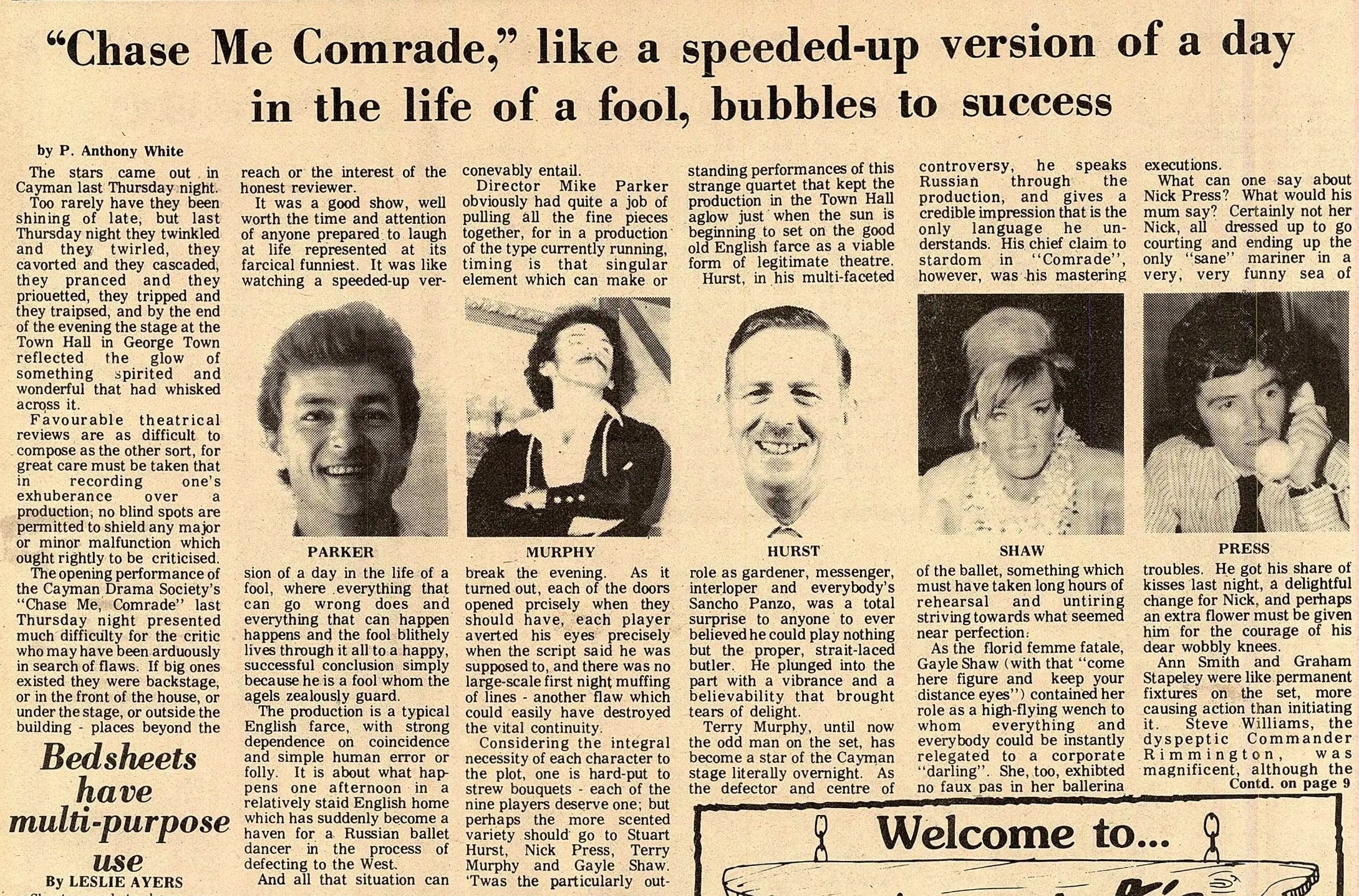
Considering the integral necessity of each character to the plot, one is hard-put to strew bouquets - each of the nine players deserve one; but perhaps the more scented variety should go to Stuart Hurst, Nick Press, Terry Murphy and Gayle Shaw. 'Twas the particularly outstanding performances of this strange quartet that kept the production in the Town Hall aglow just when the sun is beginning to set on the good old English farce as a viable form of legitimate theatre.
Hurst, in his multi-faceted role as gardener, messenger, interloper and everybody's Sancho Panzo, was a total surprise to anyone to ever believed he could play nothing but the proper, strait-laced butler. He plunged into the part with a vibrance and a believability that brought tears of delight.
Terry Murphy, until now the odd man on the set, has become a star of the Cayman stage literally overnight. As the defector and centre of controversy, he speaks Russian through the production, and gives a credible impression that is the only language he understands. His chief claim to stardom in "Comrade", however, was his mastering of the ballet, something which must have taken long hours of rehearsal and untiring striving towards what seemed near perfection:
As the florid femme fatale, Gayle Shaw (with that "come here figure and keep your distance eyes") contained her role as a high-flying wench to whom everything and everybody could be instantly relegated to a corporate "darling". She, too, exhibted no faux pas in her ballerina executions.
What can one say about Nick Press? What would his mum say? Certainly not her Nick, all dressed up to go courting and ending up the only "sane" mariner in a very, very funny sea of troubles. He got his share of kisses last night, a delightful change for Nick, and perhaps an extra flower must be given him for the courage of his dear wobbly knees.
Ann Smith and Graham Stapeley were like permanent fixtures on the set, more causing action than initiating it. Steve Williams, the dyspeptic Commander Rimmington, was magnificent, although the Contd. on page 9 from page 8
make-up people did not quite succeed in aging him to the point where he could be a believable father to Ann Smith.
Tony Staples, Val Watts and Mike Marshall, whose roles were relatively brief, made commendable contributions to the overall effort.
Margaret Barwick's set, such an important factor in a farce of this type, demonstrated once more that lady's valuable contribution to Cayman's drama scene.
In summation it must be said that the play was not without its minor flaws such as locked doors that are miraculously opened with a mere twist of the knob - but all in all there can be little doubt that "Chase Me, Comrade" was by far one of the Drama Society's finest productions in the past year and a half.
A determined, dauntless Mike Parker pushed and persisted until he had tuned his players to a keen edge, each slotting sweetly into his facet of the play like a little wheel inside a finely-crafted timepiece. Through and through there was the unmistakable hand of the master director, and with this one Parker has left no doubt that he is among the best the Society has to offer. There have been occasions when the Cayman Drama Society has been found wanting in some of its well-intentioned efforts to provide the community with good theatrical fare. Criticisms of efforts that go awry have not always been accepted with overwhelming grace, and too often those who cry out against criticisms have confused the purposes of a theatrical review with the promotion of the dramatic arts in the colony.
There will not often arise the occasion when a review, such as this one, can find no blatant faults with a production. When it must come it will, and it is hoped that those who rail indignantly against the harsher critiques will come to believe and understand that the measure of honesty put into the bad review remains constant in the favourable.
It has been just over a year separating "South Pacific" and "Chase Me, Comrade". Time and events have understandably changed in that period. The reviewer's adherence to the unalterable guiding principles lives on.