Now a new "Dictionary of Omens and Superstitions" probes the origins and explanations of some familiar fables
About the article
This is a digitised version of an article from The Cayman Compass's print archive. Occasionally, the digitisation process introduces transcription errors, or other problems.
See the article in its original context from March 1979.
Brought to you by

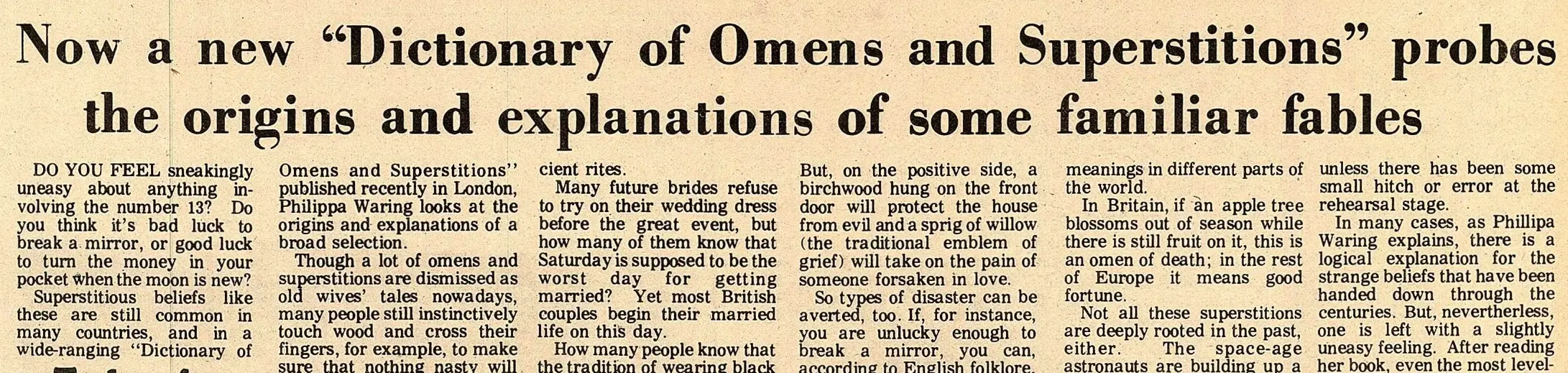
Superstitious beliefs like these are still common in many countries, and in a wide-ranging "Dictionary of Omens and Superstitions" published recently in London, Philippa Waring looks at the origins and explanations of a broad selection.
Though a lot of omens and superstitions are dismissed as old wives' tales nowadays, many people still instinctively touch wood and cross their fingers, for example, to make sure that nothing nasty will happen. Most people are wary of Fridays, and tie knots in their handkerchiefs to remember things but, says Phillipa Waring, few know how these traditions actually started.
In her recently published dictionary the most farreaching of its kind she describes the origin of over 500 of these superstitions from all over the Western world, ranging from the quaint to the distinctly horrifying.
Birds animals, flowers, the sun, the moon, the stars and even inanimate objects such as umbrellas and mirrors can all apparently influence us for good or ill. In fact, according to this dictionary, almost every part of our daily lives is governed by some kind of superstition and the great landmarks of birth, love, marriage and death are all steeped in folklore and ancient rites. Many future brides refuse to try on their wedding dress before the great event, but how many of them know that Saturday is supposed to be the worst day for getting married? Yet most British couples begin their married life on this day.
How many people know that the tradition of wearing black at funerals began in Roman times and that in some places it is not so much a sign of grief for the dead as an attempt to trick the Devil who is always looking for more souls but who apparently cannot see black?
Fortunately, not all superstitions are morbid or unlucky. Though the number 13 is universally avoided, three and seven, on the contrary, are considered very lucky, as are certain colours like blue or red.
Cats, too, though long, associated with witches, mostly bring good luck, especially if they are totally black except in the United States, where the opposite is true.
The longest entry in Phillipa Waring's dictionary is devoted to trees which can bring bad luck if sufficient precautions are not taken. But, on the positive side, a birchwood hung on the front door will protect the house from evil and a sprig of willow (the traditional emblem of grief) will take on the pain of someone forsaken in love.
So types of disaster can be averted, too. If, for instance, you are unlucky enough to break a mirror, you can, according to English folklore, turn away the seven years' bad luck by hurling the broken pieces into a fast-running stream or river. And another consoling thought some omens have opposite. meanings in different parts of the world.
In Britain, if an apple tree blossoms out of season while there is still fruit on it, this is an omen of death; in the rest of Europe it means good fortune.
Not all these superstitions are deeply rooted in the past, either. The space-age astronauts are building up a special code of do's and don'ts of their own. They are known to avoid certain ill-omened colours and, like members of the acting profession, are not confident about a mission unless there has been some small hitch or error at the rehearsal stage.
In many cases, as Phillipa Waring explains, there is a logical explanation for the strange beliefs that have been handed down through the centuries. But, nevertheless, one is left with a slightly uneasy feeling. After reading her book, even the most levelheaded person could be forgiven for thinking twice before stepping on a spider, opening an umbrella indoors or looking at the new moon through glass.