BASEBALL: Ballard Smith shows how to make friends
About the article
This is a digitised version of an article from The Cayman Compass's print archive. Occasionally, the digitisation process introduces transcription errors, or other problems.
See the article in its original context from January 1982.
Brought to you by

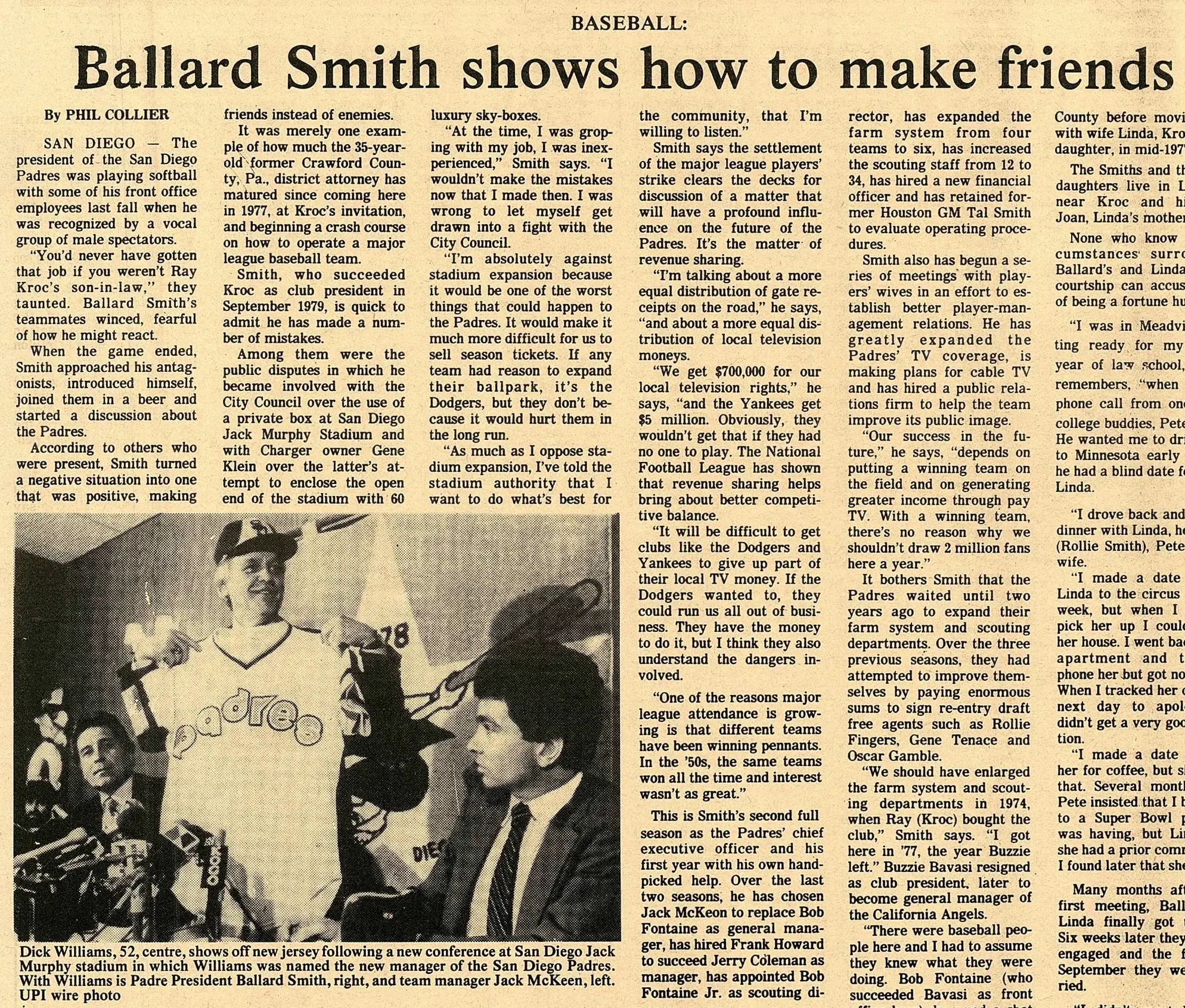
SAN DIEGO - The president of the San Diego Padres was playing softball with some of his front office employees last fall when he was recognized by a vocal group of male spectators.
"You'd never have gotten that job if you weren't Ray Kroc's son-in-law," they taunted. Ballard Smith's teammates winced, fearful of how he might react. When the game ended, Smith approached his antagonists, introduced himself, joined them in a beer and started a discussion about the Padres.
According to others who were present, Smith turned a negative situation into one that was positive, making friends instead of enemies.
It was merely one example of how much the 35-year-old former Crawford County, Pa., district attorney has matured since coming here in 1977, at Kroc's invitation, and beginning a crash course on how to operate a major league baseball team.
Smith, who succeeded Kroc as club president in September 1979, is quick to admit he has made a number of mistakes.
Among them were the public disputes in which he became involved with the City Council over the use of a private box at San Diego Jack Murphy Stadium and with Charger owner Gene Klein over the latter's attempt to enclose the open end of the stadium with 60 luxury sky-boxes.
"At the time, I was groping with my job, I was inexperienced," Smith says. "I wouldn't make the mistakes now that I made then. I was wrong to let myself get drawn into a fight with the City Council.
"I'm absolutely against stadium expansion because it would be one of the worst things that could happen to the Padres. It would make it much more difficult for us to sell season tickets. If any team had reason to expand their ballpark, it's the Dodgers, but they don't because it would hurt them in the long run.
"As much as I oppose stadium expansion, I've told the stadium authority that I want to do what's best for the community, that I'm willing to listen."
Smith says the settlement of the major league players' strike clears the decks for discussion of a matter that will have a profound influence on the future of the Padres. It's the matter of revenue sharing.
"I'm talking about a more equal distribution of gate receipts on the road," he says, "and about a more equal distribution of local television moneys.
"We get $700,000 for our local television rights," he says, "and the Yankees get $5 million. Obviously, they wouldn't get that if they had no one to play. The National Football League has shown that revenue sharing helps bring about better competitive balance.
"It will be difficult to get clubs like the Dodgers and Yankees to give up part of their local TV money. If the Dodgers wanted to, they could run us all out of business. They have the money to do it, but I think they also understand the dangers involved. "One of the reasons major league attendance is growing is that different teams have been winning pennants.
In the '50s, the same teams won all the time and interest wasn't as great." This is Smith's second full season as the Padres' chief executive officer and his first year with his own hand-picked help. Over the last two seasons, he has chosen Jack McKeon to replace Bob Fontaine as general manager, has hired Frank Howard to succeed Jerry Coleman as manager, has appointed Bob Fontaine Jr. as scouting director, has expanded the farm system from four teams to six, has increased the scouting staff from 12 to 34, has hired a new financial officer and has retained former Houston GM Tal Smith to evaluate operating procedures.
Smith also has begun a series of meetings with players' wives in an effort to establish better player-management relations. He has greatly expanded the Padres' TV coverage, is making plans for cable TV and has hired a public relations firm to help the team improve its public image.
"Our success in the future," he says, "depends on putting a winning team on the field and on generating greater income through pay TV. With a winning team, there's no reason why we shouldn't draw 2 million fans here a year."
It bothers Smith that the Padres waited until two years ago to expand their farm system and scouting departments. Over the three previous seasons, they had attempted to improve themselves by paying enormous sums to sign reentry draft free agents such as Rollie Fingers, Gene Tenace and Oscar Gamble.
"We should have enlarged the farm system and scouting departments in 1974, when Ray (Kroc) bought the club," Smith says. "I got here in '77, the year Buzzie left." Buzzie Bavasi resigned as club president, later to become general manager of the California Angels.
"There were baseball people here and I had to assume they knew what they were doing. Bob Fontaine (who succeeded Bavasi as front office boss) deserved a shot at the job, but what we should have done was go out and hire an experienced general manager. "We've based too many of our player trades on emotions, rather than on logic. We made a spur-of-the-moment decision to hire Roger Craig as manager the day we fired Alvin Dark."
Some believe the Padres are only two power hitters and maybe a couple of pitchers away from becoming National League title contenders for the first time. Smith says they'll attempt to fill those voids from within the farm system, or via trades.
"I won't say 'never again' to the re-entry draft," he says, "but I wouldn't want to get involved again until we're one player away from getting to the top."
Smith grew up in Meadville, Pa., obtained his law degree at the University of Minnesota and a bachelor of arts degree in sociology at Carleton College in Minnesota. He worked for a law firm in Meadville and was district attorney for Crawford County before moving here with wife Linda, Kroc's stepdaughter, in mid-1977.
The Smiths and their four daughters live in La Jolla, near Kroc and his wife, Joan, Linda's mother. None who know the circumstances surrounding Ballard's and Linda's early courtship can accuse Smith of being a fortune hunter. "I was in Meadville, get[g]ting ready for my second year of law school,” Smith remembers, "when I got a phone call from one of my college buddies, Pete Myhre. He wanted me to drive back to Minnesota early because he had a blind date for me - Linda. "I drove back and went to dinner with Linda, her father (Rollie Smith), Pete and his wife.
"I made a date to take Linda to the circus the next week, but when I went to pick her up I couldn't find her house. I went back to my apartment and tried to phone her but got no answer. When I tracked her down the next day to apologize, I didn't get a very good reception. "I made a date to meet her for coffee, but she broke that. Several months later, Pete insisted that I bring her to a Super Bowl party he was having, but Linda said she had a prior commitment. I found later that she didn't." Many months after their first meeting, Ballard and Linda finally got together.
Six weeks later they became engaged and the following September they were married. "I didn't meet Ray and Joan until after Linda and I were engaged," Smith says.
"All I knew about Ray Kroc was that he was with McDonald's and that he must have a pretty good job. "None of this would have happened if Pete Myhre hadn't kept insisting that I get together with Linda.
There's no question that I got this job because I'm Ray Kroc's son-in-law but that's not going to keep on the job if we aren't successful.