The Colombian elections
About the article
This is a digitised version of an article from The Cayman Compass's print archive. Occasionally, the digitisation process introduces transcription errors, or other problems.
See the article in its original context from May 1982.
Brought to you by

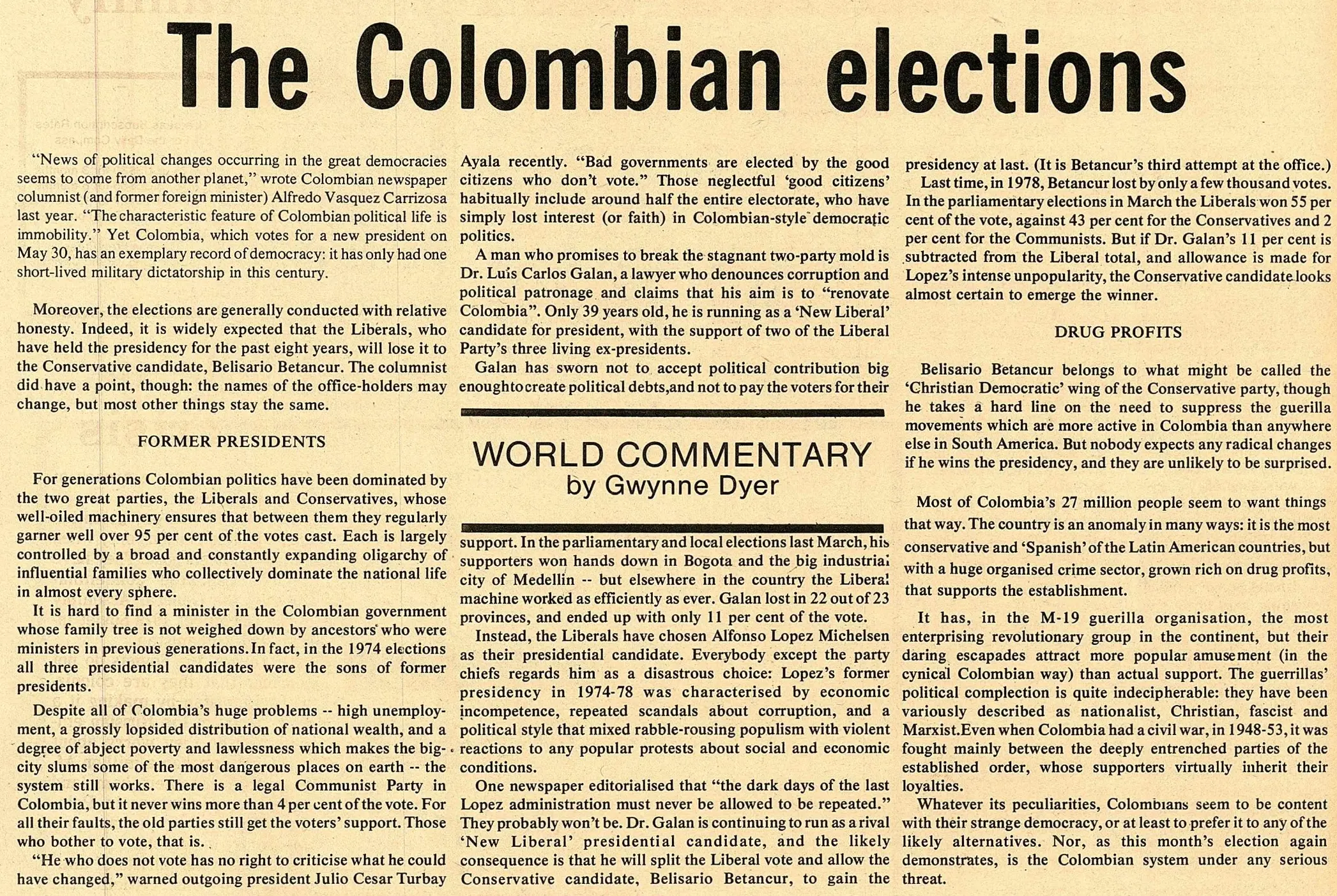
"The characteristic feature of Colombian political life is immobility." Yet Colombia, which votes for a new president on May 30, has an exemplary record of democracy: it has only had one short-lived military dictatorship in this century. Moreover, the elections are generally conducted with relative honesty. Indeed, it is widely expected that the Liberals, who have held the presidency for the past eight years, will lose it to the Conservative candidate, Belisario Betancur. The columnist did have a point, though: the names of the office-holders may change, but most other things stay the same.
FORMER PRESIDENTS
For generations Colombian politics have been dominated by the two great parties, the Liberals and Conservatives, whose well-oiled machinery ensures that between them they regularly garner well over 95 per cent of the votes cast. Each is largely controlled by a broad and constantly expanding oligarchy of influential families who collectively dominate the national life in almost every sphere.
It is hard to find a minister in the Colombian government whose family tree is not weighed down by ancestors who were ministers in previous generations. In fact, in the 1974 elections all three presidential candidates were the sons of former presidents. Despite all of Colombia's huge problems -- high unemployment, a grossly lopsided distribution of national wealth, and a degree of abject poverty and lawlessness which makes the big-city slums some of the most dangerous places on earth -- the system still works. There is a legal Communist Party in Colombia, but it never wins more than 4 per cent of the vote. For all their faults, the old parties still get the voters' support. Those who bother to vote, that is.
"He who does not vote has no right to criticise what he could have changed," warned outgoing president Julio Cesar Turbay Ayala recently. "Bad governments are elected by the good citizens who don't vote." Those neglectful 'good citizens' habitually include around half the entire electorate, who have simply lost interest (or faith) in Colombian-style democratic politics.
A man who promises to break the stagnant two-party mold is Dr. Luis Carlos Galan, a lawyer who denounces corruption and political patronage and claims that his aim is to "renovate Colombia". Only 39 years old, he is running as a 'New Liberal' candidate for president, with the support of two of the Liberal Party's three living ex-presidents.
Galan has sworn not to accept political contribution big enoughto create political debts, and not to pay the voters for their support. In the parliamentary and local elections last March, his supporters won hands down in Bogota and the big industriai city of Medellin -- but elsewhere in the country the Liberal machine worked as efficiently as ever. Galan lost in 22 out of 23 provinces, and ended up with only 11 per cent of the vote.
Instead, the Liberals have chosen Alfonso Lopez Michelsen as their presidential candidate. Everybody except the party chiefs regards him as a disastrous choice: Lopez's former presidency in 1974-78 was characterised by economic incompetence, repeated scandals about corruption, and a political style that mixed rabble-rousing populism with violent reactions to any popular protests about social and economic conditions.
One newspaper editorialised that "the dark days of the last Lopez administration must never be allowed to be repeated." They probably won't be. Dr. Galan is continuing to run as a rival 'New Liberal' presidential candidate, and the likely consequence is that he will split the Liberal vote and allow the Conservative candidate, Belisario Betancur, to gain the presidency at last. (It is Betancur's third attempt at the office.)
Last time, in 1978, Betancur lost by only a few thousand votes. In the parliamentary elections in March the Liberals won 55 per cent of the vote, against 43 per cent for the Conservatives and 2 per cent for the Communists. But if Dr. Galan's 11 per cent is subtracted from the Liberal total, and allowance is made for Lopez's intense unpopularity, the Conservative candidate looks almost certain to emerge the winner.
DRUG PROFITS
Belisario Betancur belongs to what might be called the 'Christian Democratic' wing of the Conservative party, though he takes a hard line on the need to suppress the guerilla movements which are more active in Colombia than anywhere else in South America.
But nobody expects any radical changes if he wins the presidency, and they are unlikely to be surprised. Most of Colombia's 27 million people seem to want things that way. The country is an anomaly in many ways: it is the most conservative and 'Spanish' of the Latin American countries, but with a huge organised crime sector, grown rich on drug profits, that supports the establishment. It has, in the M-19 guerilla organisation, the most enterprising revolutionary group in the continent, but their daring escapades attract more popular amusement (in the cynical Colombian way) than actual support. The guerrillas' political complection is quite indecipherable: they have been variously described as nationalist, Christian, fascist and Marxist. Even when Colombia had a civil war, in 1948-53, it was fought mainly between the deeply entrenched parties of the established order, whose supporters virtually inherit their loyalties.
Whatever its peculiarities, Colombians seem to be content with their strange democracy, or at least to prefer it to any of the likely alternatives. Nor, as this month's election again demonstrates, is the Colombian system under any serious threat.