Charlene's song: I've never been to me
About the article
This is a digitised version of an article from The Cayman Compass's print archive. Occasionally, the digitisation process introduces transcription errors, or other problems.
See the article in its original context from June 1982.
Brought to you by

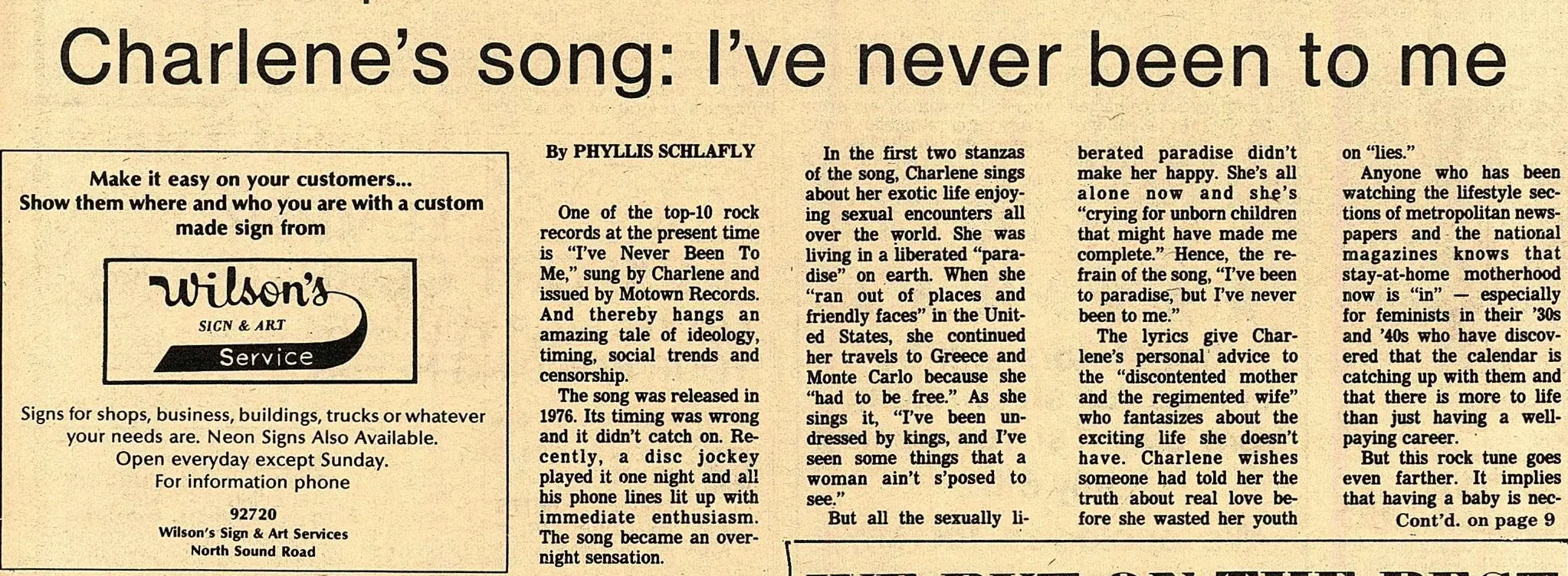
One of the top-10 rock records at the present time is "I've Never Been To Me," sung by Charlene and issued by Motown Records. And thereby hangs an amazing tale of ideology, timing, social trends and censorship.
The song was released in 1976. Its timing was wrong and it didn't catch on. Recently, a disc jockey played it one night and all his phone lines lit up with immediate enthusiasm. The song became an overnight sensation. In the first two stanzas of the song, Charlene sings about her exotic life enjoying sexual encounters all over the world. She was living in a liberated "paradise" on earth. When she "ran out of places and friendly faces" in the United States, she continued her travels to Greece and Monte Carlo because she "had to be free." As she sings it, "I've been undressed by kings, and I've seen some things that a woman ain't s'posed to see."
But all the sexually liberated paradise didn't make her happy. She's all alone now and she's "crying for unborn children that might have made me complete." Hence, the refrain of the song, "I've been to paradise, but I've never been to me."
The lyrics give Charlene's personal advice to the "discontented mother and the regimented wife" who fantasizes about the exciting life she doesn't have. Charlene wishes someone had told her the truth about real love before she wasted her youth. on "lies."
Anyone who has been watching the lifestyle sections of metropolitan newspapers and the national magazines knows that stay-at-home motherhood now is "in" - especially for feminists in their '30s and '40s who have discovered that the calendar is catching up with them and that there is more to life than just having a well-paying career.
But this rock tune goes even farther. It implies that having a baby is nec-Cont'd. on page 9 from page 6 essary to make a women "complete." Even more remarkable, it says that real "truth" is not only in having a baby but in loving and living with only one man. For years, teen-age girls have been taught just the opposite. Through a combination of peer pressure, classroom sex courses, X- and R-rated movies, suggestive TV programs, softporn literature and rock music, they've been taught that sex with any partner is OK if you feel comfortable about it, that housewives lead dull and unrewarding lives and that fulfillment for women means liberation from home, husband, family and children.
Now at last, young women are hearing about the joys of a husband and children from a rock record. Times surely have changed. But, wait a minute, there's more to this story. As soon as "I've Never Been To Me" became a hit song, the liberals and the feminists caught on to its clear profamily message and they set out to silence it. A columnist for the Washington Post wrote an indignant column about it. He is all upset because "the pendulum is swinging back" to motherhood. He concludes that the song's popularity is a social commentary which proves that a "reaction has set in" to the feminist movement (which he says was good because it "shattered stereotypes" and its "liberated women").
Now comes the most interesting part of this story about the "motherhood song." After it became so popular and its message so clear, Motown Records accommodated the liberals by issuing a censored version of "I've Never Been To Me." Of course, Motown and the radio stations don't use the word "censored;" they call it the "edited version."
If you tune in on your local adult rock radio stations, you will probably hear the song within a couple of hours of listening. You will find that some stations play the original version and some play the censored version. What has been censored out of the edited version is the middle part where Charlene interrupts her singing to talk straight to the housewife who thinks she is missing out on liberated living.
In the censored passage, Charlene says: "Hey, you know what paradise is? It's a lie, a fantasy we create about people and places as we like them to be. But you know what truth is? It's that little baby you're holding and it's that man you fought with this morning - the same one you're going to make love with tonight. That's truth; that's love." "Censorship" is the current chic slogan of the liberals who today are trying to intimidate pro-family activists who object to obscenity, profanity, blasphemy, immorality and violence in textbooks, other school materials and television programming.
It is clear that the liberals are like the thief who tries to conceal his crime by crying, "Stop, thief." The pressure groups against motherhood and against traditional moral standards are really the most ruthless censors of all.