Abortion: A life and death issue
About the article
This is a digitised version of an article from The Cayman Compass's print archive. Occasionally, the digitisation process introduces transcription errors, or other problems.
See the article in its original context from March 1983.
Brought to you by

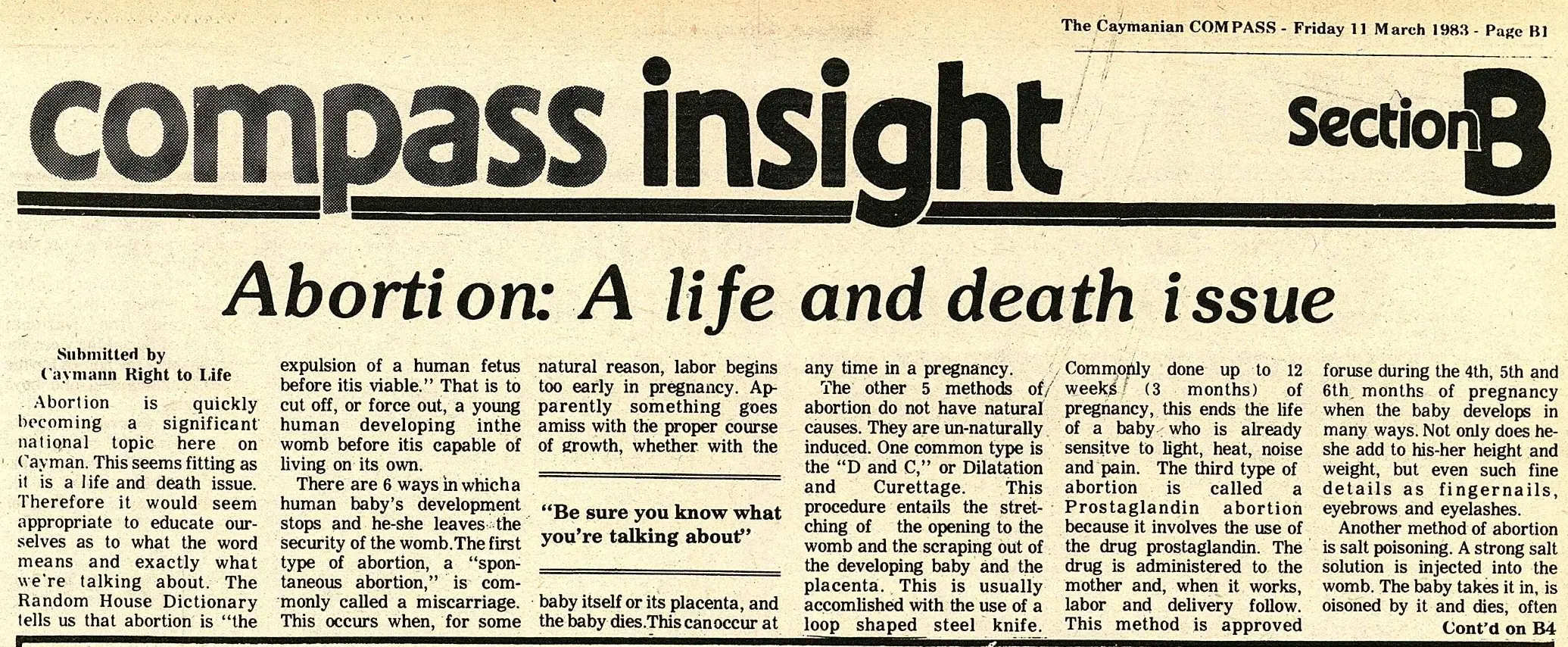
Therefore it would seem appropriate to educate ourselves as to what the word means and exactly what we're talking about. The Random House Dictionary tells us that abortion is "the expulsion of a human fetus before itis viable." That is to cut off, or force out, a young human developing inthe womb before itis capable of living on its own.
There are 6 ways in whicha human baby's development stops and he-she leaves the security of the womb. The first type of abortion, a "spontaneous abortion," is commonly called a miscarriage. This occurs when, for some natural reason, labor begins too early in pregnancy. Apparently something goes amiss with the proper course of growth, whether with the "Be sure you know what you're talking about" baby itself or its placenta, and the baby dies. This can occur at any time in a pregnancy.
The other 5 methods of abortion do not have natural causes. They are unnaturally induced. One common type is the "D and C," or Dilatation and Curettage. This procedure entails the stretching of the opening to the womb and the scraping out of the developing baby and the placenta. This is usually accomplished with the use of a loop shaped steel knife. Commonly done up to 12 weeks (3 months) of pregnancy, this ends the life of a baby who is already sensitve to light, heat, noise and pain. The third type of abortion is called a Prostaglandin abortion because it involves the use of the drug prostaglandin.
The drug is administered to the mother and, when it works, labor and delivery follow. This method is approved foruse during the 4th, 5th and 6th months of pregnancy when the baby develops in many ways. Not only does he-she add to his-her height and weight, but even such fine details as fingernails, eyebrows and eyelashes.
Another method of abortion is salt poisoning. A strong salt solution is injected into the womb. The baby takes it in, is oisoned by it and dies, often Cont'd on B4 from page B1 struggling. This type cannot be perfomred until after 16 weeks when there is sufficient fluid in the womb for it to work. The baby in this case has a heart that has already been beating for 13 weeks.
A hysterotomy is a surgical abortion. It is similar to a Caesarian section and is used late in the pregnancy when other methods would lead to too many embarrassing complications for the abortionist. Almost all babies aborted by hysterotomy are born alive.
The sixth type of abortion, quickly becoming the most widely used, is the suction method. After forcing the muscular neck of the womb open, a hollow tube with a knife-like edged tip is inserted and a suction 28 times stronger than a vacuum cleaner sucks out the baby and the placenta is scraped off and drawn out as well.
Perhaps this is growing in popularity because the baby's parts are kept from view, but remember that he-she is completely formed and senstive to pain by 8 weeks.
No matter what views, opinions or ideas we bring to the issue of legalizing abortion it is important that we know what is being discussed. All too often vague understandings lead people to decisions they would revise if given the facts. Abortion is such a question. Be sure you know what you're talking about.