WORDSWORTH'S ENGLAND A spring breeze whispers the old poet's words
About the article
This is a digitised version of an article from The Cayman Compass's print archive. Occasionally, the digitisation process introduces transcription errors, or other problems.
See the article in its original context from May 1984.
Brought to you by

In the countryside and, most especially, in the Lake District, the air takes on a freshness, a softness and fragrance that stirs the spirit if not to poetry at least to renewed joy in life.
Winter winds howl around the aged mountains in the area, ruffling the placid lakes, hurling the remnants of autumn's leaves and casting a shiver and pall everywhere. Then suddenly, the ground softens, the hard edge of the great trees softens with new buds, blossoms burst on the flowering shrubs and the first shy bulbs poke timid heads above the ground.
And all at once they become - "... a host of golden daffodils."
Few of us would attempt to tell it more lyrically than William Wordsworth has. Wordsworth experienced the seasons in his beloved Lake Country through most. of the years of his life - never tiring of it, always renewed by it. Samuel Taylor Coleridge called it "a cabinet of beauties." For John Ruskin it provided the serene setting essential to the development of his deepest thoughts.
Whether you know or care much at all about poetry - or the advent of the changing seasons in more northerly climes - England's Lake District beckons. It is heroic - in scale and in beauty.
The Lake District, a part of the northern area of Cumbria, covers some 900 square miles - and is today almost as rugged and rural as in the days of the writers and artists who made it famous. Deep blue lakes reflect soft white clouds sailing over ancient mountains as they have for centuries. And, in the same way, the area draws visitors to climb the fells and walk the dales and fish the tarns and meres.
It is, as Edward Bateson remarked, "dog and stick country."
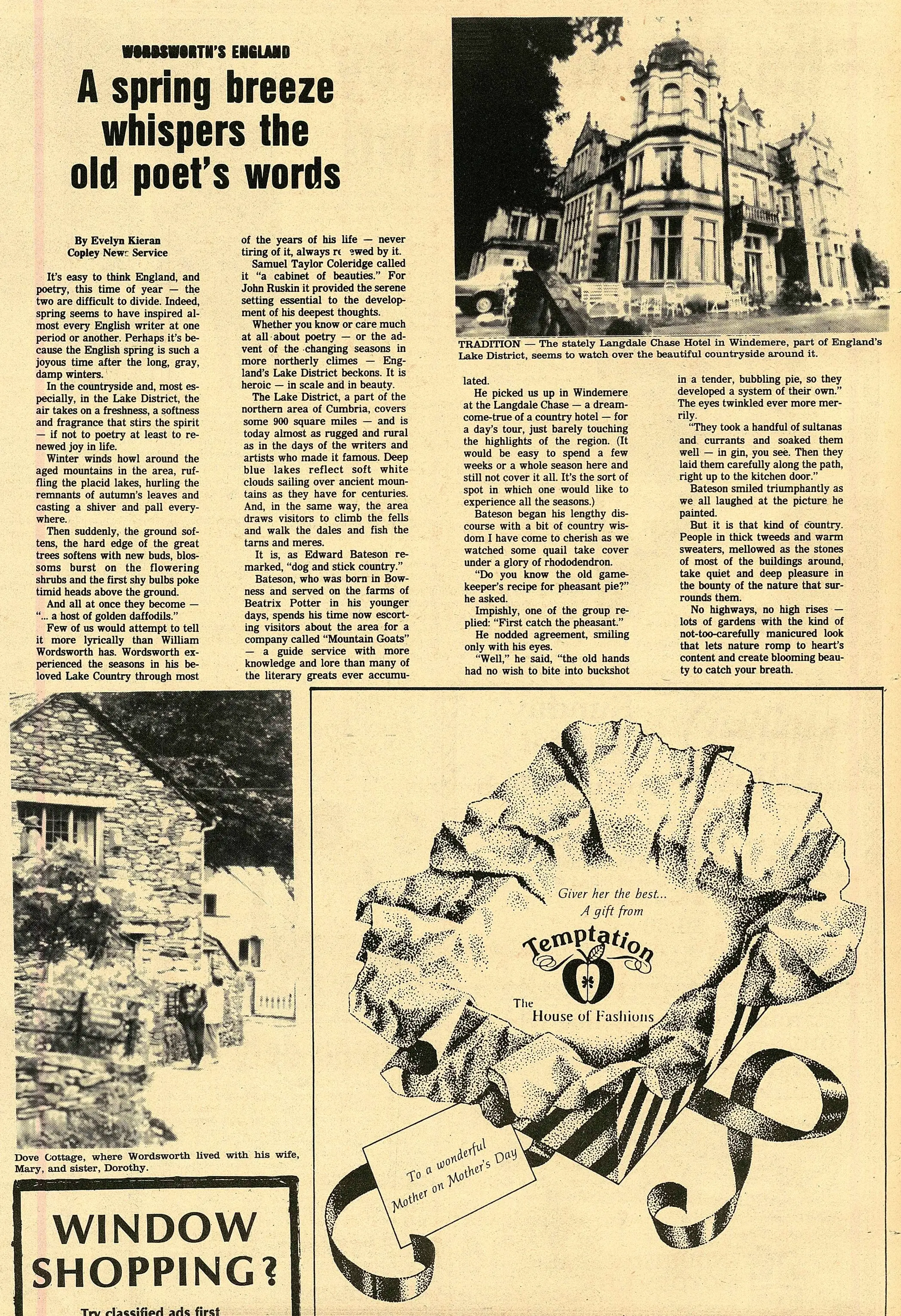
Bateson, who was born in Bowness and served on the farms of Beatrix Potter in his younger days, spends his time now escorting visitors about the area for a company called "Mountain Goats" - a guide service with more knowledge and lore than many of the literary greats ever accumulated. He picked us up in Windemere at the Langdale Chase - a dream-come-true of a country hotel - for a day's tour, just barely touching the highlights of the region. (It would be easy to spend a few weeks or a whole season here and still not cover it all. It's the sort of spot in which one would like to experience all the seasons.)
Bateson began his lengthy discourse with a bit of country wisdom I have come to cherish as we watched some quail take cover under a glory of rhododendron. "Do you know the old gamekeeper's recipe for pheasant pie?" he asked.
Impishly, one of the group replied: "First catch the pheasant." He nodded agreement, smiling only with his eyes. "Well," he said, "the old hands had no wish to bite into buckshot in a tender, bubbling pie, so they developed a system of their own.”
The eyes twinkled ever more merrily. "They took a handful of sultanas and currants and soaked them well - in gin, you see. Then they laid them carefully along the path, right up to the kitchen door."
Bateson smiled triumphantly as we all laughed at the picture he painted.
But it is that kind of country. People in thick tweeds and warm sweaters, mellowed as the stones of most of the buildings around, take quiet and deep pleasure in the bounty of the nature that surrounds them.
No highways, no high rises - lots of gardens with the kind of not-too-carefully manicured look that lets nature romp to heart's content and create blooming beauty to catch your breath.