BATTLE OF THE BULGE
About the article
This is a digitised version of an article from The Cayman Compass's print archive. Occasionally, the digitisation process introduces transcription errors, or other problems.
See the article in its original context from September 1984.
Brought to you by

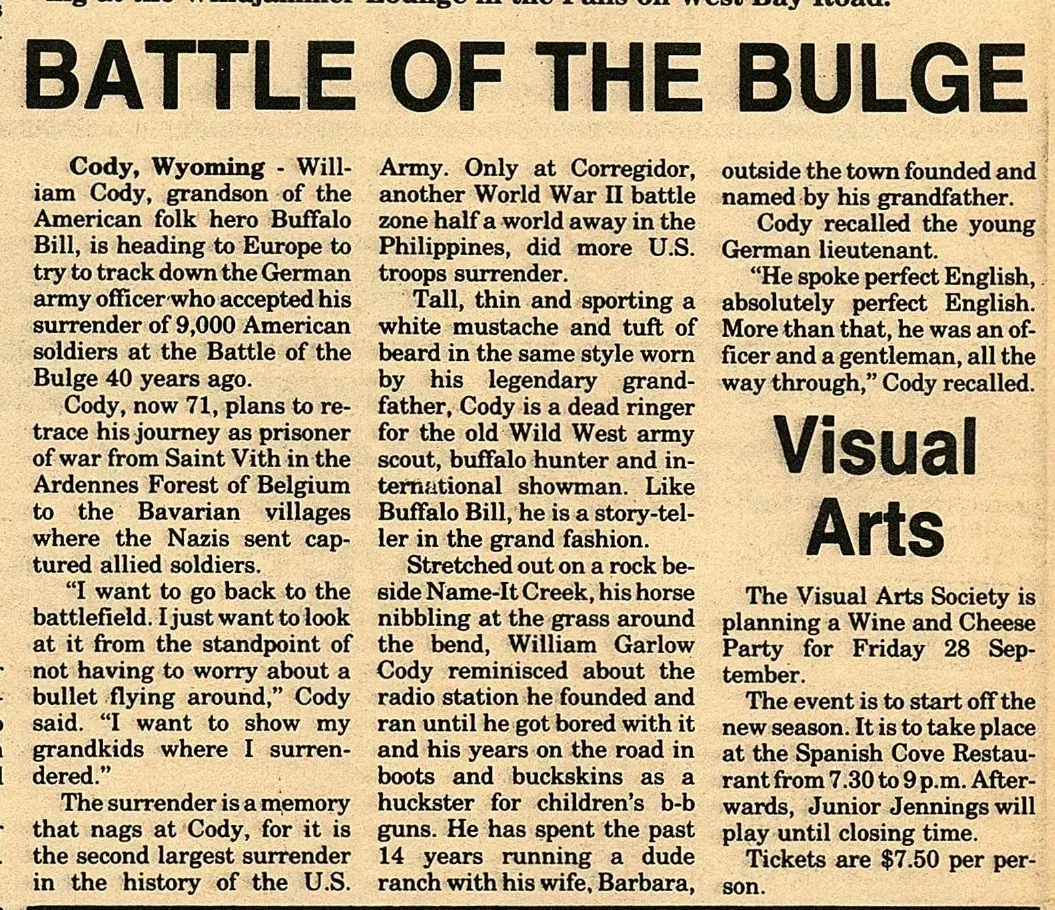
Cody, now 71, plans to retrace his journey as prisoner of war from Saint Vith in the Ardennes Forest of Belgium to the Bavarian villages where the Nazis sent captured allied soldiers.
"I want to go back to the battlefield. I just want to look at it from the standpoint of not having to worry about a bullet flying around," Cody said. "I want to show my grandkids where I surrendered." The surrender is a memory that nags at Cody, for it is the second largest surrender in the history of the U.S. Army. Only at Corregidor, another World War II battle zone half a world away in the Philippines, did more U.S. troops surrender.
Tall, thin and sporting a white mustache and tuft of beard in the same style worn by his legendary grandfather, Cody is a dead ringer for the old Wild West army scout, buffalo hunter and international showman. Like Buffalo Bill, he is a storyteller in the grand fashion.
Stretched out on a rock beside Name-It Creek, his horse nibbling at the grass around the bend, William Garlow Cody reminisced about the radio station he founded and ran until he got bored with it and his years on the road in boots and buckskins as a huckster for children's b-b guns. He has spent the past 14 years running a dude ranch with his wife, Barbara, outside the town founded and named by his grandfather.
Cody recalled the young German lieutenant.
"He spoke perfect English, absolutely perfect English. More than that, he was an officer and a gentleman, all the way through," Cody recalled.