World News GRENADIANS TO VOTE FOR 'A NEW AGE'
About the article
This is a digitised version of an article from The Cayman Compass's print archive. Occasionally, the digitisation process introduces transcription errors, or other problems.
See the article in its original context from September 1984.
Brought to you by

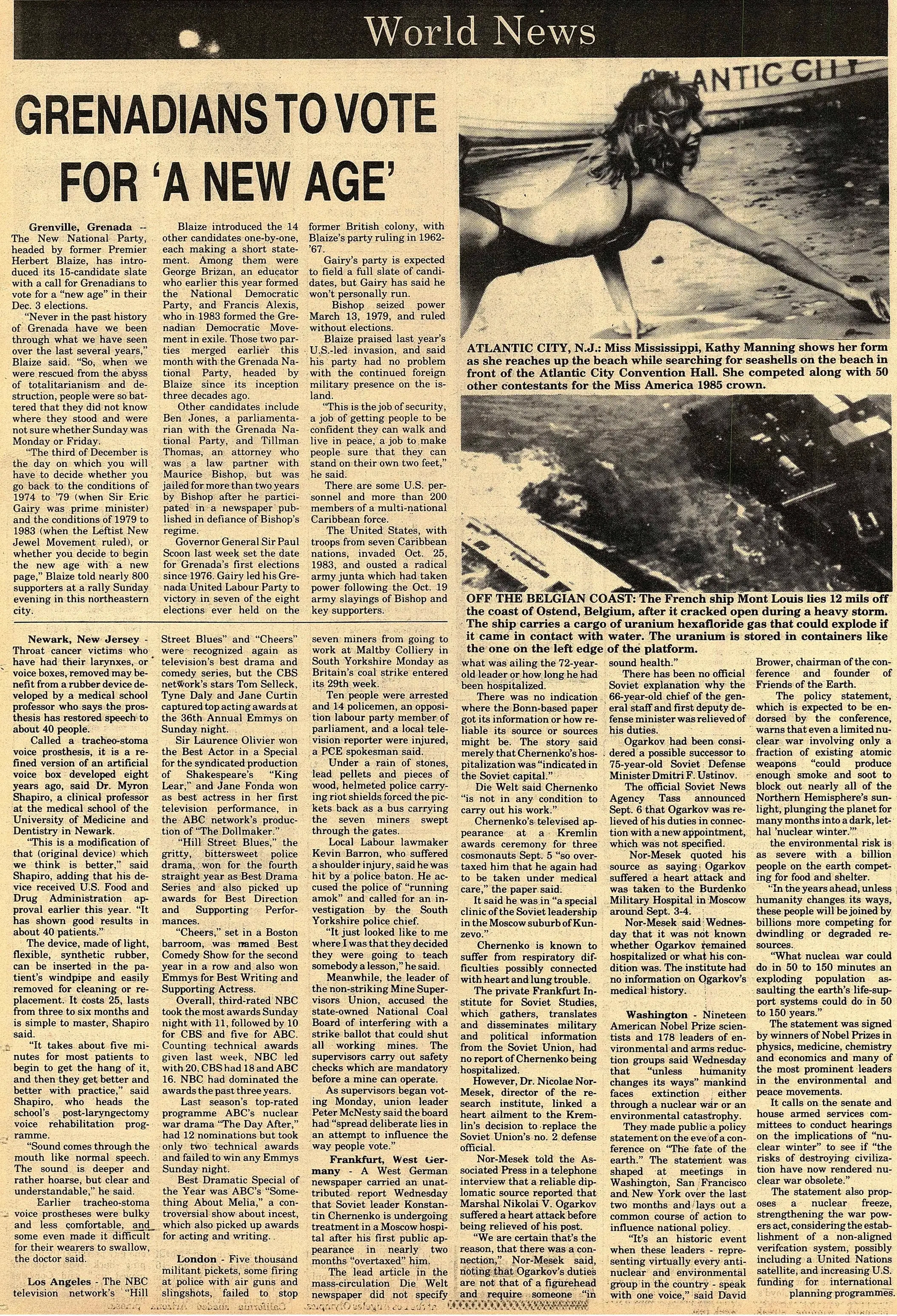
"Never in the past history of Grenada have we been through what we have seen over the last several years," Blaize said. "So, when we were rescued from the abyss of totalitarianism and destruction, people were so battered that they did not know where they stood and were not sure whether Sunday was Monday or Friday.
"The third of December is the day on which you will have to decide whether you go back to the conditions of 1974 to '79 (when Sir Eric Gairy was prime minister) and the conditions of 1979 to 1983 (when the Leftist New Jewel Movement ruled), or whether you decide to begin the new age with a new page," Blaize told nearly 800 supporters at a rally Sunday evening in this northeastern city. Blaize introduced the 14 other candidates one-by-one, each making a short statement. Among them were George Brizan, an educator who earlier this year formed the National Democratic Party, and Francis Alexis, who in 1983 formed the Grenadian Democratic Movement in exile. Those two parties merged earlier this month with the Grenada National Party, headed by Blaize since its inception three decades ago.
Other candidates include Ben Jones, a parliamentarian with the Grenada National Party, and Tillman Thomas, an attorney who was a law partner with Maurice Bishop, but was jailed for more than two years by Bishop after he participated in a newspaper published in defiance of Bishop's regime.
Governor General Sir Paul Scoon last week set the date for Grenada's first elections since 1976. Gairy led his Grenada United Labour Party to victory in seven of the eight elections ever held on the former British colony, with Blaize's party ruling in 1962-'67. Gairy's party is expected to field a full slate of candidates, but Gairy has said he won't personally run.
Bishop seized power March 13, 1979, and ruled without elections.
Blaize praised last year's U.S.-led invasion, and said his party had no problem with the continued foreign military presence on the island.
"This is the job of security, a job of getting people to be confident they can walk and live in peace, a job to make people sure that they can stand on their own two feet," he said.
There are some U.S. personnel and more than 200 members of a multinational Caribbean force.
The United States, with troops from seven Caribbean nations, invaded Oct. 25, 1983, and ousted a radical army junta which had taken power following the Oct. 19 army slayings of Bishop and key supporters. Newark, New Jersey - Throat cancer victims who have had their larynxes, or voice boxes, removed may benefit from a rubber device developed by a medical school professor who says the prosthesis has restored speech to about 40 people.
Called a tracheo-stoma voice prosthesis, it is a refined version of an artificial voice box developed eight years ago, said Dr. Myron Shapiro, a clinical professor at the medical school of the University of Medicine and Dentistry in Newark.
"This is a modification of that (original device) which we think is better," said Shapiro, adding that his device received U.S. Food and Drug Administration approval earlier this year. "It has shown good results in about 40 patients."
The device, made of light, flexible, synthetic rubber, can be inserted in the patient's windpipe and easily removed for cleaning or replacement. It costs 25, lasts from three to six months and is simple to master, Shapiro said. "It takes about five minutes for most patients to begin to get the hang of it, and then they get better and better with practice," said Shapiro, who heads the school's post-laryngectomy voice rehabilitation programme.
"Sound comes through the mouth like normal speech. The sound is deeper and rather hoarse, but clear and understandable," he said.
Earlier tracheo-stoma voice prostheses were bulky and less comfortable, and some even made it difficult for their wearers to swallow, the doctor said. Los Angeles - The NBC television network's "Hill "Street Blues" and "Cheers" were recognized again as television's best drama and comedy series, but the CBS network's stars Tom Selleck, Tyne Daly and Jane Curtin captured top acting awards at the 36th Annual Emmys on Sunday night.
Sir Laurence Olivier won the Best Actor in a Special for the syndicated production of Shakespeare's "King Lear," and Jane Fonda won as best actress in her first television performance, in the ABC network's production of "The Dollmaker."
"Hill Street Blues," the gritty, bittersweet police drama, won for the fourth straight year as Best Drama Series and also picked up awards for Best Direction and Supporting Performances. "Cheers," set in a Boston barroom, was named Best Comedy Show for the second year in a row and also won Emmys for Best Writing and Supporting Actress.
Overall, third-rated NBC took the most awards Sunday night with 11, followed by 10 for CBS and five for ABC.
Counting technical awards given last week, NBC led with 20, CBS had 18 and ABC 16. NBC had dominated the awards the past three years.
Last season's top-rated programme ABC's nuclear war drama "The Day After," had 12 nominations but took only two technical awards and failed to win any Emmys Sunday night.
Best Dramatic Special of the Year was ABC's "Something About Melia," a controversial show about incest, which also picked up awards for acting and writing. London - Five thousand militant pickets, some firing at police with air guns and slingshots, failed to stop seven miners from going to work at Maltby Colliery in South Yorkshire Monday as Britain's coal strike entered its 29th week.
Ten people were arrested and 14 policemen, an opposition labour party member of parliament, and a local television reporter were injured, a PCE spokesman said.
Under a rain of stones, lead pellets and pieces of wood, helmeted police carrying riot shields forced the pickets back as a bus carrying the seven miners swept through the gates.
Local Labour lawmaker Kevin Barron, who suffered a shoulder injury, said he was hit by a police baton. He accused the police of "running amok" and called for an investigation by the South Yorkshire police chief.
"It just looked like to me where I was that they decided they were going to teach somebody a lesson," he said.
Meanwhile, the leader of the non-striking Mine Supervisors Union, accused the state-owned National Coal Board of interfering with a strike ballot that could shut all working mines. The supervisors carry out safety checks which are mandatory before a mine can operate.
As supervisors began voting Monday, union leader Peter McNesty said the board had "spread deliberate lies in an attempt to influence the way people vote." Frankfurt, West Germany - A West German newspaper carried an unattributed report Wednesday that Soviet leader Konstantin Chernenko is undergoing treatment in a Moscow hospital after his first public appearance in nearly two months "overtaxed" him.
The lead article in the mass-circulation Die Welt newspaper did not specify what was ailing the 72-yearold leader or how long he had been hospitalized.
There was no indication where the Bonn-based paper got its information or how reliable its source or sources might be. The story said merely that Chernenko's hospitalization was "indicated in the Soviet capital."
Die Welt said Chernenko "is not in any condition to carry out his work."
Chernenko's televised appearance at a Kremlin awards ceremony for three cosmonauts Sept. 5 "so overtaxed him that he again had to be taken under medical care," the paper said.
It said he was in "a special clinic of the Soviet leadership in the Moscow suburb of Kunzeyo." Chernenko is known to suffer from respiratory difficulties possibly connected with heart and lung trouble.
The private Frankfurt Institute for Soviet Studies, which gathers, translates and disseminates military and political information from the Soviet Union, had no report of Chernenko being hospitalized.
However, Dr. Nicolae Nor-Mesek, director of the research institute, linked a heart ailment to the Kremlin's decision to replace the Soviet Union's no. 2 defense official.
Nor-Mesek told the Associated Press in a telephone interview that a reliable diplomatic source reported that Marshal Nikolai V. Ogarkov suffered a heart attack before being relieved of his post.
"We are certain that's the reason, that there was a connection," Nor-Mesek said, noting that Ogarkov's duties are not that of a figurehead and require someone "in sound health."
There has been no official Soviet explanation why the 66-year-old chief of the general staff and first deputy defense minister was relieved of his duties.
Ogarkov had been considered a possible successor to 75-year-old Soviet Defense Minister Dmitri F. Ustinov. The official Soviet News Agency Tass announced Sept. 6 that Ogarkov was relieved of his duties in connection with a new appointment, which was not specified.
Nor-Mesek quoted his source as saying, Ogarkov suffered a heart attack and was taken to the Burdenko Military Hospital in Moscow around Sept. 3-4.
Nor-Mesek said Wednesday that it was not known whether Ogarkov remained hospitalized or what his condition was. The institute had no information on Ogarkov's medical history. Washington - Nineteen American Nobel Prize scientists and 178 leaders of environmental and arms reduction groups said Wednesday that "unless humanity changes its ways" mankind faces extinction either through a nuclear war or an environmental catastrophy.
They made public a policy statement on the eve of a conference on "The fate of the earth." The statement was shaped at meetings in Washington, San Francisco and New York over the last two months and lays out a common course of action to influence national policy.
"It's an historic event when these leaders representing virtually every antinuclear and environmental group in the country speak with one voice," said David Brower, chairman of the conference and founder of Friends of the Earth.
The policy statement, which is expected to be endorsed by the conference, warns that even a limited nuclear war involving only a fraction of existing atomic weapons "could produce enough smoke and soot to block out nearly all of the Northern Hemisphere's sunlight, plunging the planet for many months into a dark, lethal 'nuclear winter.'"
the environmental risk is as severe with a billion people on the earth competing for food and shelter.
"In the years ahead, unless humanity changes its ways, these people will be joined by billions more competing for dwindling or degraded resources.
"What nuclear war could do in 50 to 150 minutes an exploding population assaulting the earth's life-support systems could do in 50 to 150 years."
The statement was signed by winners of Nobel Prizes in physics, medicine, chemistry and economics and many of the most prominent leaders in the environmental and peace movements.
It calls on the senate and house armed services committees to conduct hearings on the implications of "nuclear winter" to see if "the risks of destroying civilization have now rendered nuclear war obsolete."
The statement also proposes a nuclear freeze, strengthening the war powers act, considering the establishment of a non-aligned verification system, possibly including a United Nations satellite, and increasing U.S. funding for international planning programmes.