Caribbean Carnival brings a sparkle to Old London
About the article
This is a digitised version of an article from The Cayman Compass's print archive. Occasionally, the digitisation process introduces transcription errors, or other problems.
See the article in its original context from March 1986.
Brought to you by

Caribbean Focus
Its flamboyant coming-ofage is timed for August 1986, the year of Caribbean Focus. This is a nine-month programme of cultural and educational activities in Britain spotlighting Caribbean achievement, presided over by Alex Pascall, who has long been associated with the carnival.
Now entering its 21st year, the Notting Hill carnival is a major and well-established event in the British calendar. It is a festive occasion reaching far beyond the Caribbean community, an event with wide official sponsorship welcomed with messages of goodwill from the Prime Minister and Leader of the Opposition among other politicians and public figures.
For 1986 the organisers are planning an invitation list to include eminent people from Caribbean countries as befits a show that started from improvised bits and pieces in London's byways nd grew to be the biggest street entertainment in Europe.
The importance of the carnival is not to be measured by a single week of intense activity in the height of summer, when the streets resound with calypso and soca (soul and calypso) music. For black people it has now become a vibrant assertion of cultural identity.
The spirit of carnival runs through the year in months of hard preparation. The supporting arts - design, manufacture of costumes, floats, every kind of display paraphernalia and exotic foods sold from stalls - give a focus to creative efforts in many related fields.
Fantasy Creations
The realisation of fantasy creations in dazzling devices that go far beyond the scope of costume, but can briefly transform people into giant insects, bees or butterflies of breath-taking beauty, is an art form in itself. The concepts projected in this material fantasy seem to grow more elaborate each year. The pageantry too, has become something magical, creating an atmosphere that belongs only to carnival. Given the special make-up of London, perhaps only Notting Hill carnival can produce this precise effect.
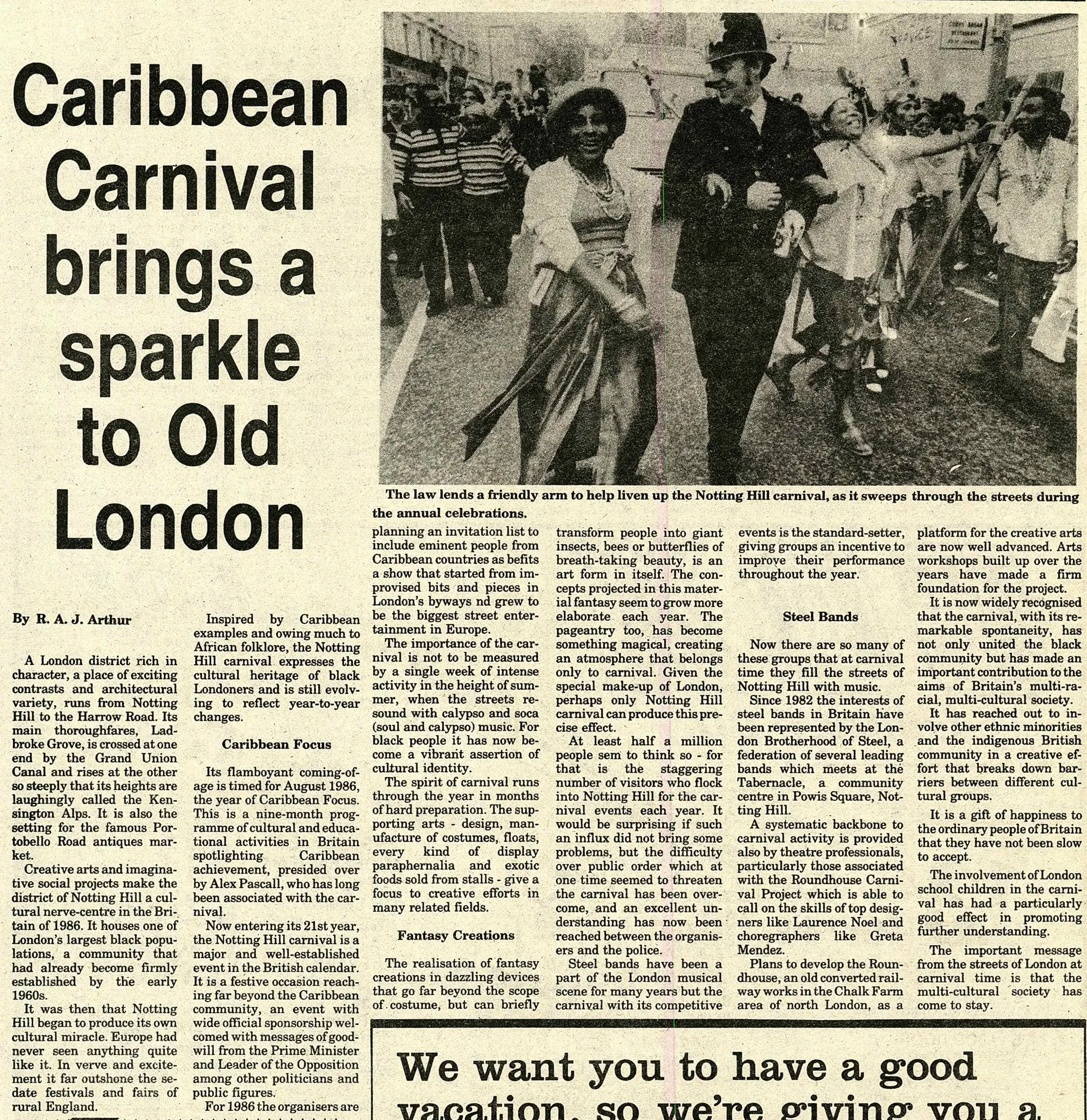
At least half a million people sem to think so - for that is the staggering number of visitors who flock into Notting Hill for the carnival events each year. It would be surprising if such an influx did not bring some problems, but the difficulty over public order which at one time seemed to threaten the carnival has been overcome, and an excellent understanding has now been reached between the organisers and the police.
Steel bands have been a part of the London musical scene for many years but the carnival with its competitive events is the standard-setter, giving groups an incentive to improve their performance throughout the year.
Steel Bands
Now there are so many of these groups that at carnival time they fill the streets of Notting Hill with music.
Since 1982 the interests of steel bands in Britain have been represented by the London Brotherhood of Steel, a federation of several leading bands which meets at the Tabernacle, a community centre in Powis Square, Notting Hill.
A systematic backbone to carnival activity is provided also by theatre professionals, particularly those associated with the Roundhouse Carnival Project which is able to call on the skills of top designers like Laurence Noel and choreographers like Greta Mendez.
Plans to develop the Roundhouse, an old converted railway works in the Chalk Farm area of north London, as a platform for the creative arts are now well advanced. Arts workshops built up over the years have made a firm foundation for the project.
It is now widely recognised that the carnival, with its remarkable spontaneity, has not only united the black community but has made an important contribution to the aims of Britain's multi-racial, multicultural society.
It has reached out to involve other ethnic minorities and the indigenous British community in a creative effort that breaks down barriers between different cultural groups. It is a gift of happiness to the ordinary people of Britain that they have not been slow to accept. The involvement of London school children in the carnival has had a particularly good effect in promoting further understanding. The important message from the streets of London at carnival time is that the multicultural society has come to stay.