FEATURE: The 'Gringo' who has them swooning in the Philippines
About the article
This is a digitised version of an article from The Cayman Compass's print archive. Occasionally, the digitisation process introduces transcription errors, or other problems.
See the article in its original context from May 1986.
Brought to you by

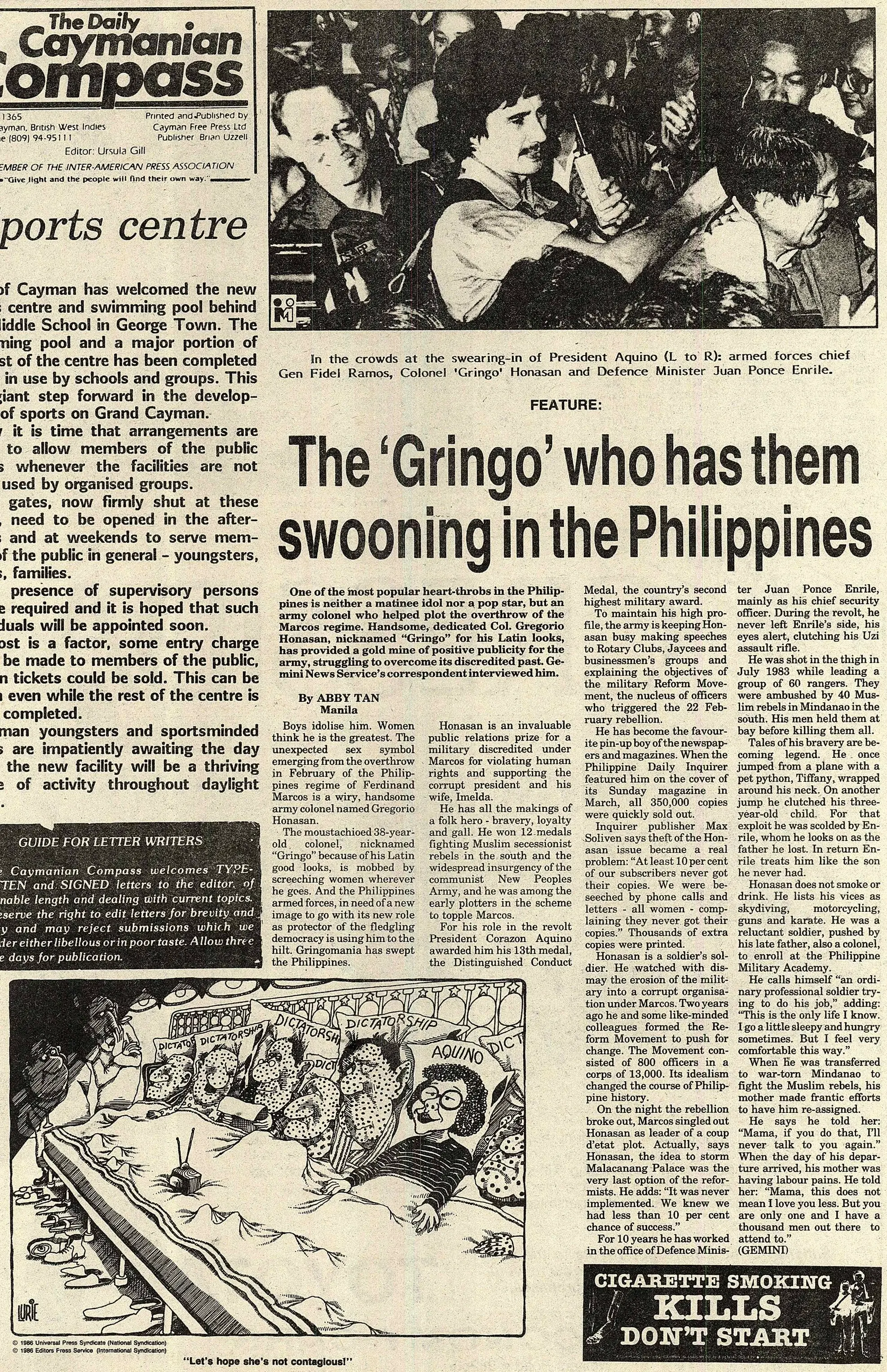
The moustachioed 38-year-old colonel, nicknamed "Gringo" because of his Latin good looks, is mobbed by screeching women wherever he goes. And the Philippines armed forces, in need of a new image to go with its new role as protector of the fledgling democracy is using him to the hilt. Gringomania has swept the Philippines. Honasan is an invaluable public relations prize for a military discredited under Marcos for violating human rights and supporting the corrupt president and his wife, Imelda.
He has all the makings of a folk hero - bravery, loyalty and gall. He won 12 medals fighting Muslim secessionist rebels in the south and the widespread insurgency of the communist New Peoples Army, and he was among the early plotters in the scheme to topple Marcos.
For his role in the revolt President Corazon Aquino awarded him his 13th medal, the Distinguished Conduct Medal, the country's second highest military award. To maintain his high profile, the army is keeping Honasan busy making speeches to Rotary Clubs, Jaycees and businessmen's groups and explaining the objectives of the military Reform Movement, the nucleus of officers who triggered the 22 February rebellion.
He has become the favourite pin-up boy of the newspapers and magazines. When the Philippine Daily Inquirer featured him on the cover of its Sunday magazine in March, all 350,000 copies were quickly sold out.
Inquirer publisher Max Soliven says theft of the Honasan issue became a real problem: "At least 10 per cent of our subscribers never got their copies. We were beseeched by phone calls and letters - all women - complaining they never got their copies." Thousands of extra copies were printed.
Honasan is a soldier's soldier. He watched with dismay the erosion of the military into a corrupt organisation under Marcos. Two years ago he and some like-minded colleagues formed the Reform Movement to push for change. The Movement consisted of 800 officers in a corps of 13,000. Its idealism changed the course of Philippine history.
On the night the rebellion broke out, Marcos singled out Honasan as leader of a coup d'etat plot. Actually, says Honasan, the idea to storm Malacanang Palace was the very last option of the reformists. He adds: "It was never implemented. We knew we had less than 10 per cent chance of success."
For 10 years he has worked in the office of Defence Minister Juan Ponce Enrile, mainly as his chief security officer. During the revolt, he never left Enrile's side, his eyes alert, clutching his Uzi assault rifle.
He was shot in the thigh in July 1983 while leading a group of 60 rangers. They were ambushed by 40 Muslim rebels in Mindanao in the south. His men held them at bay before killing them all. Tales of his bravery are becoming legend. He once jumped from a plane with a pet python, Tiffany, wrapped around his neck. On another jump he clutched his three-year-old child. For that exploit he was scolded by Enrile, whom he looks on as the father he lost. In return Enrile treats him like the son he never had.
Honasan does not smoke or drink. He lists his vices as skydiving, motorcycling, guns and karate. He was a reluctant soldier, pushed by his late father, also a colonel, to enroll at the Philippine Military Academy.
He calls himself "an ordinary professional soldier trying to do his job," adding: "This is the only life I know. I go a little sleepy and hungry sometimes. But I feel very comfortable this way."
When he was transferred to war-torn Mindanao to fight the Muslim rebels, his mother made frantic efforts to have him re-assigned.
He says he told her: "Mama, if you do that, I'll never talk to you again." When the day of his departure arrived, his mother was having labour pains. He told her: "Mama, this does not mean I love you less. But you are only one and I have a thousand men out there to attend to." (GEMINI)