Nuclear power breeds hypocrisy
About the article
This is a digitised version of an article from The Cayman Compass's print archive. Occasionally, the digitisation process introduces transcription errors, or other problems.
See the article in its original context from May 1986.
Brought to you by

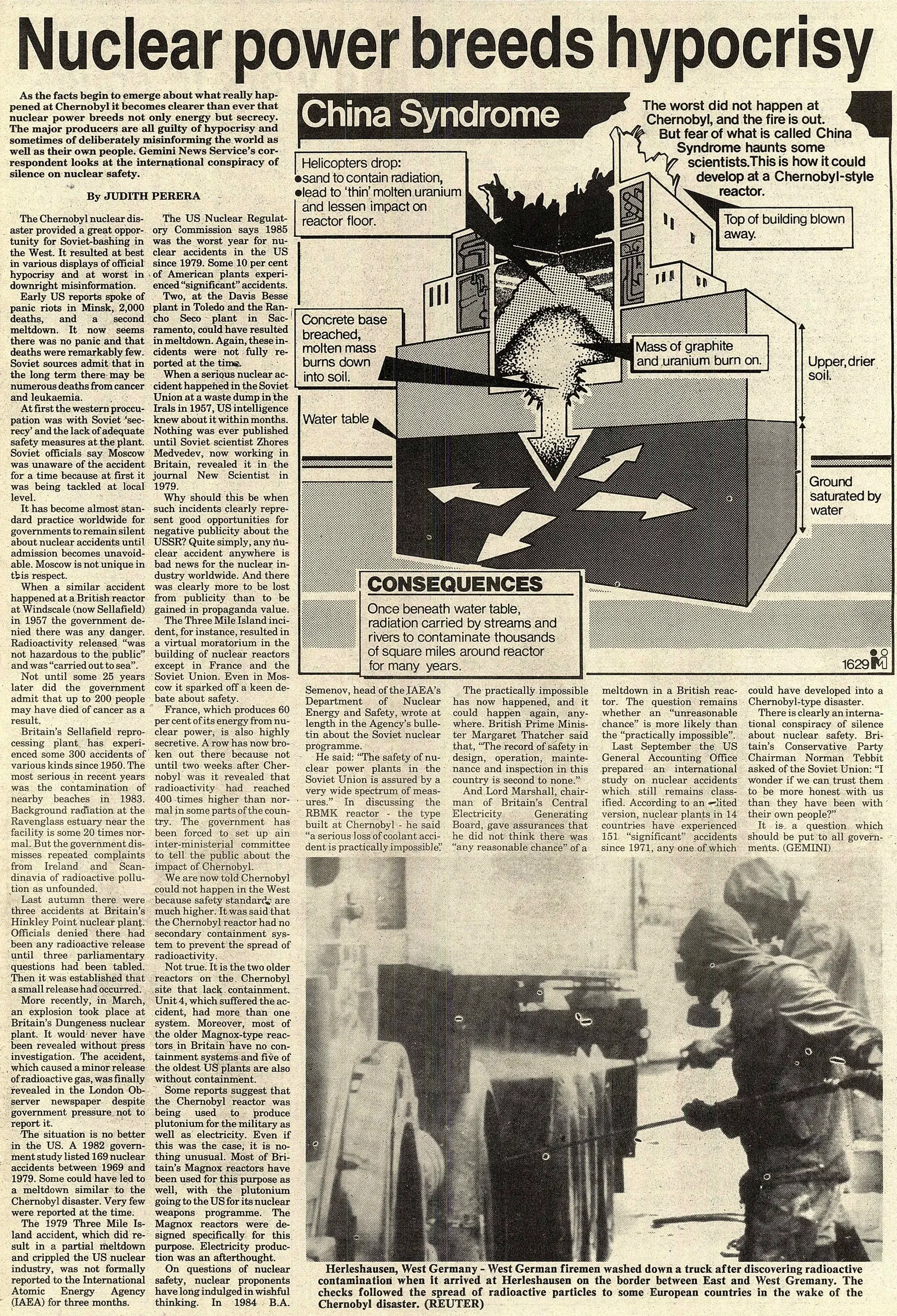
The Chernobyl nuclear disaster provided a great opportunity for Soviet-bashing in the West. It resulted at best in various displays of official hypocrisy and at worst in downright misinformation. Early US reports spoke of panic riots in Minsk, 2,000 deaths, and a second meltdown. It now seems there was no panic and that deaths were remarkably few. Soviet sources admit that in the long term there may be numerous deaths from cancer and leukaemia.
At first the western proccupation was with Soviet 'secrecy' and the lack of adequate safety measures at the plant. Soviet officials say Moscow was unaware of the accident for a time because at first it was being tackled at local level.
It has become almost standard practice worldwide for governments to remain silent about nuclear accidents until admission becomes unavoidable. Moscow is not unique in this respect.
When a similar accident happened at a British reactor at Windscale (now Sellafield) in 1957 the government denied there was any danger. Radioactivity released "was not hazardous to the public" and was "carried out to sea".
Not until some 25 years later did the government admit that up to 200 people may have died of cancer as a result. Britain's Sellafield reprocessing plant has experienced some 300 accidents of various kinds since 1950. The most serious in recent years was the contamination of nearby beaches in 1983. Background radiation at the Ravenglass estuary near the facility is some 20 times normal. But the government dismisses repeated complaints from Ireland and Scandinavia of radioactive pollution as unfounded.
Last autumn there were three accidents at Britain's Hinkley Point nuclear plant. Officials denied there had been any radioactive release until three parliamentary questions had been tabled. Then it was established that a small release had occurred. More recently, in March, an explosion took place at Britain's Dungeness nuclear plant. It would never have been revealed without press investigation. The accident, which caused a minor release of radioactive gas, was finally revealed in the London Observer newspaper despite government pressure not to report it.
The situation is no better in the US. A 1982 government study listed 169 nuclear accidents between 1969 and 1979. Some could have led to a meltdown similar to the Chernobyl disaster. Very few were reported at the time.
The 1979 Three Mile Island accident, which did result in a partial meltdown and crippled the US nuclear industry, was not formally reported to the International Atomic Energy Agency (IAEA) for three months. The US Nuclear Regulatory Commission says 1985 was the worst year for nuclear accidents in the US since 1979. Some 10 per cent of American plants experienced "significant" accidents. Two, at the Davis Besse plant in Toledo and the Rancho Seco plant in Sacramento, could have resulted in meltdown. Again, these incidents were not fully reported at the times.
When a serious nuclear accident happened in the Soviet Union at a waste dump in the Irals in 1957, US intelligence knew about it within months. Nothing was ever published until Soviet scientist Zhores Medvedev, now working in Britain, revealed it in the journal New Scientist in 1979.
Why should this be when such incidents clearly represent good opportunities for negative publicity about the USSR? Quite simply, any nuclear accident anywhere is bad news for the nuclear industry worldwide. And there was clearly more to be lost from publicity than to be gained in propaganda value. The Three Mile Island incident, for instance, resulted in a virtual moratorium in the building of nuclear reactors except in France and the Soviet Union. Even in Moscow it sparked off a keen debate about safety.
France, which produces 60 per cent of its energy from nuclear power, is also highly secretive. A row has now broken out there because not until two weeks after Chernobyl was it revealed that radioactivity had reached 400 times higher than normal in some parts of the country. The government has been forced to set up ain inter-ministerial committee to tell the public about the impact of Chernobyl.
We are now told Chernobyl could not happen in the West because safety standards are much higher. It was said that the Chernobyl reactor had no secondary containment system to prevent the spread of radioactivity.
Not true. It is the two older reactors on the Chernobyl site that lack containment. Unit 4, which suffered the accident, had more than one system. Moreover, most of the older Magnox-type reactors in Britain have no containment systems and five of the oldest US plants are also without containment.
Some reports suggest that the Chernobyl reactor was being used to produce plutonium for the military as well as electricity. Even if this was the case, it is nothing unusual. Most of Britain's Magnox reactors have been used for this purpose as well, with the plutonium going to the US for its nuclear weapons programme. The Magnox reactors were designed specifically for this purpose. Electricity production was an afterthought.
On questions of nuclear safety, nuclear proponents have long indulged in wishful thinking. In 1984 B.A. Semenov, head of the IAEA's Department of Nuclear Energy and Safety, wrote at length in the Agency's bulletin about the Soviet nuclear programme.
He said: "The safety of nuclear power plants in the Soviet Union is assured by a very wide spectrum of measures." In discussing the RBMK reactor - the type built at Chernobyl - he said "a serious loss of coolant accident is practically impossible." The practically impossible has now happened, and it could happen again, anywhere. British Prime Minister Margaret Thatcher said that, "The record of safety in design, operation, maintenance and inspection in this country is second to none."
And Lord Marshall, chairman of Britain's Central Electricity Generating Board, gave assurances that he did not think there was "any reasonable chance" of a meltdown in a British reactor. The question remains whether an "unreasonable chance" is more likely than the "practically impossible".
Last September the US General Accounting Office prepared an international study on nuclear accidents which still remains classified. According to an edited version, nuclear plants in 14 countries have experienced 151 "significant" accidents since 1971, any one of which could have developed into a Chernobyl-type disaster.
There is clearly an international conspiracy of silence about nuclear safety. Britain's Conservative Party Chairman Norman Tebbit asked of the Soviet Union: "I wonder if we can trust them to be more honest with us than they have been with their own people?"
It is a question which should be put to all governments. (GEMINI)