Pilot project yields plenty tomatoes
About the article
This is a digitised version of an article from The Cayman Compass's print archive. Occasionally, the digitisation process introduces transcription errors, or other problems.
See the article in its original context from June 1986.
Brought to you by

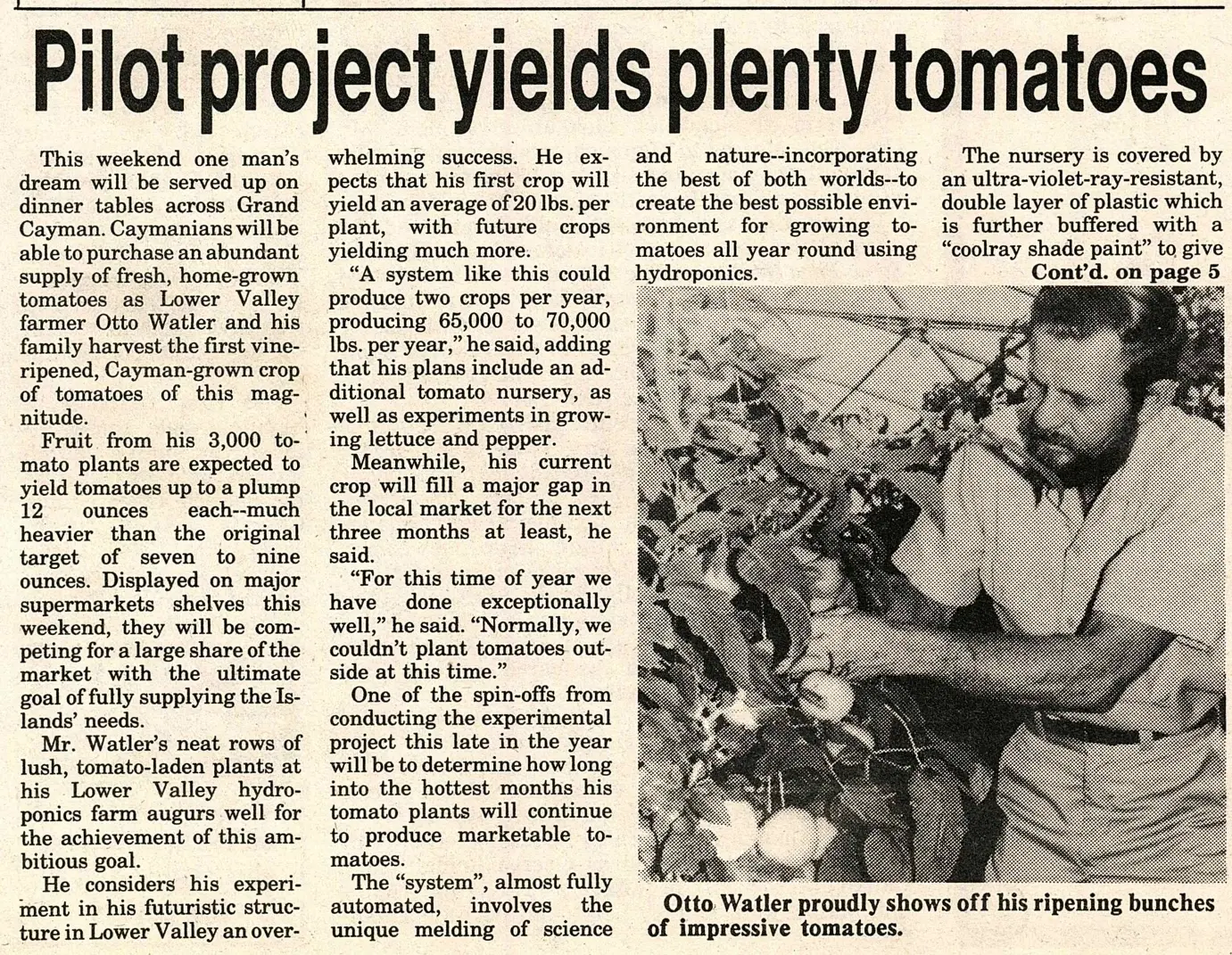
Fruit from his 3,000 tomato plants are expected to yield tomatoes up to a plump 12 ounces each--much heavier than the original target of seven to nine ounces. Displayed on major supermarkets shelves this weekend, they will be competing for a large share of the market with the ultimate goal of fully supplying the Islands' needs.
Mr. Watler's neat rows of lush, tomato-laden plants at his Lower Valley hydroponics farm augurs well for the achievement of this ambitious goal.
He considers his experiment in his futuristic structure in Lower Valley an overwhelming success. He expects that his first crop will yield an average of 20 lbs. per plant, with future crops yielding much more.
"A system like this could produce two crops per year, producing 65,000 to 70,000 lbs. per year," he said, adding that his plans include an additional tomato nursery, as well as experiments in growing lettuce and pepper.
Meanwhile, his current crop will fill a major gap in the local market for the next three months at least, he said. "For this time of year we have done exceptionally well," he said. "Normally, we couldn't plant tomatoes outside at this time."
One of the spin-offs from conducting the experimental project this late in the year will be to determine how long into the hottest months his tomato plants will continue to produce marketable tomatoes.
The "system", almost fully automated, involves the unique melding of science and nature-incorporating the best of both worlds-to create the best possible environment for growing tomatoes all year round using hydroponics. The nursery is covered by an ultra-violet-ray-resistant, double layer of plastic which is further buffered with a "coolray shade paint" to give
Cont'd. on page 5 from page 1
added protection.
With the sides and ends covered with shade cloth, convection cooling is utilised, allowing a constant cross-flow of fresh air to the plants.
The environment is further enhanced by the injection of "fog" into the atmosphere, the result of pumping cool water under pressure down to between 7,000 to 9,000 lbs. psi. The plants are automatically fed a specially-prepared solution containing just the right balance of nutrients. Each plant gets the same amount, whether at the beginning of the row or at the end.
The plants, from local seedlings, are grown in a medium called "rock wool," which absorbs the nutrient solution.
"We are using proven techniques that are very energy-efficient," Mr. Walter said.
He monitors the system daily, assisted by his "right-hand" man, a Haitian immigrant affectionately called "Shortie." Both are constantly engaged in "clipping" the plants to their supports, and "suckering"--that is, removing additional buds so that the plant maintains one "growing tip," allowing for maximum supply of nutrients to the fruit.
But this is essentially a family project. Otto's wife, Sybil, has been involved in the project right from the start, along with his sons, Stephen and Bruce, and daughters, Evelyn and Marlice, who work at nights and weekends.
The project was conceived as a pilot project to evaluate the feasibility of growing tomatoes by hydroponics with the view of ultimately fully supplying the local market. It was funded by the Agricultural Industrial Development Board (AIDB) whose officers took a personal interest in the development of the project.
"I have had very good cooperation," said Mr. Watler, who had special praise for the late Armando Cardena who was then the AIDB manager, as well as the present Acting Manager, Vanessa Godfrey, and the Industrial Development Specialist, Herman Simpson.
"They worked very hard on this," he said.
Both Mr. Simpson and Mr. Cardena accompanied Mr. Watler and his family to Ohio to attend a seminar on hydroponics and to visit tomato nurseries in operation.
The seminar was organised by "Crop King," a Ohio firm which specialises in manufacturing and installing these systems. He had been referred to Crop King by a good friend, Jim Considine, who works with the Colorado State Government and who spotted Crop King's booth in the 1984 World's Fair in New Orleans. By this time, Mr. Watler had compiled a great deal of local data, including weather conditions over the years, pertinent to the development of the project.
"This is something I had wanted to do for a long time," He said. "It took me two years to get it off the ground, much of this spent in painstaking planning." At his own expense, he invited Crop King's President, Dan Brentlinger to Grand Cayman. "He was selling and I was buying, but at the end I asked him for his impartial opinion," said Mr. Watler.
Mr. Brentlinger gave his blessing and a great deal of help and interest in the project from then on. Crop King's building supervisor, Doug Kreuder and his wife, Jill, arrived in December, 1985, to supervise the construction of the house-the first building of its type on the island--contracted to David Arch Construction Company Ltd. Crop King's horticulturist, Jim Brown, came down in April to set the plants on the pads and put the system into operation.
"From there on it's been my baby," Mr. Watler said.
During this period he has learnt from a process of trial and error as operational problems developed. One of the major problems was with water. "I would like to give special thanks to Richard Beswick, Director of the Water Authority, and his lab. technician, Michael Hislop, who came to rescue and solved the problem," Mr. Watler said.
He added that the success of this pilot project was an example of the kind of results which are possible when private sector projects are blessed with this level of Governmental co-operation and assistance. Now Mr. Watler is hoping that his home-grown tomatoes will meet with the right public support.
"This will be a superior tomato. Cayman has been asking for good tomatoes. They have one now. I hope they appreciate it," he said.
So far, he has made personal contacts with several of the major supermarkets.
"Everyone I have spoken with has pledged support," he said.
And this weekend the public will have an opportunity to sample Mr. Watler's tomatoes, which will be distinguished by special packaging and identification stickers. (GIS)