Mexico go even toughe
About the article
This is a digitised version of an article from The Cayman Compass's print archive. Occasionally, the digitisation process introduces transcription errors, or other problems.
See the article in its original context from June 1986.
Brought to you by

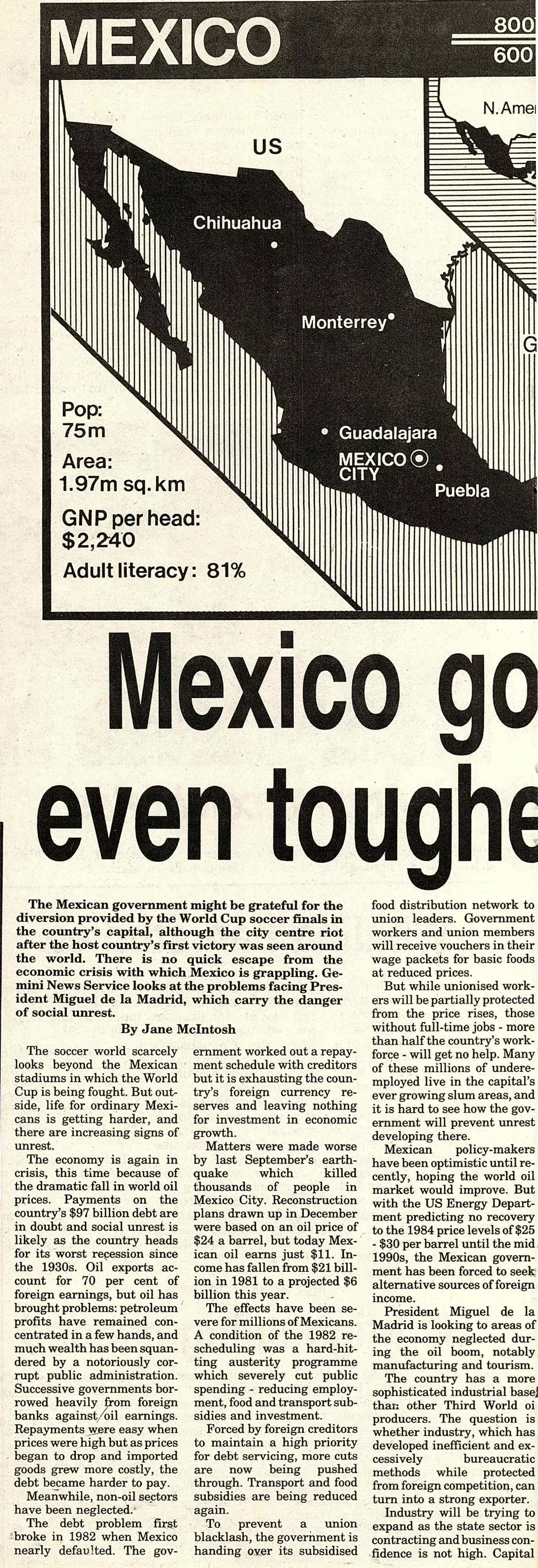
The economy is again in crisis, this time because of the dramatic fall in world oil prices. Payments on the country's $97 billion debt are in doubt and social unrest is likely as the country heads for its worst recession since the 1930s. Oil exports account for 70 per cent of foreign earnings, but oil has brought problems: petroleum profits have remained concentrated in a few hands, and much wealth has been squandered by a notoriously corrupt public administration. Successive governments borrowed heavily from foreign banks against/oil earnings. Repayments were easy when prices were high but as prices began to drop and imported goods grew more costly, the debt became harder to pay. Meanwhile, non-oil sectors have been neglected.
The debt problem first broke in 1982 when Mexico nearly defaulted. The government worked out a repayment schedule with creditors but it is exhausting the country's foreign currency reserves and leaving nothing for investment in economic growth.
Matters were made worse by last September's earthquake which killed thousands of people in Mexico City. Reconstruction plans drawn up in December were based on an oil price of $24 a barrel, but today Mexican oil earns just $11. Income has fallen from $21 billion in 1981 to a projected $6 billion this year.
The effects have been severe for millions of Mexicans. A condition of the 1982 rescheduling was a hard-hitting austerity programme which severely cut public spending - reducing employment, food and transport subsidies and investment.
Forced by foreign creditors to maintain a high priority for debt servicing, more cuts are now being pushed through. Transport and food subsidies are being reduced again.
To prevent a union blacklash, the government is handing over its subsidised food distribution network to union leaders. Government workers and union members will receive vouchers in their wage packets for basic foods at reduced prices.
But while unionised workers will be partially protected from the price rises, those without full-time jobs - more than half the country's workforce - will get no help. Many of these millions of underemployed live in the capital's ever growing slum areas, and it is hard to see how the government will prevent unrest developing there.
Mexican policymaker have been optimistic until recently, hoping the world oil market would improve. But with the US Energy Department predicting no recovery to the 1984 price levels of $25 - $30 per barrel until the mid 1990s, the Mexican government has been forced to seek alternative sources of foreign income.
President Miguel de la Madrid is looking to areas of the economy neglected during the oil boom, notably manufacturing and tourism. The country has a more sophisticated industrial base than other Third World oil producers. The question is whether industry, which has developed inefficient and excessively bureaucratic methods while protected from foreign competition, can turn into a strong exporter.
Industry will be trying to expand as the state sector is contracting and business confidence is not high. Capital