'Neighbourhood watch' helps Toronto fight crime
About the article
This is a digitised version of an article from The Cayman Compass's print archive. Occasionally, the digitisation process introduces transcription errors, or other problems.
See the article in its original context from August 1986.
Brought to you by

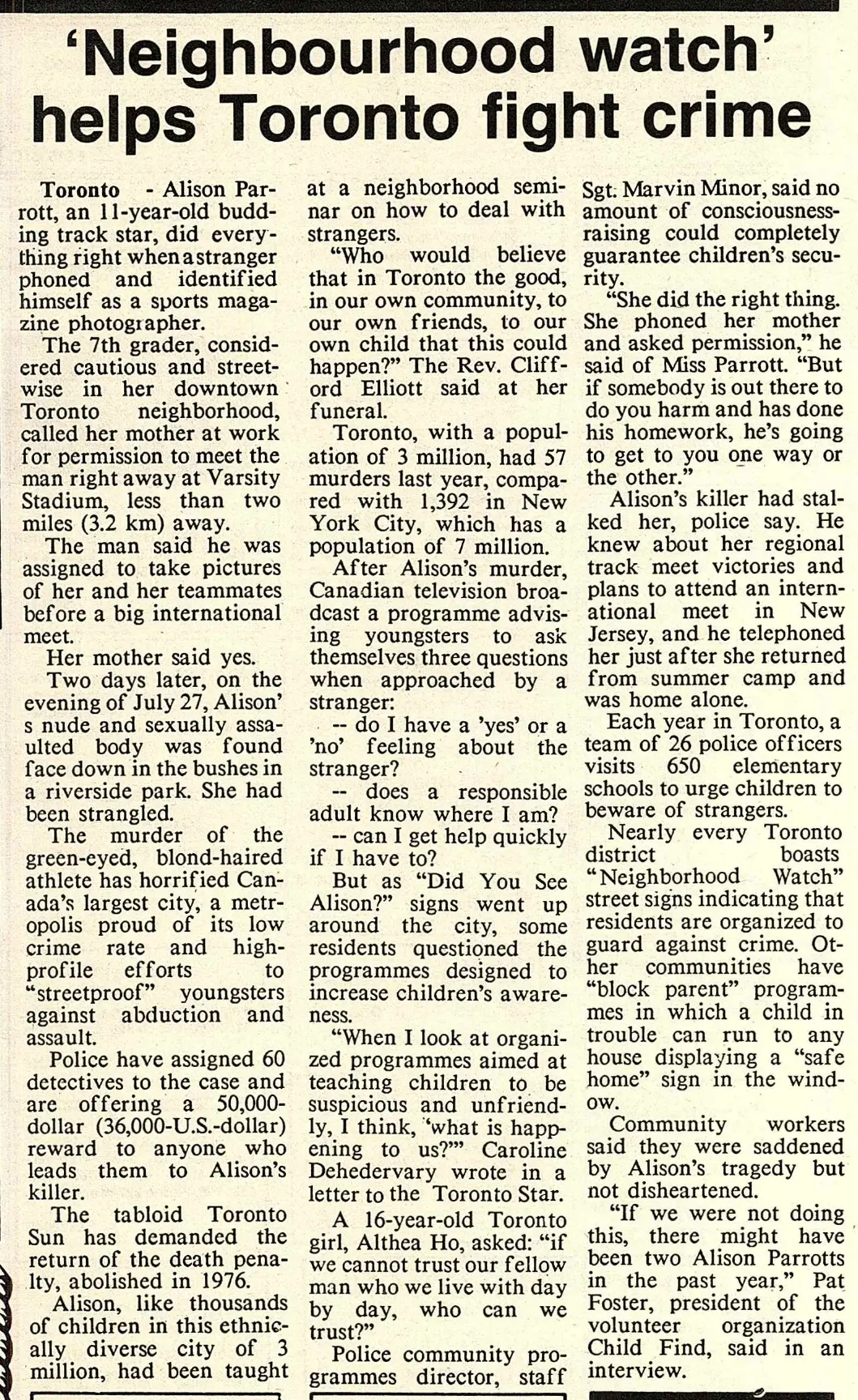
Two days later, on the evening of July 27, Alison's nude and sexually assaulted body was found face down in the bushes in a riverside park. She had been strangled.
The murder of the green-eyed, blond-haired athlete has horrified Canada's largest city, a metropolis proud of its low crime rate and high-profile efforts to "streetproof" youngsters against abduction and assault.
Police have assigned 60 detectives to the case and are offering a 50,000-dollar (36,000-U.S.-dollar) reward to anyone who leads them to Alison's killer.
The tabloid Toronto Sun has demanded the return of the death penalty, abolished in 1976. Alison, like thousands of children in this ethnically diverse city of 3 million, had been taught at a neighborhood seminar on how to deal with strangers.
"Who would believe that in Toronto the good, in our own community, to our own friends, to our own child that this could happen?" The Rev. Clifford Elliott said at her funeral.
Toronto, with a population of 3 million, had 57 murders last year, compared with 1,392 in New York City, which has a population of 7 million.
After Alison's murder, Canadian television broadcast a programme advising youngsters to ask themselves three questions when approached by a stranger: do I have a 'yes' or a 'no' feeling about the stranger? does a responsible adult know where I am? can I get help quickly if I have to?
But as "Did You See Alison?" signs went up around the city, some residents questioned the programmes designed to increase children's awareness. "When I look at organized programmes aimed at teaching children to be suspicious and unfriendly, I think, "what is happening to us?" Caroline Dehedervary wrote in a letter to the Toronto Star.
A 16-year-old Toronto girl, Althea Ho, asked: "if we cannot trust our fellow man who we live with day by day, who can we trust?"
Police community programmes director, staff Sgt. Marvin Minor, said no amount of consciousness-raising could completely guarantee children's security.
"She did the right thing. She phoned her mother and asked permission," he said of Miss Parrott. "But if somebody is out there to do you harm and has done his homework, he's going to get to you one way or the other."
Alison's killer had stalked her, police say. He knew about her regional track meet victories and plans to attend an international meet in New Jersey, and he telephoned her just after she returned from summer camp and was home alone.
Each year in Toronto, a team of 26 police officers visits 650 elementary schools to urge children to beware of strangers.
Nearly every Toronto district boasts "Neighborhood Watch" street signs indicating that residents are organized to guard against crime. Other communities have "block parent" programmes in which a child in trouble can run to any house displaying a "safe home" sign in the window. Community workers said they were saddened by Alison's tragedy but not disheartened.
"If we were not doing this, there might have been two Alison Parrotts in the past year," Pat Foster, president of the volunteer organization Child Find, said in an interview.