The cookie monster says... Reagan's no Santa Claus
About the article
This is a digitised version of an article from The Cayman Compass's print archive. Occasionally, the digitisation process introduces transcription errors, or other problems.
See the article in its original context from August 1986.
Brought to you by

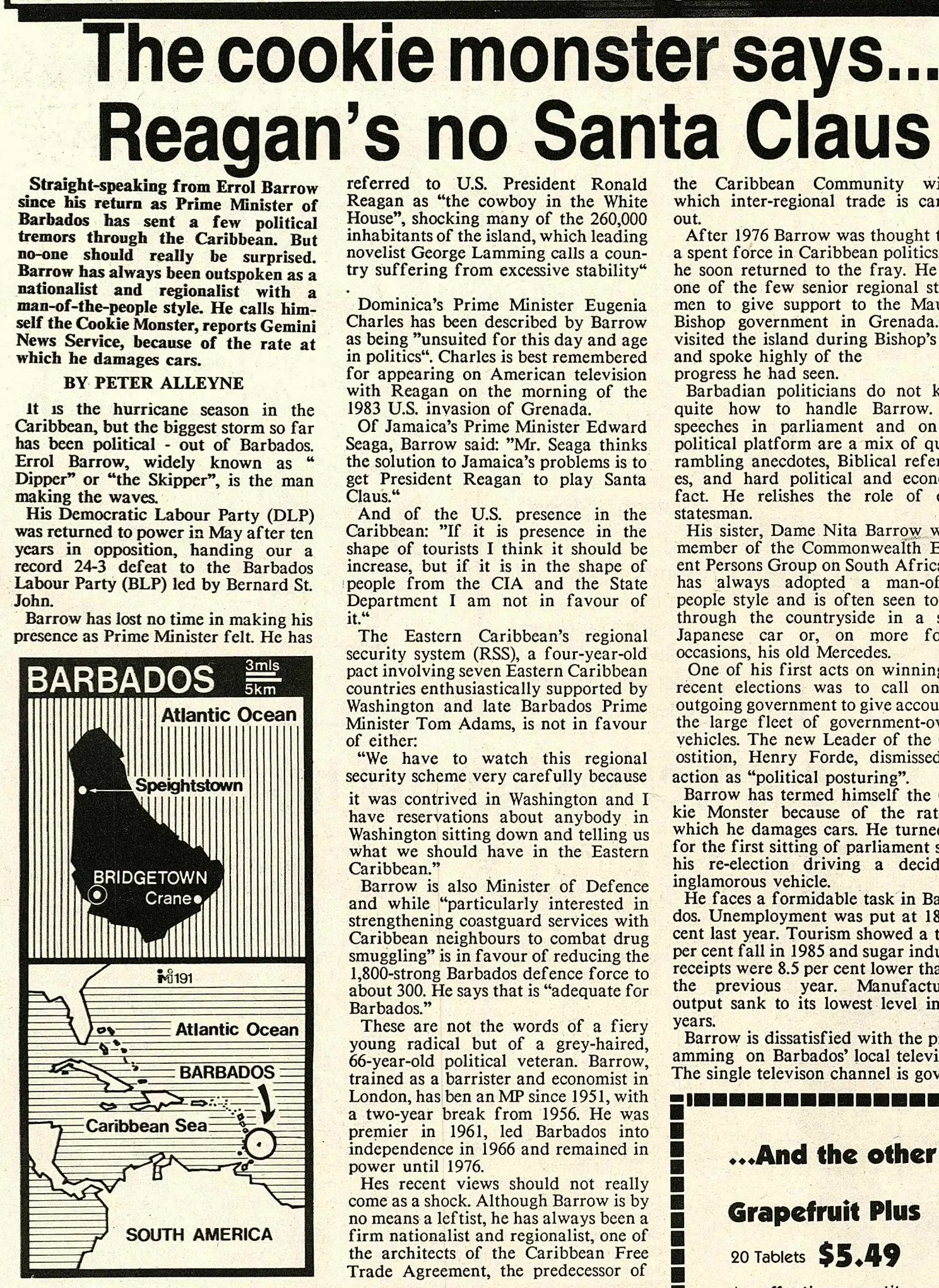
Barrow has always been outspoken as a nationalist and regionalist with a man-of-the-people style. He calls himself the Cookie Monster, reports Gemini News Service, because of the rate at which he damages cars.
BY PETER ALLEYNE
It is the hurricane season in the Caribbean, but the biggest storm so far has been political - out of Barbados.
Errol Barrow, widely known as “Dipper" or "the Skipper", is the man making the waves.
His Democratic Labour Party (DLP) was returned to power in May after ten years in opposition, handing our a record 24-3 defeat to the Barbados Labour Party (BLP) led by Bernard St. John.
Barrow has lost no time in making his presence as Prime Minister felt. He has referred to U.S. President Ronald Reagan as "the cowboy in the White House", shocking many of the 260,000 inhabitants of the island, which leading novelist George Lamming calls a country suffering from excessivestability" Dominica's Prime Minister Eugenia Charles has been described by Barrow as being "unsuited for this day and age in politics". Charles is best remembered for appearing on American television with Reagan on the morning of the 1983 U.S. invasion of Grenada.
Of Jamaica's Prime Minister Edward Seaga, Barrow said: "Mr. Seaga thinks the solution to Jamaica's problems is to get President Reagan to play Santa Claus."
And of the U.S. presence in the Caribbean: "If it is presence in the shape of tourists I think it should be increase, but if it is in the shape of people from the CIA and the State Department I am not in favour of it." The Eastern Caribbean's regional security system (RSS), a four-year-old pact involving seven Eastern Caribbean countries enthusiastically supported by Washington and late Barbados Prime Minister Tom Adams, is not in favour of either:
"We have to watch this regional security scheme very carefully because it was contrived in Washington and I have reservations about anybody in Washington sitting down and telling us what we should have in the Eastern Caribbean."
Barrow is also Minister of Defence and while "particularly interested in strengthening coastguard services with Caribbean neighbours to combat drug smuggling" is in favour of reducing the 1,800-strong Barbados defence force to about 300. He says that is "adequate for Barbados."
These are not the words of a fiery young radical but of a grey-haired, 66-year-old political veteran. Barrow, trained as a barrister and economist in London, has ben an MP since 1951, with a two-year break from 1956. He was premier in 1961, led Barbados into independence in 1966 and remained in power until 1976.
Hes recent views should not really come as a shock. Although Barrow is by no means a leftist, he has always been a firm nationalist and regionalist, one of the architects of the Caribbean Free Trade Agreement, the predecessor of