The pleasure of Snook
About the article
This is a digitised version of an article from The Cayman Compass's print archive. Occasionally, the digitisation process introduces transcription errors, or other problems.
See the article in its original context from September 1986.
Brought to you by

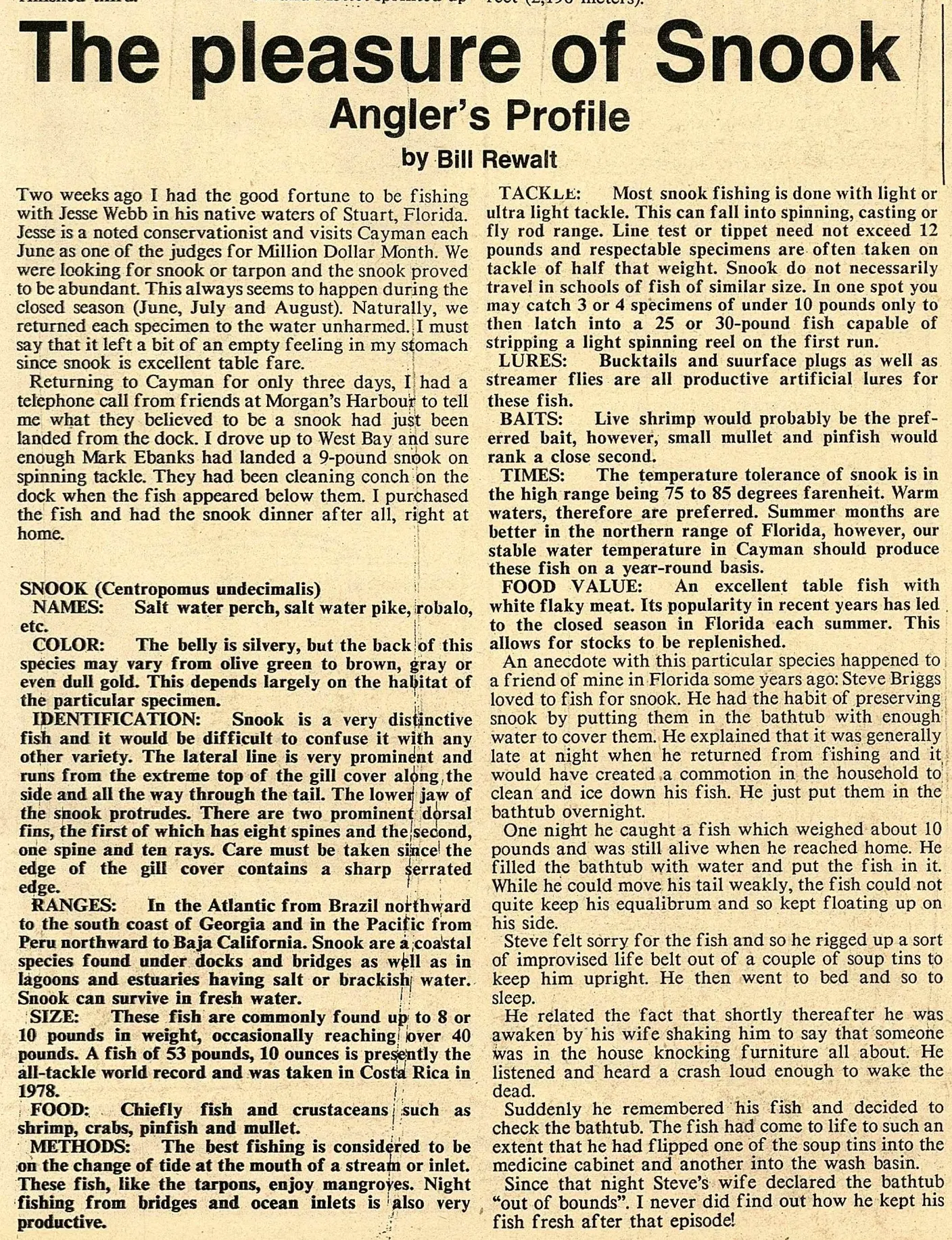
Returning to Cayman for only three days, I had a telephone call from friends at Morgan's Harbour to tell me what they believed to be a snook had just been landed from the dock. I drove up to West Bay and sure enough Mark Ebanks had landed a 9-pound snook on spinning tackle. They had been cleaning conch on the dock when the fish appeared below them. I purchased the fish and had the snook dinner after all, right at home. SNOOK (Centropomus undecimalis) NAMES: Salt water perch, salt water pike, robalo, etc.
COLOR: The belly is silvery, but the back of this species may vary from olive green to brown, gray or even dull gold. This depends largely on the habitat of the particular specimen.
IDENTIFICATION: Snook is a very distinctive fish and it would be difficult to confuse it with any other variety. The lateral line is very prominent and runs from the extreme top of the gill cover along the side and all the way through the tail. The lower jaw of the snook protrudes. There are two prominent dorsal fins, the first of which has eight spines and the second, one spine and ten rays. Care must be taken since the edge of the gill cover contains a sharp serrated edge.
RANGES: In the Atlantic from Brazil northward to the south coast of Georgia and in the Pacific from Peru northward to Baja California. Snook are a coastal species found under docks and bridges as well as in lagoons and estuaries having salt or brackish water. Snook can survive in fresh water.
SIZE: These fish are commonly found up to 8 or 10 pounds in weight, occasionally reaching over 40 pounds. A fish of 53 pounds, 10 ounces is presently the all-tackle world record and was taken in Costa Rica in 1978.
FOOD: Chiefly fish and crustaceans such as shrimp, crabs, pinfish and mullet.
METHODS: The best fishing is considered to be on the change of tide at the mouth of a stream or inlet. These fish, like the tarpons, enjoy mangroves. Night fishing from bridges and ocean inlets is also very productive. TACKLE: Most snook fishing is done with light or ultralight tackle. This can fall into spinning, casting or fly rod range. Line test or tippet need not exceed 12 pounds and respectable specimens are often taken on tackle of half that weight. Snook do not necessarily travel in schools of fish of similar size. In one spot you may catch 3 or 4 specimens of under 10 pounds only to then latch into a 25 or 30-pound fish capable of stripping a light spinning reel on the first run.
LURES: Bucktails and suurface plugs as well as streamer flies are all productive artificial lures for these fish.
BAITS: Live shrimp would probably be the preferred bait, however, small mullet and pinfish would rank a close second.
TIMES: The temperature tolerance of snook is in the high range being 75 to 85 degrees farenheit. Warm waters, therefore are preferred. Summer months are better in the northern range of Florida, however, our stable water temperature in Cayman should produce these fish on a year-round basis.
FOOD VALUE: An excellent table fish with white flaky meat. Its popularity in recent years has led to the closed season in Florida each summer. This allows for stocks to be replenished.
An anecdote with this particular species happened to a friend of mine in Florida some years ago: Steve Briggs loved to fish for snook. He had the habit of preserving snook by putting them in the bathtub with enough water to cover them. He explained that it was generally late at night when he returned from fishing and it would have created a commotion in the household to clean and ice down his fish. He just put them in the bathtub overnight.
One night he caught a fish which weighed about 10 pounds and was still alive when he reached home. He filled the bathtub with water and put the fish in it. While he could move his tail weakly, the fish could not quite keep his equalibrum and so kept floating up on his side.
Steve felt sorry for the fish and so he rigged up a sort of improvised life belt out of a couple of soup tins to keep him upright. He then went to bed and so to sleep.
He related the fact that shortly thereafter he was awaken by his wife shaking him to say that someone was in the house knocking furniture all about. He listened and heard a crash loud enough to wake the dead.
Suddenly he remembered his fish and decided to check the bathtub. The fish had come to life to such an extent that he had flipped one of the soup tins into the medicine cabinet and another into the wash basin.
Since that night Steve's wife declared the bathtub "out of bounds". I never did find out how he kept his fish fresh after that episode!