What cruise lines look for when choosing ports of call
About the article
This is a digitised version of an article from The Cayman Compass's print archive. Occasionally, the digitisation process introduces transcription errors, or other problems.
See the article in its original context from October 1986.
Brought to you by

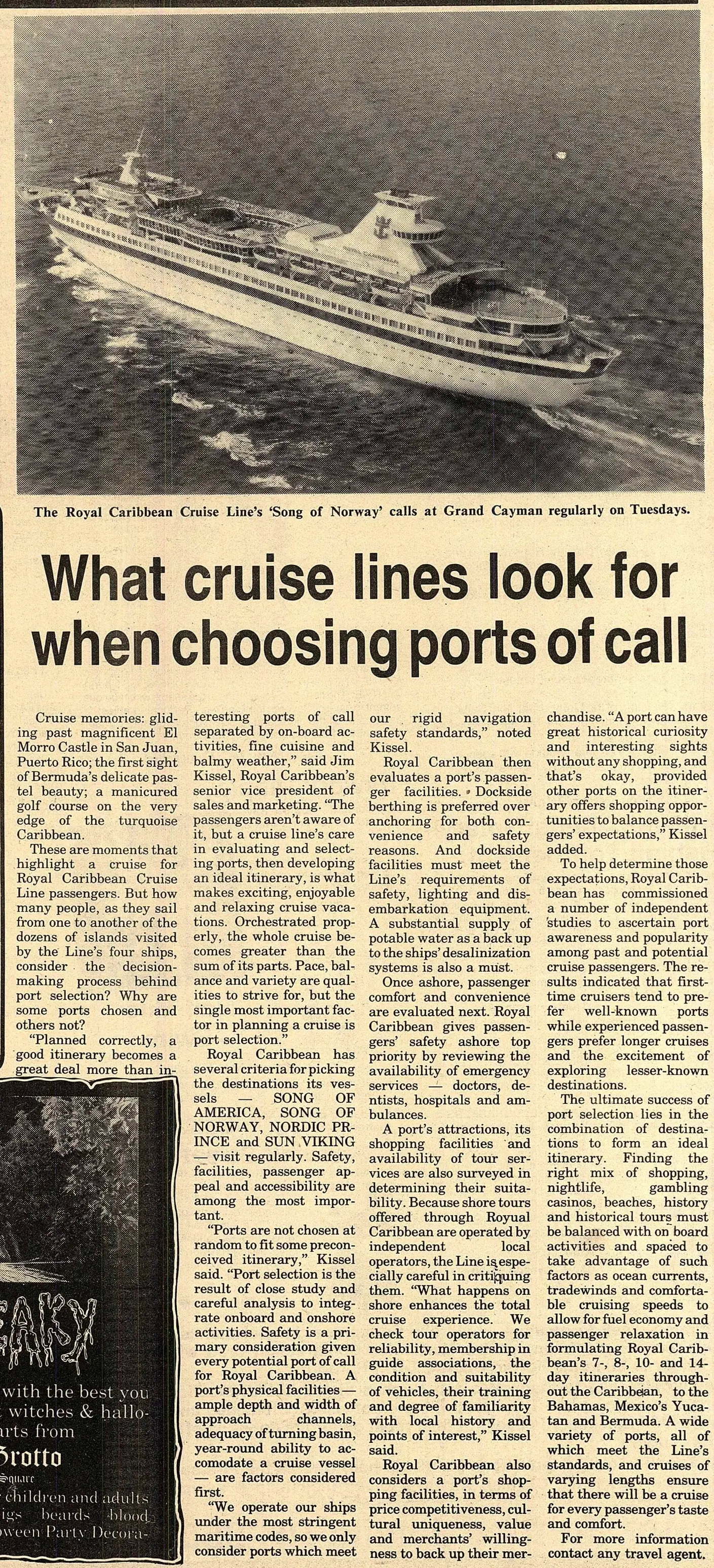
These are moments that highlight a cruise for Royal Caribbean Cruise Line passengers. But how many people, as they sail from one to another of the dozens of islands visited by the Line's four ships, consider the decisionmaking process behind port selection? Why are some ports chosen and others not?
"Planned correctly, a good itinerary becomes a great deal more than interesting ports of call separated by on-board activities, fine cuisine and balmy weather," said Jim Kissel, Royal Caribbean's senior vice president of sales and marketing. "The passengers aren't aware of it, but a cruise line's care in evaluating and selecting ports, then developing an ideal itinerary, is what makes exciting, enjoyable and relaxing cruise vacations. Orchestrated properly, the whole cruise becomes greater than the sum of its parts. Pace, balance and variety are qualities to strive for, but the single most important factor in planning a cruise is port selection."
Royal Caribbean has several criteria for picking the destinations its vessels - SONG OF AMERICA, SONG OF NORWAY, NORDIC PRINCE and SUN VIKING - visit regularly. Safety, facilities, passenger appeal and accessibility are among the most important.
"Ports are not chosen at random to fit some preconceived itinerary," Kissel said. "Port selection is the result of close study and careful analysis to integrate onboard and onshore activities. Safety is a primary consideration given every potential port of call for Royal Caribbean. A port's physical facilities - ample depth and width of approach channels, adequacy of turning basin, year-round ability to accomodate a cruise vessel - are factors considered first. "We operate our ships under the most stringent maritime codes, so we only consider ports which meet our rigid navigation safety standards," noted Kissel.
Royal Caribbean then evaluates a port's passenger facilities. Dockside berthing is preferred over anchoring for both convenience and safety reasons. And dockside facilities must meet the Line's requirements of safety, lighting and disembarkation equipment. A substantial supply of potable water as a back up to the ships' desalinization systems is also a must.
Once ashore, passenger comfort and convenience are evaluated next. Royal Caribbean gives passengers' safety ashore top priority by reviewing the availability of emergency services doctors, dentists, hospitals and ambulances.
A port's attractions, its shopping facilities and availability of tour services are also surveyed in determining their suitability. Because shore tours offered through Royual Caribbean are operated by independent local operators, the Line is especially careful in critiquing them. "What happens on shore enhances the total cruise experience. We check tour operators for reliability, membership in guide associations, the condition and suitability of vehicles, their training and degree of familiarity with local history and points of interest," Kissel said.
Royal Caribbean also considers a port's shopping facilities, in terms of price competitiveness, cultural uniqueness, value and merchants' willingness to back up their merchandise. "A port can have great historical curiosity and interesting sights without any shopping, and that's okay, provided other ports on the itinerary offers shopping opportunities to balance passengers' expectations," Kissel added.
To help determine those expectations, Royal Caribbean has commissioned a number of independent 'studies to ascertain port awareness and popularity among past and potential cruise passengers. The results indicated that first-time cruisers tend to prefer well-known ports while experienced passengers prefer longer cruises and the excitement of exploring lesser-knowndestinations.
The ultimate success of port selection lies in the combination of destinations to form an ideal itinerary. Finding the right mix of shopping, nightlife, gambling casinos, beaches, history and historical tours must be balanced with on board activities and spaced to take advantage of such factors as ocean currents, tradewinds and comfortable cruising speeds to allow for fuel economy and passenger relaxation in formulating Royal Caribbean's 7-, 8-, 10- and 14-day itineraries throughout the Caribbean, to the Bahamas, Mexico's Yucatan and Bermuda. A wide variety of ports, all of which meet the Line's standards, and cruises of varying lengths ensure that there will be a cruise for every passenger's taste and comfort.
For more information contact any travel agent.