Mystery surrounds deaths of British military scientists
About the article
This is a digitised version of an article from The Cayman Compass's print archive. Occasionally, the digitisation process introduces transcription errors, or other problems.
See the article in its original context from April 1987.
Brought to you by

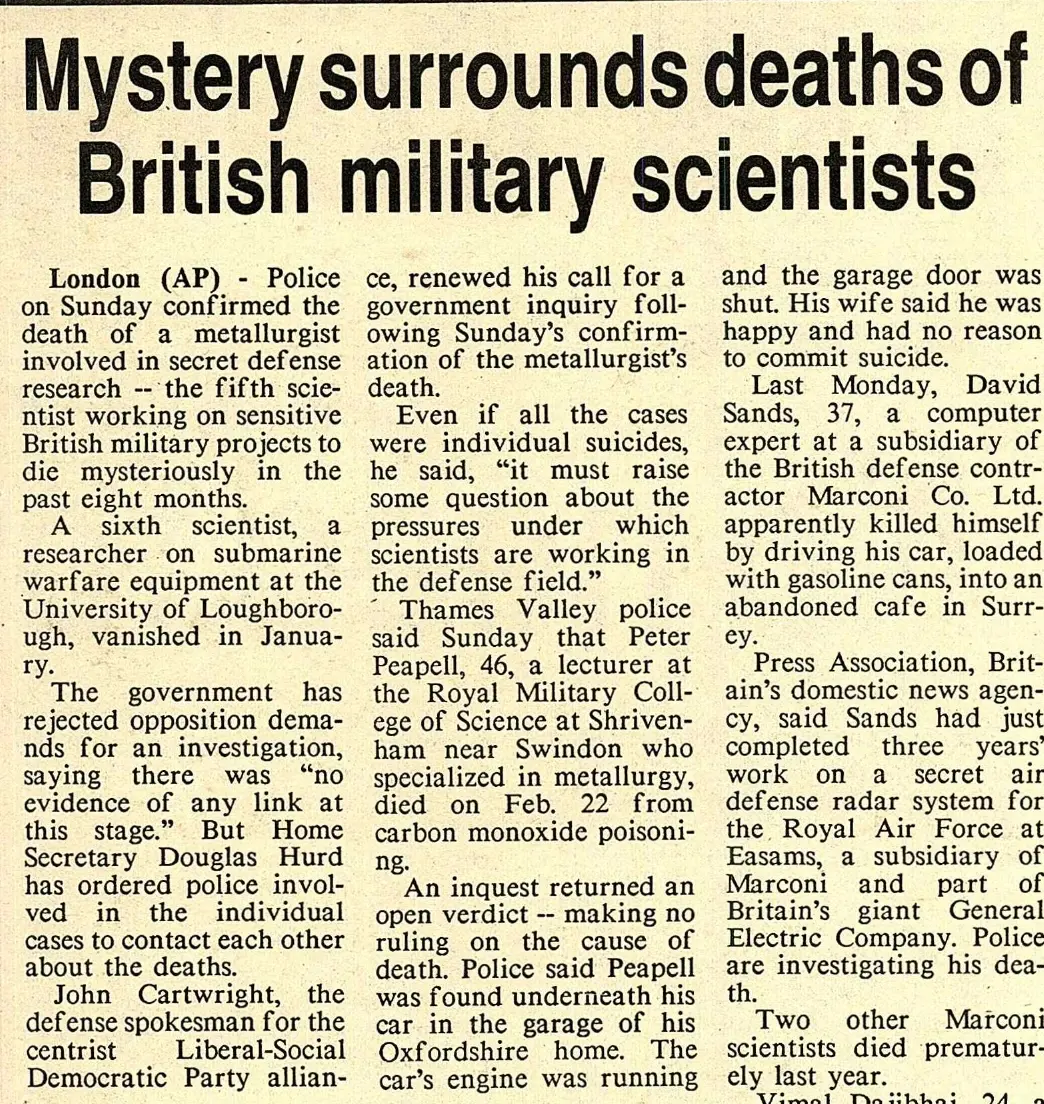
A sixth scientist, a researcher on submarine warfare equipment at the University of Loughborough, vanished in January. The government has rejected opposition demands for an investigation, saying there was "no evidence of any link at this stage." But Home Secretary Douglas Hurd has ordered police involved in the individual cases to contact each other about the deaths.
John Cartwright, the defense spokesman for the centrist Liberal-Social Democratic Party allian. ce, renewed his call for a government inquiry following Sunday's confirmation of the metallurgist's death.
Even if all the cases were individual suicides, he said, "it must raise some question about the pressures under which scientists are working in the defense field."
Thames Valley police said Sunday that Peter Peapell, 46, a lecturer at the Royal Military College of Science at Shrivenham near Swindon who specialized in metallurgy, died on Feb. 22 from carbon monoxide poisoning. An inquest returned an open verdict -- making no ruling on the cause of death. Police said Peapell was found underneath his car in the garage of his Oxfordshire home. The car's engine was running and the garage door was shut. His wife said he was happy and had no reason to commit suicide.
Last Monday, David Sands, 37, a computer expert at a subsidiary of the British defense contractor Marconi Co. Ltd. apparently killed himself by driving his car, loaded with gasoline cans, into an abandoned cafe in Surrey. Press Association, Britain's domestic news agency, said Sands had just completed three years' work on a secret air defense radar system for the Royal Air Force at Easams, a subsidiary of Marconi and part of Britain's giant General Electric Company.
Police are investigating his death. Two other Marconi scientists died prematurely last year.
Vimal Dajibhai, 24, a programmemer with Marconi underwater systems, was found dead last August beath a suspension bridge spanning the River Avon in Bristol, Western England.
Relatives and friends testified he had no reason to commit suicide and an inquest returned an open verdict.
Ashad Sharif, 26, a computer expert with Marconi Defense Systems, died near Bristol in October. He apparently tied one end of a rope to a tree, the other around his neck, got into his car and drove off, strangling himself. An inquest returned a verdict of suicide.
Richard Pugh, a computer design expert, was found dead in his home in Essex in January. The circumstance of his death have never been explained. A seventh scientist, Avtar Singh-Gida, 26, disappeared in January in Northern England while conducting experiments on underwater acoustics.
His disappearance is under police investigation.