We are crabs in a barrel, says soccer coach
About the article
This is a digitised version of an article from The Cayman Compass's print archive. Occasionally, the digitisation process introduces transcription errors, or other problems.
See the article in its original context from November 1987.
Brought to you by

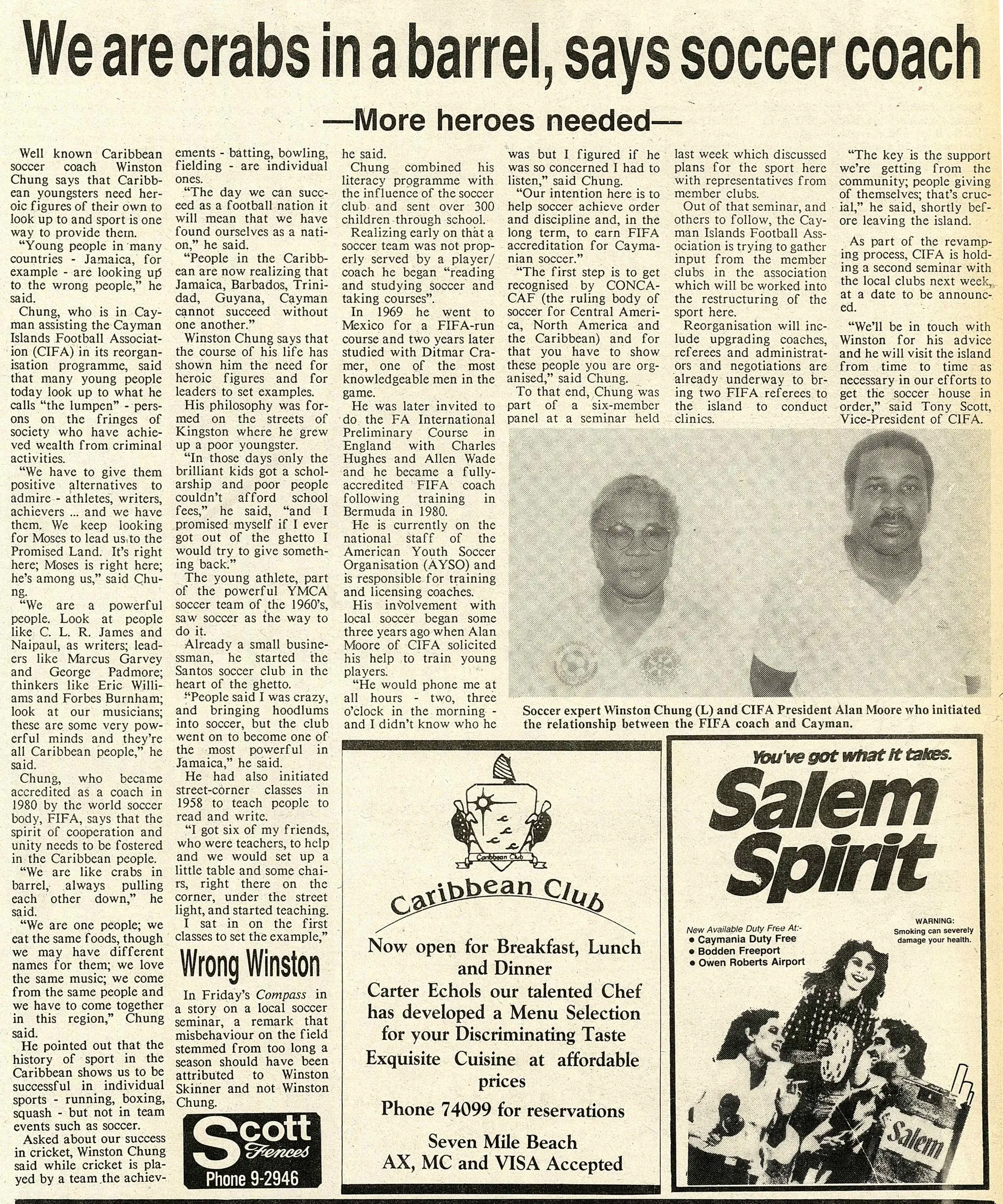
"Young people in many countries - Jamaica, for example - are looking up to the wrong people," he said.
Chung, who is in Cayman assisting the Cayman Islands Football Association (CIFA) in its reorganisation programme, said that many young people today look up to what he calls "the lumpen" - persons on the fringes of society who have achieved wealth from criminal activities.
"We have to give them positive alternatives to admire-athletes, writers, achievers ... and we have them. We keep looking for Moses to lead us to the Promised Land. It's right here; Moses is right here; he's among us," said Chung. "We are a powerful people. Look at people like C. L. R. James and Naipaul, as writers; leaders like Marcus Garvey and George Padmore; thinkers like Eric Williams and Forbes Burnham; look at our musicians; these are some very powerful minds and they're all Caribbean people," he said.
Chung, who became accredited as a coach in 1980 by the world soccer body, FIFA, says that the spirit of cooperation and unity needs to be fostered in the Caribbean people. "We are like crabs in barrel, always pulling each other down," he said.
"We are one people; we eat the same foods, though we may have different names for them; we love the same music; we come from the same people and we have to come together in this region," Chung said.
He pointed out that the history of sport in the Caribbean shows us to be successful in individual sports - running, boxing, squash - but not in team events such as soccer.
Asked about our success in cricket, Winston Chung said while cricket is played by a team the achievements - batting, bowling, fielding - are individual ones.
"The day we can succeed as a football nation it will mean that we have found ourselves as a nation," he said.
"People in the Caribbean are now realizing that Jamaica, Barbados, Trinidad, Guyana, Cayman cannot succeed without one another."
Winston Chung says that the course of his life has shown him the need for heroic figures and for leaders to set examples. His philosophy was formed on the streets of Kingston where he grew up a poor youngster.
"In those days only the brilliant kids got a scholarship and poor people couldn't afford school fees," he said, "and I promised myself if I ever got out of the ghetto I would try to give something back."
The young athlete, part of the powerful YMCA soccer team of the 1960's, saw soccer as the way to do it.
Already a small businessman, he started the Santos soccer club in the heart of the ghetto. "People said I was crazy, and bringing hoodlums into soccer, but the club went on to become one of the most powerful in Jamaica," he said. He had also initiated street-corner classes in 1958 to teach people to read and write.
"I got six of my friends, who were teachers, to help and we would set up a little table and some chairs, right there on the corner, under the street light, and started teaching. I sat in on the first classes to set the example," he said.
Chung combined his literacy programme with the influence of the soccer club and sent over 300 children through school. Realizing early on that a soccer team was not properly served by a player/coach he began "reading and studying soccer and taking courses".
In 1969 he went to Mexico for a FIFA-run course and two years later studied with Ditmar Cramer, one of the most knowledgeable men in the game.
He was later invited to do the FA International Preliminary Course in England with Charles Hughes and Allen Wade and he became a fully-accredited FIFA coach following training in Bermuda in 1980.
He is currently on the national staff of the American Youth Soccer Organisation (AYSO) and is responsible for training and licensing coaches. His involvement with local soccer began some three years ago when Alan Moore of CIFA solicited his help to train young players.
"He would phone me at all hours - two, three o'clock in the morning - and I didn't know who he was but I figured if he was so concerned I had to listen," said Chung.
"Our intention here is to help soccer achieve order and discipline and, in the long term, to earn FIFA accreditation for Caymanian soccer."
"The first step is to get recognised by CONCACAF (the ruling body of soccer for Central America, North America and the Caribbean) and for that you have to show these people you are organised," said Chung.
To that end, Chung was part of a six-member panel at a seminar held last week which discussed plans for the sport here with representatives from member clubs.
Out of that seminar, and others to follow, the Cayman Islands Football Association is trying to gather input from the member clubs in the association which will be worked into the restructuring of the sport here.
Reorganisation will include upgrading coaches, referees and administrators and negotiations are already underway to bring two FIFA referees to the island to conduct clinics. "The key is the support we're getting from the community; people giving of themselves; that's crucial," he said, shortly before leaving the island. As part of the revamping process, CIFA is holding a second seminar with the local clubs next week, at a date to be announced. "We'll be in touch with Winston for his advice and he will visit the island from time to time as necessary in our efforts to get the soccer house in order," said Tony Scott, Vice-President of CIFA.