After coup, Haiti appears calm
About the article
This is a digitised version of an article from The Cayman Compass's print archive. Occasionally, the digitisation process introduces transcription errors, or other problems.
See the article in its original context from June 1988.
Brought to you by

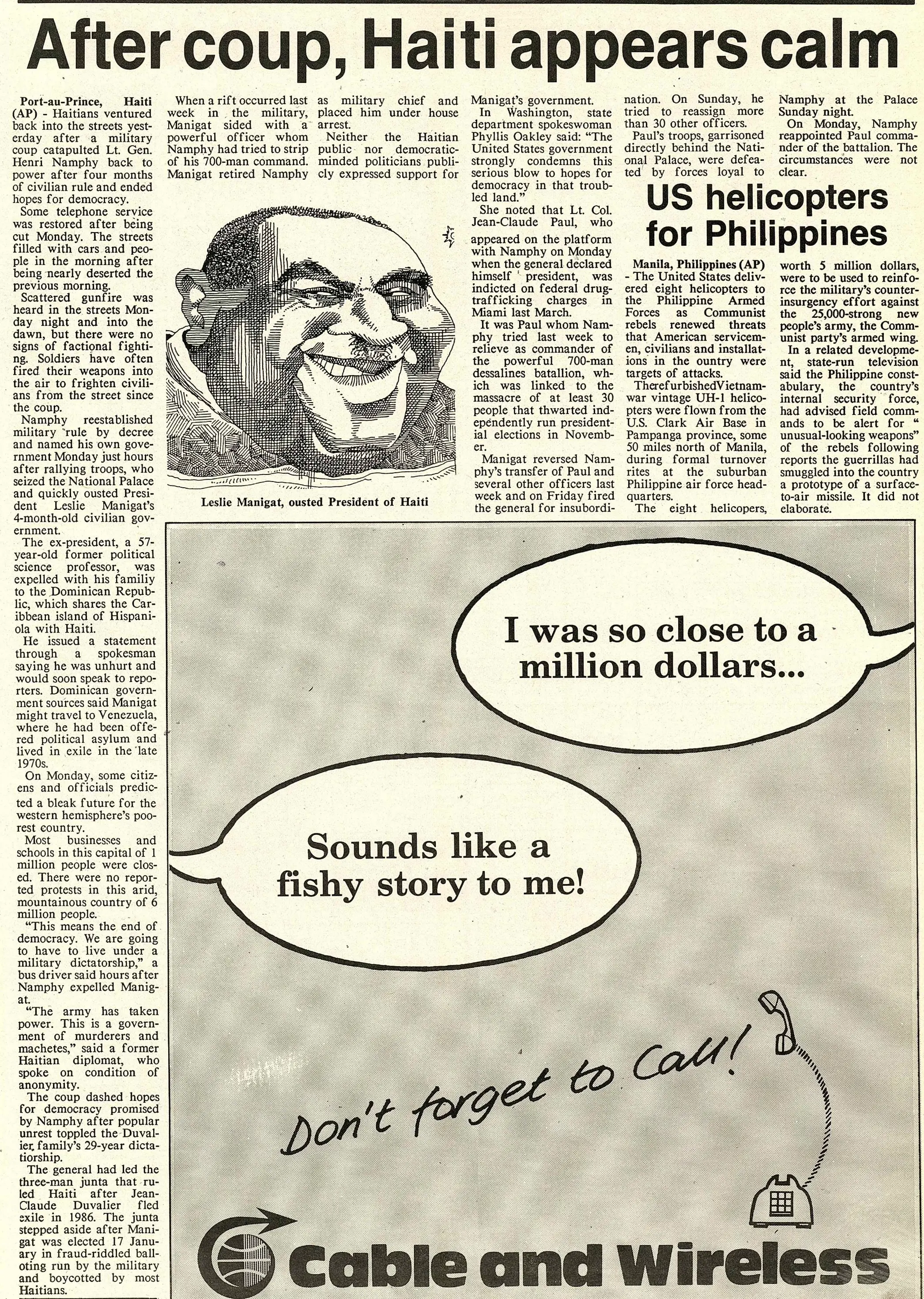
Some telephone service was restored after being cut Monday. The streets filled with cars and people in the morning after being nearly deserted the previous morning. Scattered gunfire was heard in the streets Monday night and into the dawn, but there were no signs of factional fighting. Soldiers have often fired their weapons into the air to frighten civilians from the street since the coup.
Namphy reestablished military rule by decree and named his own government Monday just hours after rallying troops, who seized the National Palace and quickly ousted President Leslie Manigat's 4-month-old civilian government.
The ex-president, a 57-year-old former political science professor, was expelled with his familiy to the Dominican Republic, which shares the Caribbean island of Hispaniola with Haiti. He issued a statement through a spokesman saying he was unhurt and would soon speak to reporters. Dominican government sources said Manigat might travel to Venezuela, where he had been offered political asylum and lived in exile in the late 1970s.
On Monday, some citizens and officials predicted a bleak future for the western hemisphere's poorest country.
Most businesses and schools in this capital of 1 million people were closed. There were no reported protests in this arid, mountainous country of 6 million people.
"This means the end of democracy. We are going to have to live under a military dictatorship," a bus driver said hours after Namphy expelled Manigat. "The army has taken power. This is a government of murderers and machetes," said a former Haitian diplomat, who spoke on condition of anonymity.
The coup dashed hopes for democracy promised by Namphy after popular unrest toppled the Duvalier, family's 29-year dictatorship.
The general had led the three-man junta that ruled Haiti after Jean-Claude Duvalier fled exile in 1986. The junta stepped aside after Manigat was elected 17 January in fraud-riddled balloting run by the military and boycotted by most Haitians. When a rift occurred last week in the military, Manigat sided with a powerful officer whom Namphy had tried to strip of his 700-man command.
Manigat retired Namphy as military chief and placed him under house arrest.
Neither the Haitian public nor democraticminded politicians publicly expressed support for Manigat's government.
In Washington, state department spokeswoman Phyllis Oakley said: "The United States government strongly condemns this serious blow to hopes for democracy in that troubled land."
She noted that Lt. Col. Jean-Claude Paul, who appeared on the platform with Namphy on Monday when the general declared himself president, was indicted on federal drugtrafficking charges in Miami last March.
It was Paul whom Namphy tried last week to relieve as commander of the powerful 700-man dessalines batallion, which was linked to the massacre of at least 30 people that thwarted independently run presidential elections in November. Manigat reversed Namphy's transfer of Paul and several other officers last week and on Friday fired the general for insubordination. nation. On Sunday, he tried to reassign more than 30 other officers.
Paul's troops, garrisoned directly behind the National Palace, were defeated by forces loyal to Namphy at the Palace Sunday night.
On Monday, Namphy reappointed Paul commander of the battalion. The circumstances were not clear.