Stress that stares us in
About the article
This is a digitised version of an article from The Cayman Compass's print archive. Occasionally, the digitisation process introduces transcription errors, or other problems.
See the article in its original context from September 1988.
Brought to you by

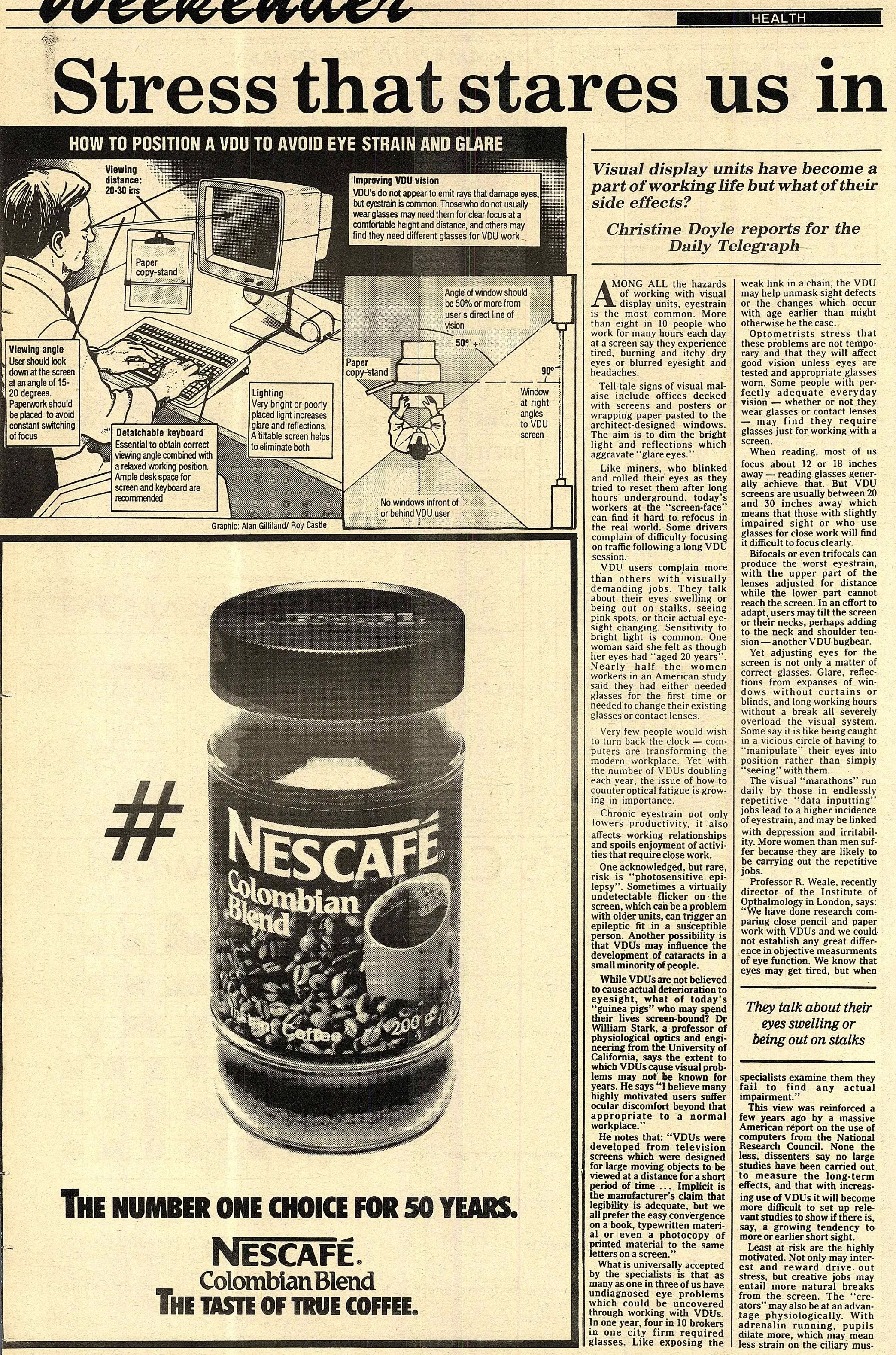
The aim is to dim the bright light and reflections which aggravate "glare eyes." Like miners, who blinked and rolled their eyes as they tried to reset them after long hours underground, today's workers at the "screen-face" can find it hard to refocus in the real world. Some drivers complain of difficulty focusing on traffic following a long VDU session.
VDU users complain more than others with visually demanding jobs. They talk about their eyes swelling or being out on stalks, seeing pink spots, or their actual eyesight changing. Sensitivity to bright light is common. One woman said she felt as though her eyes had "aged 20 years".
Nearly half the women workers in an American study said they had either needed glasses for the first time or needed to change their existing glasses or contact lenses. Very few people would wish to turn back the clock - computers are transforming the modern workplace.
Yet with the number of VDUs doubling each year, the issue of how to counter optical fatigue is growing in importance. Chronic eyestrain not only lowers productivity, it also affects working relationships and spoils enjoyment of activities that require close work.
One acknowledged, but rare, risk is "photosensitive epilepsy". Sometimes a virtually undetectable flicker on the screen, which can be a problem with older units, can trigger an epileptic fit in a susceptible person. Another possibility is that VDUs may influence the development of cataracts in a small minority of people. While VDUs are not believed to cause actual deterioration to eyesight, what of today's "guinea pigs" who may spend their lives screen-bound? Dr William Stark, a professor of physiological optics and engineering from the University of California, says the extent to which VDUs cause visual problems may not be known for years. He says "I believe many highly motivated users suffer ocular discomfort beyond that appropriate to a normal workplace."
He notes that: "VDUs were developed from television screens which were designed for large moving objects to be viewed at a distance for a short period of time.... Implicit is the manufacturer's claim that legibility is adequate, but we all prefer the easy convergence on a book, typewritten material or even a photocopy of printed material to the same letters on a screen."
What is universally accepted by the specialists is that as many as one in three of us have undiagnosed eye problems which could be uncovered through working with VDUs. In one year, four in 10 brokers in one city firm required glasses. Like exposing the weak link in a chain, the VDU may help unmask sight defects or the changes which occur with age earlier than might otherwise be the case.
Optometrists stress that these problems are not temporary and that they will affect good vision unless eyes are tested and appropriate glasses worn. Some people with perfectly adequate everyday vision whether or not they wear glasses or contact lenses - may find they require glasses just for working with a screen.
When reading, most of us focus about 12 or 18 inches away - reading glasses generally achieve that. But VDU screens are usually between 20 and 30 inches away which means that those with slightly impaired sight or who use glasses for close work will find it difficult to focus clearly.
Bifocals or even trifocals can produce the worst eyestrain, with the upper part of the lenses adjusted for distance while the lower part cannot reach the screen. In an effort to adapt, users may tilt the screen or their necks, perhaps adding to the neck and shoulder tension-another VDU bugbear.
Yet adjusting eyes for the screen is not only a matter of correct glasses. Glare, reflections from expanses of windows without curtains or blinds, and long working hours without a break all severely overload the visual system. Some say it is like being caught in a vicious circle of having to "manipulate" their eyes into position rather than simply "seeing" with them.
The visual "marathons" run daily by those in endlessly repetitive "data inputting" jobs lead to a higher incidence of eyestrain, and may be linked with depression and irritability. More women than men suffer because they are likely to be carrying out the repetitive jobs.
Professor R. Weale, recently director of the Institute of Opthalmology in London, says: "We have done research comparing close pencil and paper work with VDUs and we could not establish any great difference in objective measurments of eye function. We know that eyes may get tired, but when They talk about their eyes swelling or being out on stalks specialists examine them they fail to find any actual impairment."
This view was reinforced a few years ago by a massive American report on the use of computers from the National Research Council. None the less, dissenters say no large studies have been carried out to measure the long-term effects, and that with increasing use of VDUs it will become more difficult to set up relevant studies to show if there is, say, a growing tendency to more or earlier short sight.
Least at risk are the highly motivated. Not only may interest and reward drive out stress, but creative jobs may entail more natural breaks from the screen. The "creators" may also be at an advantage physiologically. With adrenalin running, pupils dilate more, which may mean less strain on the ciliary mus