Cuban offensive feared in Angola
About the article
This is a digitised version of an article from The Cayman Compass's print archive. Occasionally, the digitisation process introduces transcription errors, or other problems.
See the article in its original context from September 1988.
Brought to you by

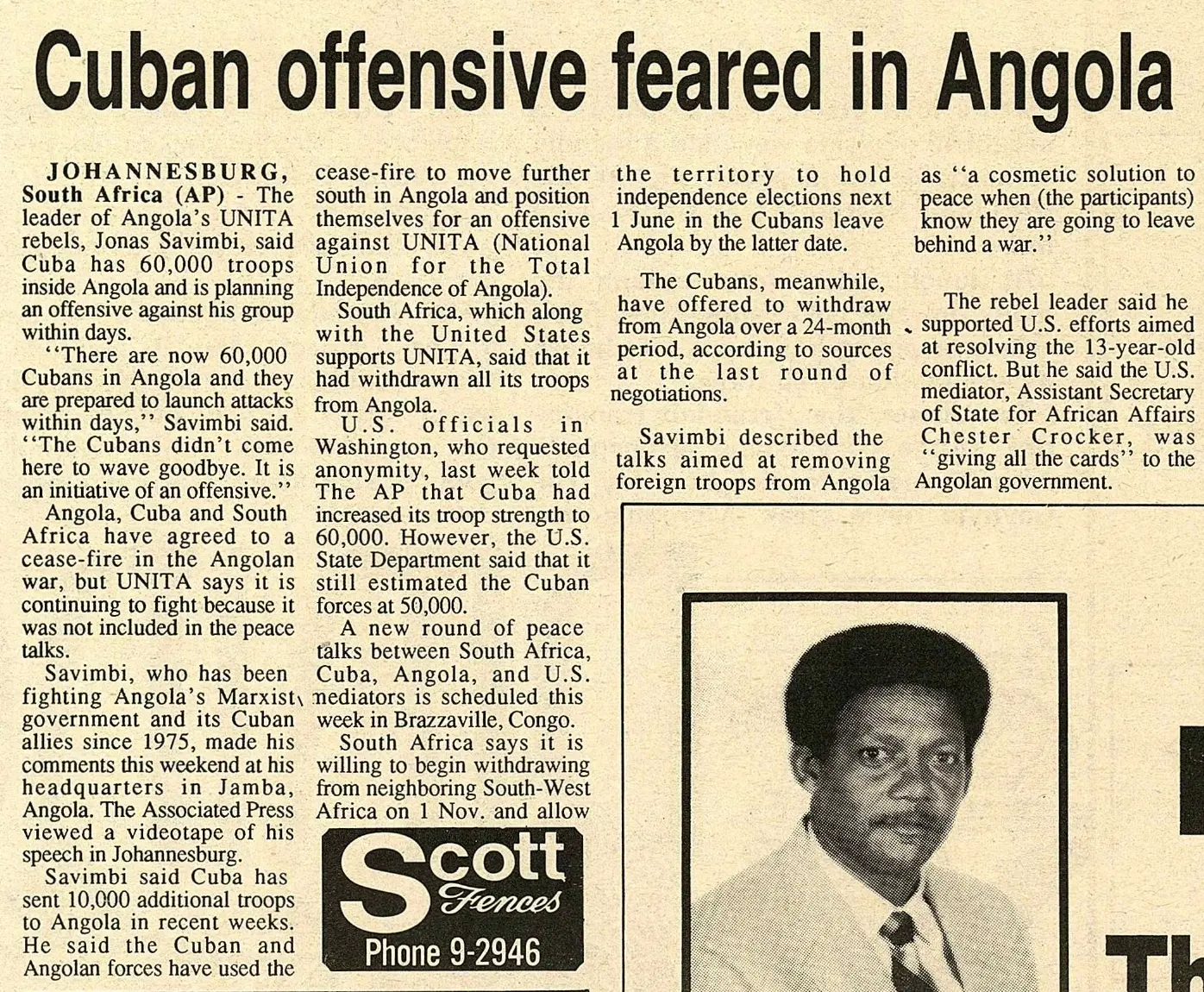
"There are now 60,000 Cubans in Angola and they are prepared to launch attacks within days," Savimbi said. "The Cubans didn't come here to wave goodbye. It is an initiative of an offensive."
Angola, Cuba and South Africa have agreed to a cease-fire in the Angolan war, but UNITA says it is continuing to fight because it was not included in the peace talks.
Savimbi, who has been fighting Angola's Marxist government and its Cuban allies since 1975, made his comments this weekend at his headquarters in Jamba, Angola. The Associated Press viewed a videotape of his speech in Johannesburg.
Savimbi said Cuba has sent 10,000 additional troops to Angola in recent weeks. He said the Cuban and Angolan forces have used the cease-fire to move further south in Angola and position themselves for an offensive against UNITA (National Union for the Total Independence of Angola).
South Africa, which along with the United States supports UNITA, said that it had withdrawn all its troops from Angola.
U.S. officials in Washington, who requested anonymity, last week told The AP that Cuba had increased its troop strength to 60,000. However, the U.S. State Department said that it still estimated the Cuban forces at 50,000.
A new round of peace talks between South Africa, Cuba, Angola, and U.S. mediators is scheduled this week in Brazzaville, Congo. South Africa says it is willing to begin withdrawing from neighboring South-West Africa on 1 Nov. and allow the territory to hold independence elections next 1 June in the Cubans leave Angola by the latter date. The Cubans, meanwhile, have offered to withdraw from Angola over a 24-month period, according to sources at the last round of negotiations. Savimbi described the talks aimed at removing foreign troops from Angola as "a cosmetic solution to peace when (the participants) know they are going to leave behind a war." The rebel leader said he supported U.S. efforts aimed at resolving the 13-year-old conflict. But he said the U.S. mediator, Assistant Secretary of State for African Affairs Chester Crocker, was "giving all the cards" to the Angolan government.