More U.N. peacekeepers
About the article
This is a digitised version of an article from The Cayman Compass's print archive. Occasionally, the digitisation process introduces transcription errors, or other problems.
See the article in its original context from January 1989.
Brought to you by

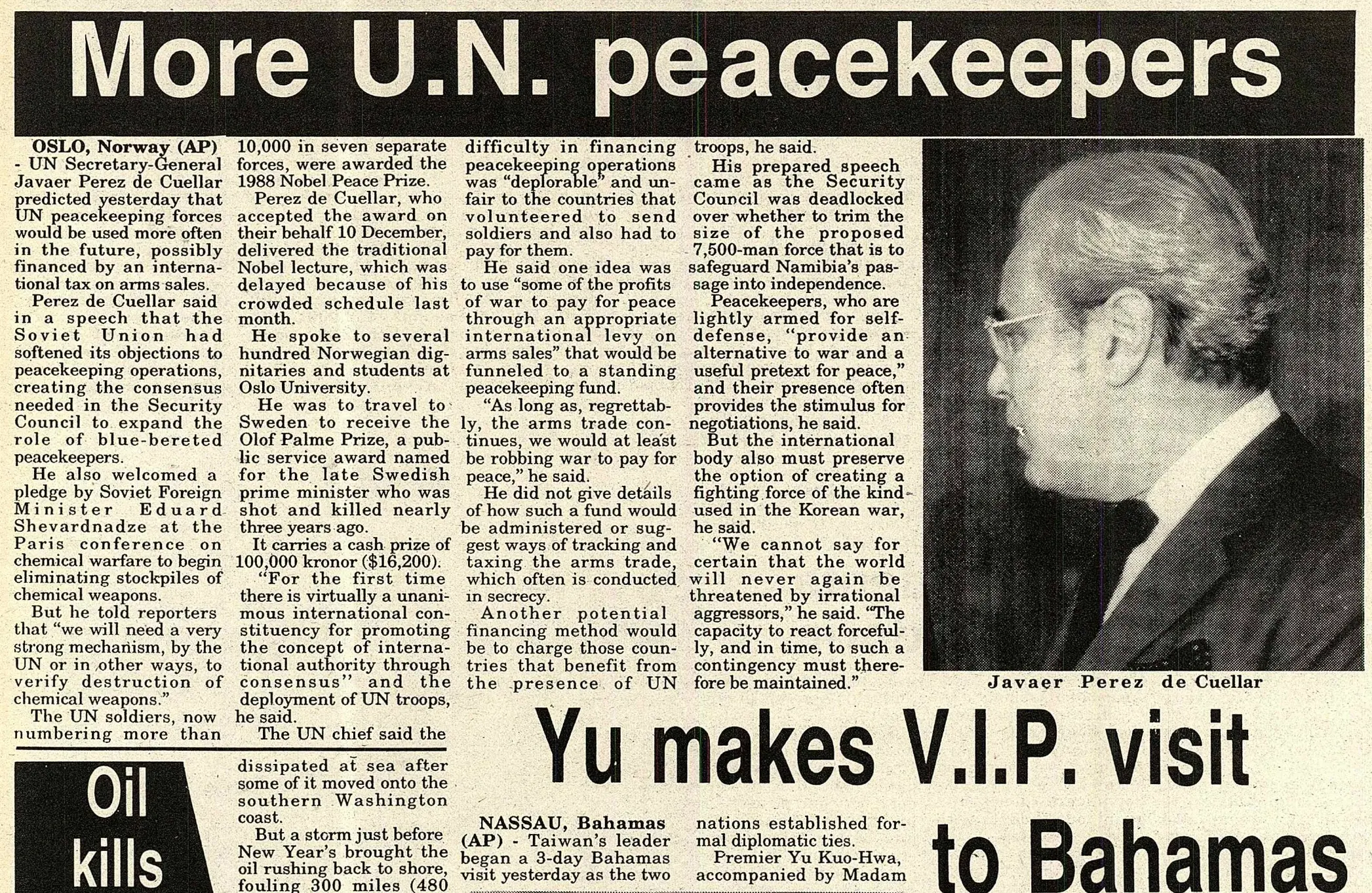
Perez de Cuellar said in a speech that the Soviet Union had softened its objections to peacekeeping operations, creating the consensus needed in the Security Council to expand the role of blue-bereted peacekeepers.
He also welcomed a pledge by Soviet Foreign Minister Eduard Shevardnadze at the Paris conference on chemical warfare to begin eliminating stockpiles of chemical weapons.
But he told reporters that "we will need a very strong mechanism, by the UN or in other ways, to verify destruction of chemical weapons." The UN soldiers, now numbering more than 10,000 in seven separate forces, were awarded the 1988 Nobel Peace Prize. Perez de Cuellar, who accepted the award on their behalf 10 December, delivered the traditional Nobel lecture, which was delayed because of his crowded schedule last month.
He spoke to several hundred Norwegian dignitaries and students at Oslo University.
He was to travel to Sweden to receive the Olof Palme Prize, a public service award named for the late Swedish prime minister who was shot and killed nearly three years ago.
It carries a cash prize of 100,000 kronor ($16,200). "For the first time there is virtually a unanimous international constituency for promoting the concept of international authority through consensus" and the deployment of UN troops, he said.
The UN chief said the difficulty in financing peacekeeping operations was "deplorable" and unfair to the countries that volunteered to send soldiers and also had to pay for them.
He said one idea was to use "some of the profits of war to pay for peace through an appropriate international levy on arms sales" that would be funneled to a standing peacekeeping fund. "As long as, regrettably, the arms trade continues, we would at least be robbing war to pay for peace," he said.
He did not give details of how such a fund would be administered or suggest ways of tracking and taxing the arms trade, which often is conducted in secrecy.
Another potential financing method would be to charge those countries that benefit from the presence of UN troops, he said.
His prepared speech came as the Security Council was deadlocked over whether to trim the size of the proposed 7,500-man force that is to safeguard Namibia's passage into independence.
Peacekeepers, who are lightly armed for self-defense, "provide an alternative to war and a useful pretext for peace," and their presence often provides the stimulus for negotiations, he said.
But the international body also must preserve the option of creating a fighting force of the kind used in the Korean war, he said.
"We cannot say for certain that the world will never again be threatened by irrational aggressors," he said. "The capacity to react forcefully, and in time, to such a contingency must therefore be maintained."