Rodriguez of Paraguay: mystery of his coup remains
About the article
This is a digitised version of an article from The Cayman Compass's print archive. Occasionally, the digitisation process introduces transcription errors, or other problems.
See the article in its original context from March 1989.
Brought to you by

The toppled strongman. General Alfredo Stroessner, had maintained power for 36 years by using an unsavoury blend of brute force, playing competing groups off against each other and liberally distributing funds gained from a highly lucrative smuggling racket to buy loyalty.
Rodriguez was one of Stroessner's right hand men and had latterly been his second-in. command. Their personal relationship through the marriage of their children seemed to emphasise their complicity.
Within one power base, the army, Rodriguez helped Stroessner juggle potential rivals around to stop them building their own power bases, constantly promoting and retiring senior officers. They usually received substantial pensions to keep them happy.
Stroessner also hijacked one of Paraguay's oldest and most influential political parties, the Colorado party, with the aid of Rodrigues, turning it into his personal vehicle for civilian legitimacy.
But, according to political scientist Ernesto Barrios, "somewhere along the line, the apprentice decided to upstage the master for reasons which are at prresent far from clear."
Some say the struggle for influence within the Colorado party was the reason for the coup, with Rodriguez persuaded to side with the "traditionalist" faction which wanted an end to the personality cult which the pro-Stroessner "militant" faction promoted.
The split within the Colorados emerged after the economy started to decline at the turn of this decade on completion of the world's largest hydroelectric project, Itaipu. The multi-billion dollar scheme, financed largely by Brazil, had generated the highest growth rate in the region in the Seventies.
Others say Rodriguez turned against his mentor because Stroessner intended to move him from his post as head of the powerful First Army Corps to a desk job with greatly diminished power in the Defence Ministry.
According to Larry Birns, director of the Council on Hermispheric Affairs, a Washington-based think tank on Latin America, such a move would have weakened his control over Paraguay's highly lucrative contraband industry. With responsibility for customs and border control, the military plays a crucial role in what is officially called "the import-export industry."
Rodriguez is thought to be one of the richest men in Paraguay. His involvement in the contraband industry and drug smuggling is total," says Birns, adding that importation of foreign luxuries like Scotch whisky and American jeans and cigarettes for smuggling to neighbouring Argentina and Brazil is estimated to be worth $1 billion a year, twice the country's GNP. In Birn's view, the coup was a result of a struggle for control of the contraband trade. Yet Ernesto Barrios argues that whatever the reason for the coup, change has come about where no change was expected and this could be a positive event for the country.
Already, the new President has lifted bans on newspapers and radio stations critical of the old regime and has promised to give opposition parties "equal opportunities and full constitutional rights." A staunch critic of the old regime, the Roman Catholic Church has welcomed the change. Nevertheless, there are doubts as to whether the opposition parties so unused to a genuinely competitive political system will be a match for the Colorado party, with its vast clientelistic network.
As Barrios puts it: "Much like Mexico's Revolutionary Institutional party, the Colorado party is an octopus with tentacles embracing all levels of national life. It remains to be seen whether self-interest will maintain the status quo or whether the larger parties like the Liberals will be able to break the stronghold.
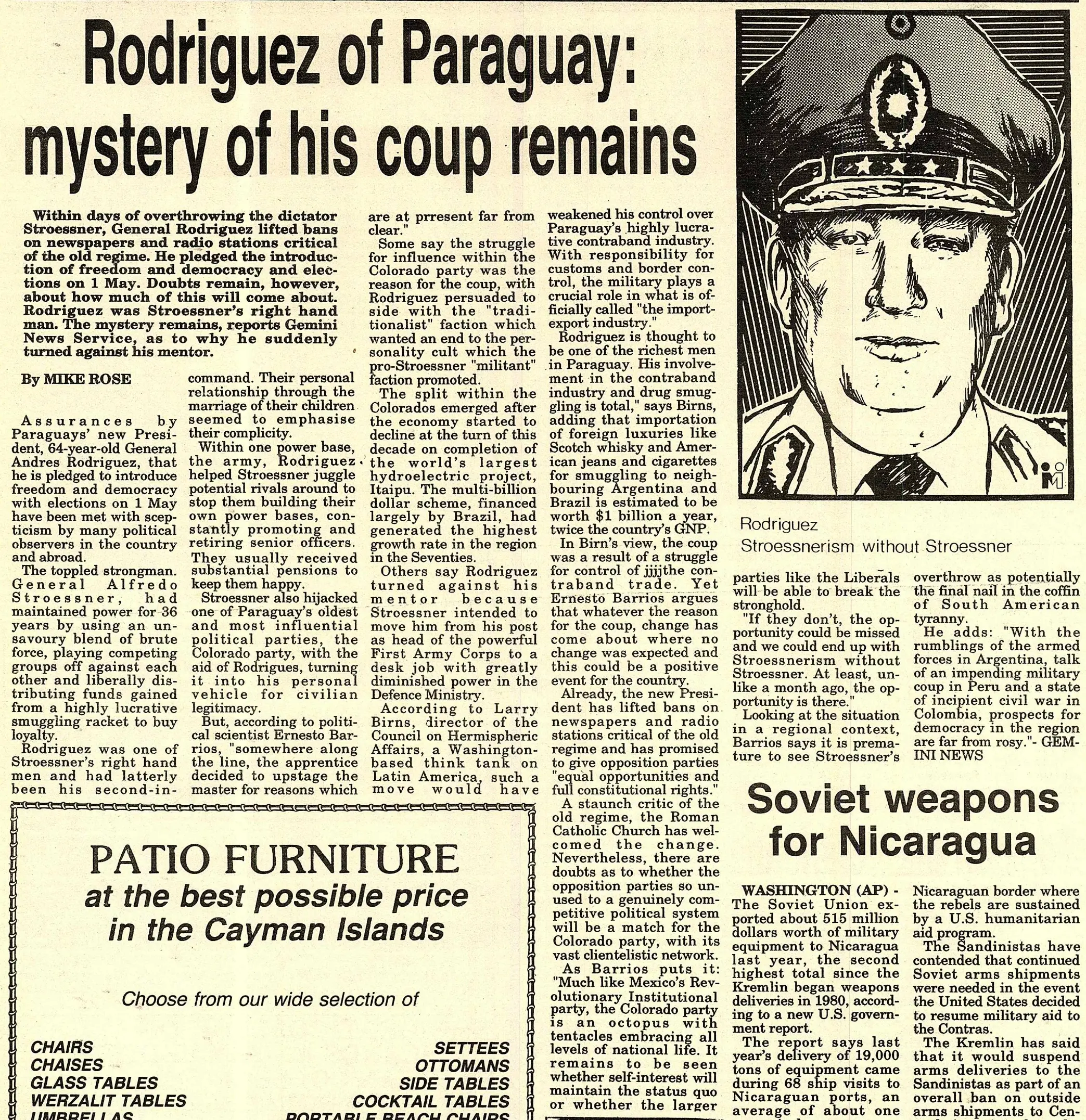
"If they don't, the opportunity could be missed and we could end up with Stroessnerism without Stroessner. At least, unlike a month ago, the opportunity is there."
Looking at the situation in a regional context, Barrios says it is premature to see Stroessner's overthrow as potentially the final nail in the coffin of South American tyranny.
He adds: "With the rumblings of the armed forces in Argentina, talk of an impending military coup in Peru and a state of incipient civil war in Colombia, prospects for democracy in the region are far from rosy."- GEMINI NEWS