Abolition of death penalty urged
About the article
This is a digitised version of an article from The Cayman Compass's print archive. Occasionally, the digitisation process introduces transcription errors, or other problems.
See the article in its original context from April 1989.
Brought to you by

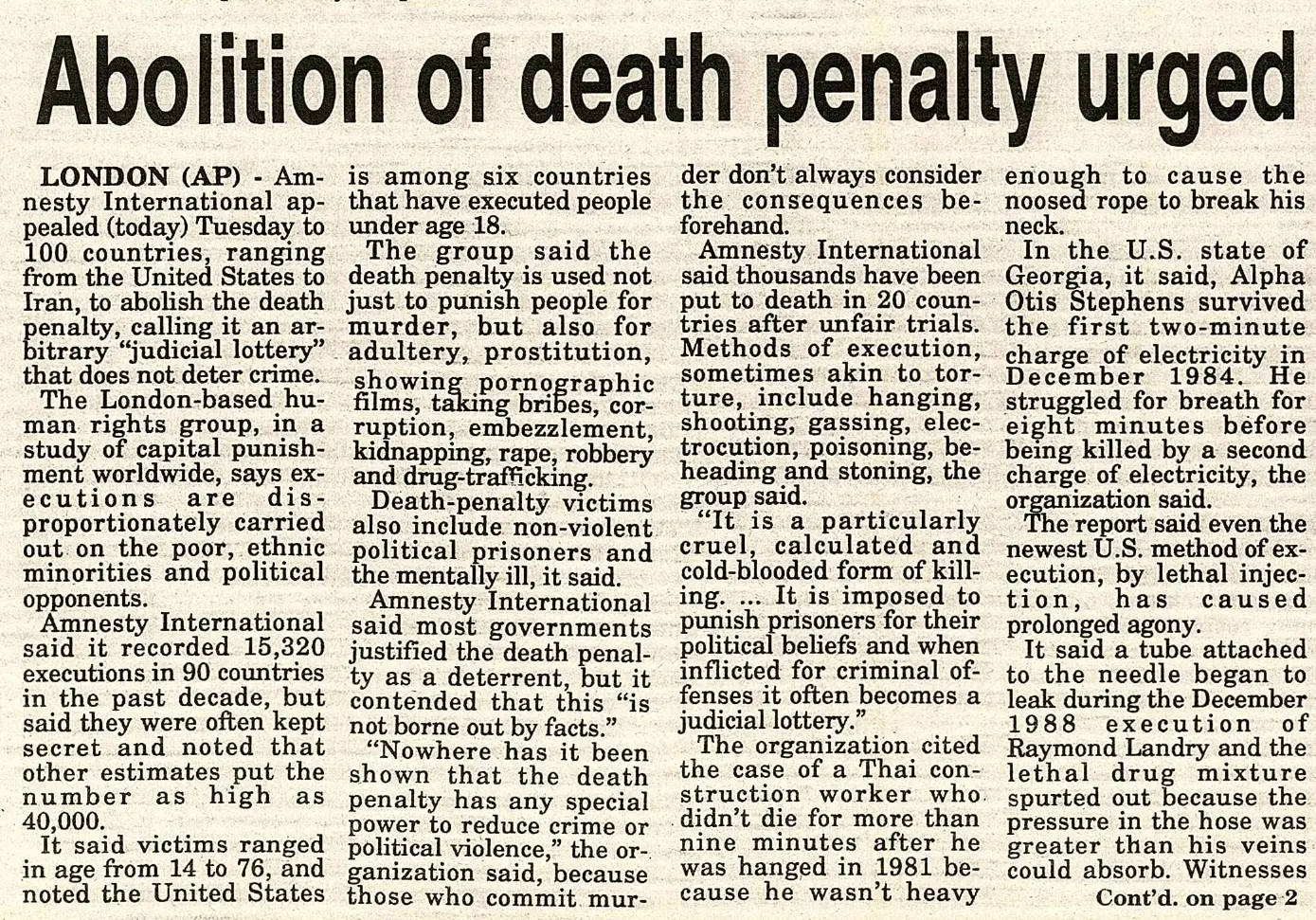
The London-based human rights group, in a study of capital punishment worldwide, says executions are disproportionately carried out on the poor, ethnic minorities and political opponents.
Amnesty International said it recorded 15,320 executions in 90 countries in the past decade, but said they were often kept secret and noted that other estimates put the number as high as 40,000.
It said victims ranged in age from 14 to 76, and noted the United States. is among six countries that have executed people under age 18.
The group said the death penalty is used not just to punish people for murder, but also for adultery, prostitution, showing pornographic films, taking bribes, corruption, embezzlement, kidnapping, rape, robbery and drug-trafficking.
Death-penalty victims also include non-violent political prisoners and the mentally ill, it said.
Amnesty International said most governments justified the death penalty as a deterrent, but it contended that this "is not borne out by facts."
"Nowhere has it been shown that the death penalty has any special power to reduce crime or political violence," the organization said, because those who commit murder don't always consider the consequences beforehand.
Amnesty International said thousands have been put to death in 20 countries after unfair trials. Methods of execution, sometimes akin to torture, include hanging, shooting, gassing, electrocution, poisoning, beheading and stoning, the group said.
"It is a particularly cruel, calculated and cold-blooded form of killing. ... It is imposed to punish prisoners for their political beliefs and when inflicted for criminal offenses it often becomes a judicial lottery."
The organization cited the case of a Thai construction worker who didn't die for more than nine minutes after he was hanged in 1981 because he wasn't heavy. enough to cause the noosed rope to break his neck.
In the U.S. state of Georgia, it said, Alpha Otis Stephens survived the first two-minute charge of electricity in December 1984. He struggled for breath for eight minutes before being killed by a second charge of electricity, the organization said.
The report said even the newest U.S. method of execution, by lethal injection, has caused prolonged agony.
It said a tube attached to the needle began to leak during the December 1988 execution of Raymond Landry and the lethal drug mixture spurted out because the pressure in the hose was greater than his veins could absorb. Witnesses Cont'd. on page 2 from page 1 reported hearing groans in the 17 minutes before Landry died, the organization said.
Amnesty International, long opposed to capital punishment as cruel and unusual punishment and a denial of the right to life, said it also objects to the "unique horror" experienced by condemned prisoners awaiting an unknown execution date.
Its survey found some prisoners were executed within minutes of sentencing, while some political prisoners in Indonesia waited 25 years. before being executed in 1987.
Amnesty International said arbitrariness and discrimination are "inherent features" of the death penalty. While blacks make up 12 percent of the U.S. population, they accounted for 40 percent of the record 2,182 prisoners on death row as of December, the organization said.
In South Africa, death sentences are imposed "disproportionately" on black defendants by the almost all-white judiciary, Amnesty said. The vast majority of the 1,250 people executed in South Africa in the past decade have been black, it added.
The report said unfair trials and executions often occur in countries where the death penalty is an instrument of political repression.
It singled out Iran, where thousands of people, including children, were reported executed for political reasons in the early 1980s, and another 1,200 in the second half of 1988. Amnesty International said that it could find no case in which a defendant before an Iranian Islamic Revolutionary Court on a political charge was allowed a lawyer or an appeal.
Hundreds of executions after unfair trials also were reported in Iraq, Turkey, Ethiopia, Ghana, Jordan, Cambodia and Somalia, it said.
Unfair trials have been reported in China where unofficial sources say up to 30,000 people were executed between 1983 and 1987, it said.
Amnesty International said death penalty statistics in the Soviet Union have been secret since 1934, but it recorded 63 executions by firing squad there between 1985 and mid-1988.