Seven underwater wonders of the world
About the article
This is a digitised version of an article from The Cayman Compass's print archive. Occasionally, the digitisation process introduces transcription errors, or other problems.
See the article in its original context from August 1989.
Brought to you by

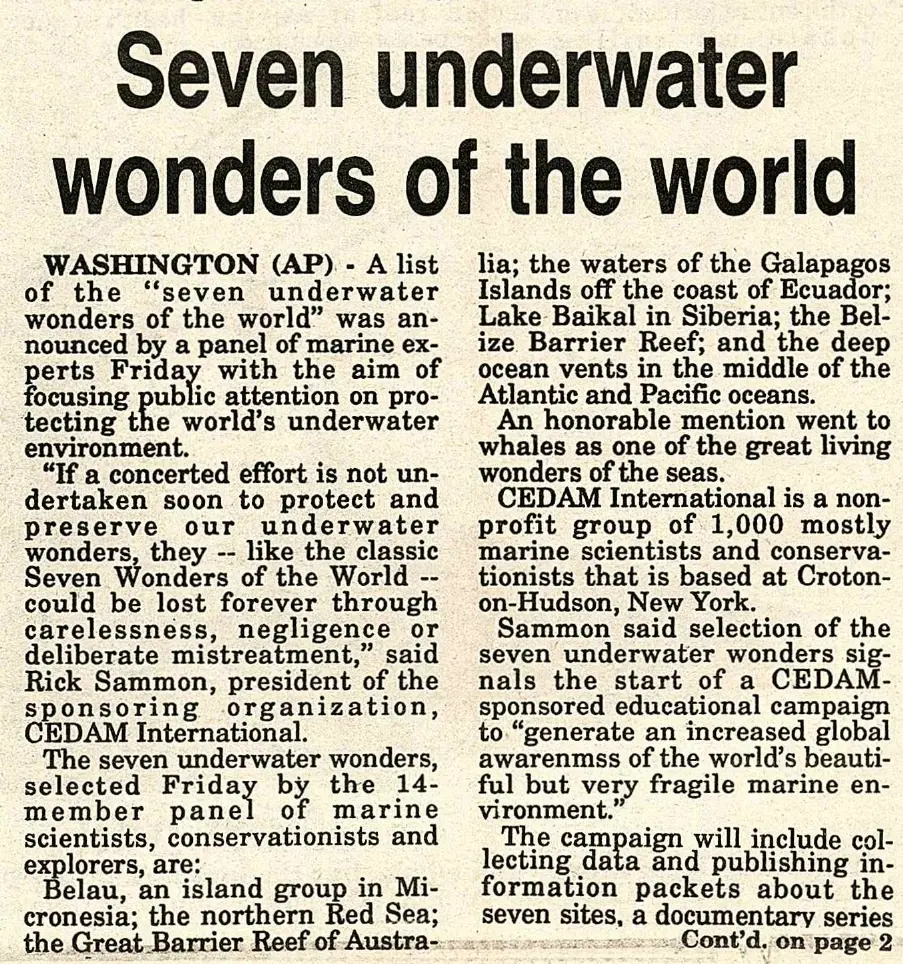
"If a concerted effort is not undertaken soon to protect and preserve our underwater wonders, they -- like the classic Seven Wonders of the World -- could be lost forever through carelessness, negligence or deliberate mistreatment," said Rick Sammon, president of the sponsoring organization, CEDAM International.
The seven underwater wonders, selected Friday by the 14-member panel of marine scientists, conservationists and explorers, are: Belau, an island group in Micronesia; the northern Red Sea; the Great Barrier Reef of Austra[lia]. lia; the waters of the Galapagos Islands off the coast of Ecuador; Lake Baikal in Siberia; the Belize Barrier Reef; and the deep ocean vents in the middle of the Atlantic and Pacific oceans.
An honorable mention went to whales as one of the great living wonders of the seas.
CEDAM International is a nonprofit group of 1,000 mostly marine scientists and conservationists that is based at Croton-on-Hudson, New York.
Sammon said selection of the seven underwater wonders signals the start of a CEDAM-sponsored educational campaign to "generate an increased global awareness of the world's beautiful but very fragile marine environment."
The campaign will include collecting data and publishing information packets about the seven sites, a documentary series Cont'd. on page 2 from page 1 on the seven wonders, a touring exhibit of underwater photographs, school curricula on marine conservation and an art-quality photo book. One of the panelists of marine experts that designated the seven underwater wonders was Scott Carpenter, a former astronaut and deep-sea diving aquanaut for the Navy's SEALAB project.
"We're killing the oceans," said Carpenter, now an environmental consultant from Vale, Colorado, who has dived in most of the world's oceans.
Carpenter blamed the world's runaway population for the declining health of the oceans and marine life. "We've got to stop population growth and we've got to eliminate our ignorance," he said.
"The ocean is a very delicate entity and people don't realize that," Carpenter said. "Without healthy oceans, a healthy planet is impossible."
The 13 other panelists included representatives of the Smithsonian Institution, the National Geographic Society, the United Nations, the New York Aquarium, the New York Zoological Society, Wildlife Conservation International, the University of Maryland, the U.S. National Oceanic and Atmospheric Administration and CSIRO, Australia's largest scientific and industrial research organization.