Getting into trolling
About the article
This is a digitised version of an article from The Cayman Compass's print archive. Occasionally, the digitisation process introduces transcription errors, or other problems.
See the article in its original context from March 1990.
Brought to you by

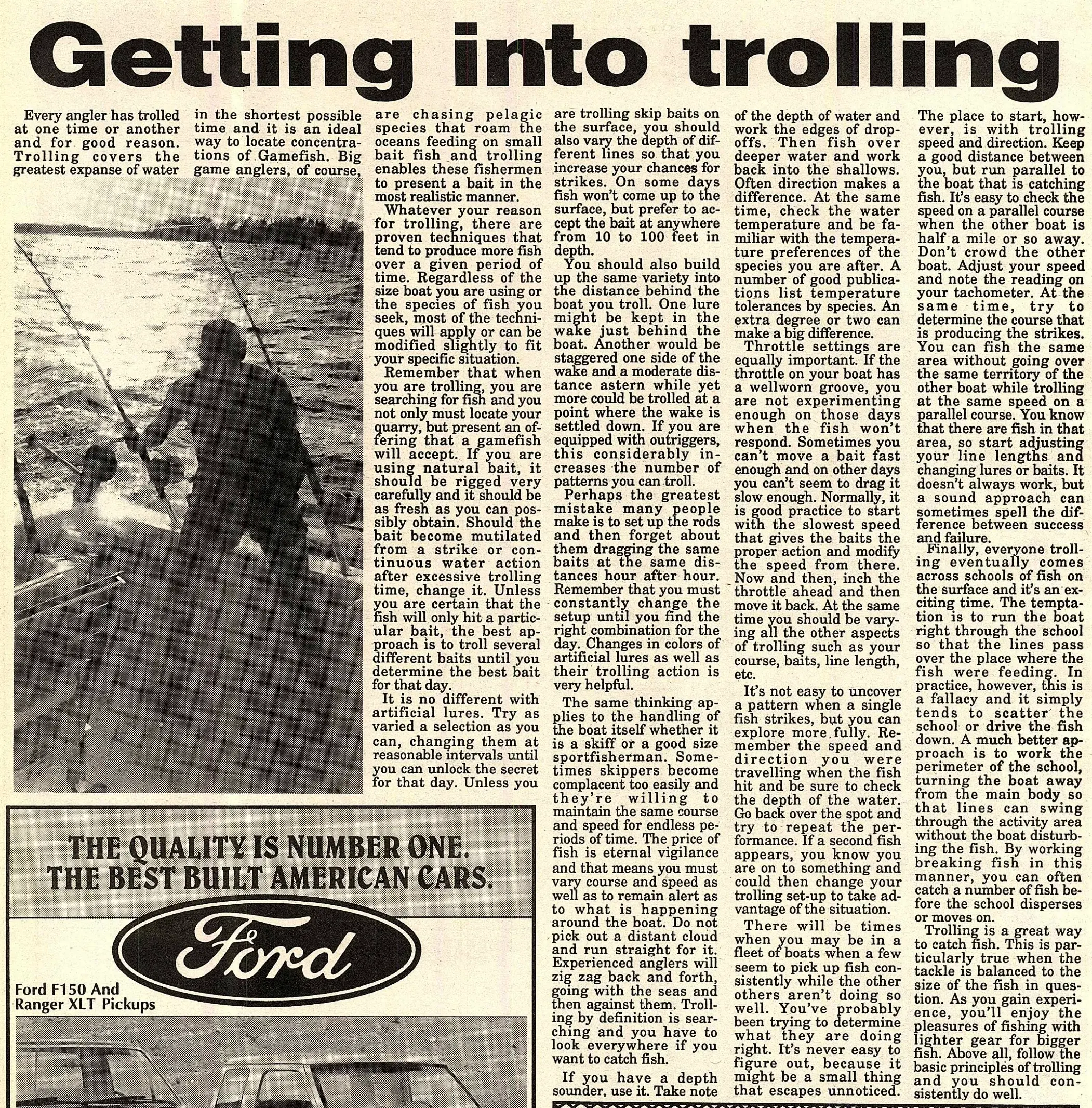
Trolling covers the greatest expanse of water in the shortest possible time and it is an ideal way to locate concentrations of Gamefish. Big game anglers, of course, are chasing pelagic species that roam the oceans feeding on small bait fish and trolling enables these fishermen to present a bait in the most realistic manner. Whatever your reason for trolling, there are proven techniques that tend to produce more fish over a given period of time. Regardless of the size boat you are using or the species of fish you seek, most of the techniques will apply or can be modified slightly to fit your specific situation.
Remember that when you are trolling, you are searching for fish and you not only must locate your quarry, but present an offering that a gamefish will accept. If you are using natural bait, it should be rigged very carefully and it should be as fresh as you can possibly obtain. Should the bait become mutilated from a strike or continuous water action after excessive trolling time, change it. Unless you are certain that the fish will only hit a particular bait, the best approach is to troll several different baits until you determine the best bait for that day.
It is no different with artificial lures. Try as varied a selection as you can, changing them at reasonable intervals until you can unlock the secret for that day. Unless you are trolling skip baits on the surface, you should also vary the depth of different lines so that you increase your chances for strikes. On some days fish won't come up to the surface, but prefer to accept the bait at anywhere from 10 to 100 feet in depth.
You should also build up the same variety into the distance behind the boat you troll. One lure might be kept in the wake just behind the boat. Another would be staggered one side of the wake and a moderate distance astern while yet more could be trolled at a point where the wake is settled down. If you are equipped with outriggers, this considerably increases the number of patterns you can troll.
Perhaps the greatest mistake many people make is to set up the rods and then forget about them dragging the same baits at the same distances hour after hour. Remember that you must constantly change the setup until you find the right combination for the day. Changes in colors of artificial lures as well as their trolling action is very helpful.
The same thinking applies to the handling of the boat itself whether it is a skiff or a good size sportfisherman. Sometimes skippers become complacent too easily and they're willing to maintain the same course and speed for endless periods of time. The price of fish is eternal vigilance and that means you must vary course and speed as well as to remain alert as to what is happening around the boat. Do not pick out a distant cloud and run straight for it. Experienced anglers will zigzag back and forth, going with the seas and then against them. Trolling by definition is searching and you have to look everywhere if you want to catch fish.
If you have a depth sounder, use it. Take note of the depth of water and work the edges of drop-offs. Then fish over deeper water and work back into the shallows. Often direction makes a difference. At the same time, check the water temperature and be familiar with the temperature preferences of the species you are after. A number of good publications list temperature tolerances by species. An extra degree or two can make a big difference. Throttle settings are equally important. If the throttle on your boat has a wellworn groove, you are not experimenting enough on those days when the fish won't respond. Sometimes you can't move a bait fast enough and on other days you can't seem to drag it slow enough. Normally, it is good practice to start with the slowest speed that gives the baits the proper action and modify the speed from there. Now and then, inch the throttle ahead and then move it back. At the same time you should be varying all the other aspects of trolling such as your course, baits, line length, etc.
It's not easy to uncover a pattern when a single fish strikes, but you can explore more fully. Remember the speed and direction you were travelling when the fish hit and be sure to check the depth of the water. Go back over the spot and try to repeat the performance. If a second fish appears, you know you are on to something and could then change your trolling set-up to take advantage of the situation.
There will be times when you may be in a fleet of boats when a few seem to pick up fish consistently while the other others aren't doing so well. You've probably been trying to determine what they are doing right. It's never easy to figure out, because it might be a small thing that escapes unnoticed. The place to start, however, is with trolling speed and direction. Keep a good distance between you, but run parallel to the boat that is catching fish. It's easy to check the speed on a parallel course when the other boat is half a mile or so away. Don't crowd the other boat. Adjust your speed and note the reading on your tachometer. At the same time, try to determine the course that is producing the strikes. You can fish the same area without going over the same territory of the other boat while trolling at the same speed on a parallel course. You know that there are fish in that area, so start adjusting your line lengths and changing lures or baits. It doesn't always work, but a sound approach can sometimes spell the difference between success and failure.
Finally, everyone trolling eventually comes across schools of fish on the surface and it's an exciting time. The temptation is to run the boat right through the school so that the lines pass over the place where the fish were feeding. In practice, however, this is a fallacy and it simply tends to scatter the school or drive the fish down. A much better approach is to work the perimeter of the school, turning the boat away from the main body so that lines can swing through the activity area without the boat disturbing the fish. By working breaking fish in this manner, you can often catch a number of fish before the school disperses or moves on.
Trolling is a great way to catch fish. This is particularly true when the tackle is balanced to the size of the fish in question. As you gain experience, you'll enjoy the pleasures of fishing with lighter gear for bigger fish. Above all, follow the basic principles of trolling and you should consistently do well.