Shiite leader fears for hostage
About the article
This is a digitised version of an article from The Cayman Compass's print archive. Occasionally, the digitisation process introduces transcription errors, or other problems.
See the article in its original context from May 1990.
Brought to you by

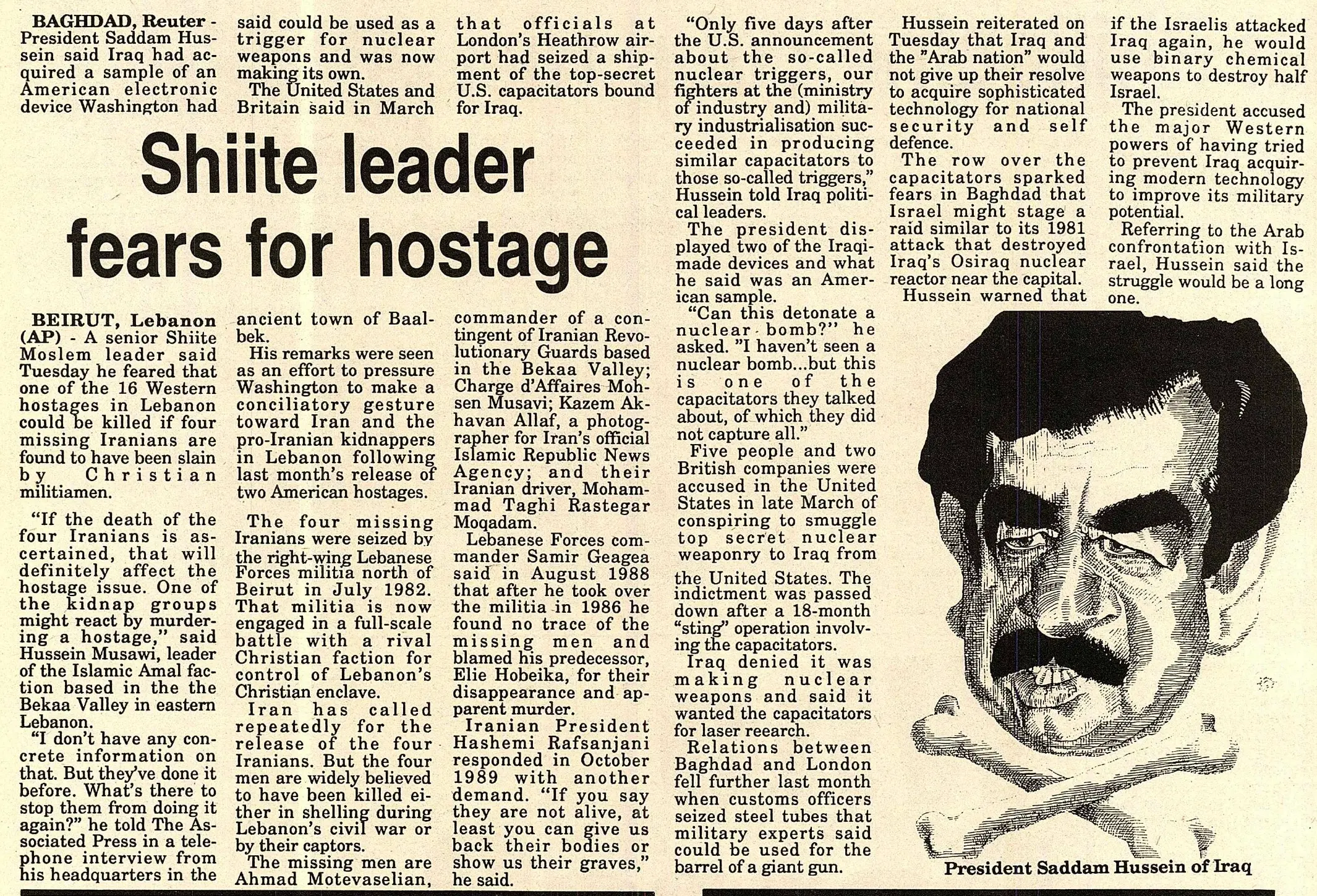
His remarks were seen as an effort to pressure Washington to make a conciliatory gesture toward Iran and the pro-Iranian kidnappers in Lebanon following last month's release of two American hostages. "If the death of the four Iranians is ascertained, that will definitely affect the hostage issue. One of the kidnap groups might react by murdering a hostage," said Hussein Musawi, leader of the Islamic Amal faction based in the the Bekaa Valley in eastern Lebanon.
"I don't have any concrete information on that. But they've done it before. What's there to stop them from doing it again?" he told The Associated Press in a telephone interview from his headquarters in the The four missing Iranians were seized by the right-wing Lebanese Forces militia north of Beirut in July 1982. That militia is now engaged in a full-scale battle with a rival Christian faction for control of Lebanon's Christian enclave.
Iran has called repeatedly for the release of the four Iranians. But the four men are widely believed to have been killed either in shelling during Lebanon's civil war or by their captors.
The missing men are Ahmad Motevaselian, commander of a contingent of Iranian Revolutionary Guards based in the Bekaa Valley; Charge d'Affaires Mohsen Musavi; Kazem Akhavan Allaf, a photographer for Iran's official Islamic Republic News Agency; and their Iranian driver, Mohammad Taghi Rastegar Moqadam.
Lebanese Forces commander Samir Geagea said in August 1988 that after he took over the militia in 1986 he found no trace of the missing men and blamed his predecessor, Elie Hobeika, for their disappearance and apparent murder.
Iranian President Hashemi Rafsanjani responded in October 1989 with another demand. "If you say they are not alive, at least you can give us back their bodies or show us their graves," he said.