Brazil takes steps against kidnapping
About the article
This is a digitised version of an article from The Cayman Compass's print archive. Occasionally, the digitisation process introduces transcription errors, or other problems.
See the article in its original context from June 1990.
Brought to you by

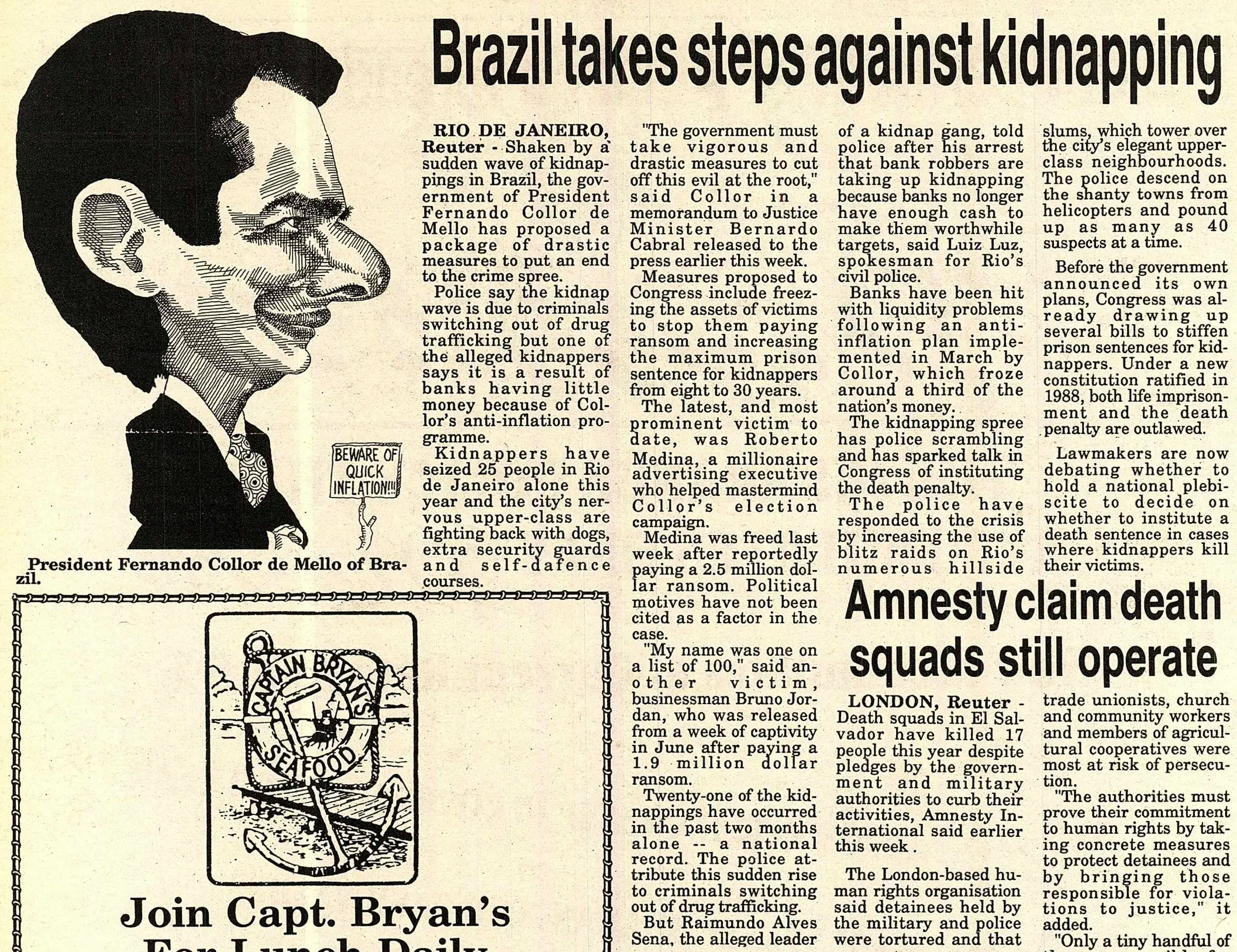
Police say the kidnap wave is due to criminals switching out of drug trafficking but one of the alleged kidnappers says it is a result of banks having little money because of Collor's anti-inflation programme.
Kidnappers have seized 25 people in Rio de Janeiro alone this year and the city's nervous upper-class are fighting back with dogs, extra security guards and self-defence courses. "The government must take vigorous and drastic measures to cut off this evil at the root," said Collor in a memorandum to Justice Minister Bernardo Cabral released to the press earlier this week.
Measures proposed to Congress include freezing the assets of victims to stop them paying ransom and increasing the maximum prison sentence for kidnappers from eight to 30 years.
The latest, and most prominent victim to date, was Roberto Medina, a millionaire advertising executive who helped mastermind Collor's election campaign.
Medina was freed last week after reportedly paying a 2.5 million dollar ransom. Political motives have not been cited as a factor in the case.
"My name was one on a list of 100," said another victim, businessman Bruno Jordan, who was released from a week of captivity in June after paying a 1.9 million dollar ransom.
Twenty-one of the kidnappings have occurred in the past two months alone a national record. The police attribute this sudden rise to criminals switching out of drug trafficking. But Raimundo Alves Sena, the alleged leader of a kidnap gang, told police after his arrest that bank robbers are taking up kidnapping because banks no longer have enough cash to make them worthwhile targets, said Luiz Luz, spokesman for Rio's civil police.
Banks have been hit with liquidity problems following an antiinflation plan implemented in March by Collor, which froze around a third of the nation's money.
The kidnapping spree has police scrambling and has sparked talk in Congress of instituting the death penalty.
The police have responded to the crisis by increasing the use of blitz raids on Rio's numerous hillside. slums, which tower over the city's elegant upper-class neighbourhoods.
The police descend on the shanty towns from helicopters and pound up as many as 40 suspects at a time. Before the government announced its own plans, Congress was already drawing up several bills to stiffen prison sentences for kidnappers. Under a new constitution ratified in 1988, both life imprisonment and the death penalty are outlawed. Lawmakers are now debating whether to hold a national plebiscite to decide on whether to institute a death sentence in cases where kidnappers kill their victims.