Jack, the Signalman Baboon
About the article
This is a digitised version of an article from The Cayman Compass's print archive. Occasionally, the digitisation process introduces transcription errors, or other problems.
See the article in its original context from November 1990.
Brought to you by

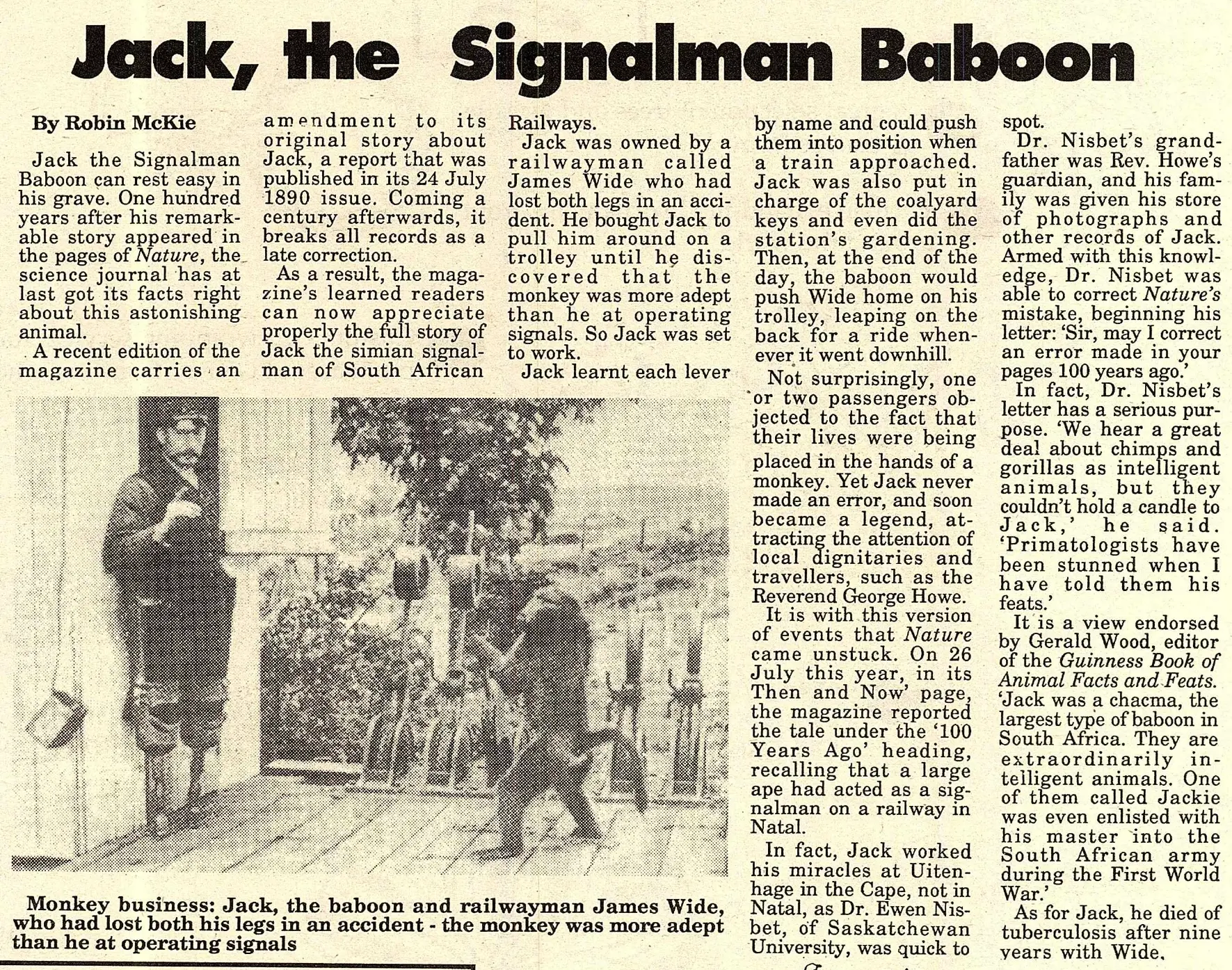
A recent edition of the magazine carries an amendment to its original story about Jack, a report that was published in its 24 July 1890 issue. Coming a century afterwards, it breaks all records as a late correction.
As a result, the magazine's learned readers can now appreciate properly the full story of Jack the simian signalman of South African Railways. Jack was owned by a railwayman called James Wide who had lost both legs in an accident. He bought Jack to pull him around on a trolley until he discovered that the monkey was more adept than he at operating signals. So Jack was set to work.
Jack learnt each lever by name and could push them into position when a train approached. Jack was also put in charge of the coalyard keys and even did the station's gardening. Then, at the end of the day, the baboon would push Wide home on his trolley, leaping on the back for a ride whenever it went downhill.
Not surprisingly, one or two passengers objected to the fact that their lives were being placed in the hands of a monkey. Yet Jack never made an error, and soon became a legend, attracting the attention of local dignitaries and travellers, such as the Reverend George Howe. It is with this version of events that Nature came unstuck. On 26 July this year, in its Then and Now' page, the magazine reported the tale under the '100 Years Ago' heading, recalling that a large ape had acted as a signalman on a railway in Natal.
In fact, Jack worked his miracles at Uitenhage in the Cape, not in Natal, as Dr. Ewen Nisbet, of Saskatchewan University, was quick to spot. Dr. Nisbet's grandfather was Rev. Howe's guardian, and his family was given his store of photographs and other records of Jack. Armed with this knowledge, Dr. Nisbet was able to correct Nature's mistake, beginning his letter: 'Sir, may I correct an error made in your pages 100 years ago.'
In fact, Dr. Nisbet's letter has a serious purpose. 'We hear a great deal about chimps and gorillas as intelligent animals, but they couldn't hold a candle to Jack,' he said. 'Primatologists have been stunned when I have told them his feats.'
It is a view endorsed by Gerald Wood, editor of the Guinness Book of Animal Facts and Feats. 'Jack was a chacma, the largest type of baboon in South Africa. They are extraordinarily intelligent animals. One of them called Jackie was even enlisted with his master into the South African army during the First World War.'
As for Jack, he died of tuberculosis after nine years with Wide,