Iraq's war ruses not all unconventional
About the article
This is a digitised version of an article from The Cayman Compass's print archive. Occasionally, the digitisation process introduces transcription errors, or other problems.
See the article in its original context from February 1991.
Brought to you by

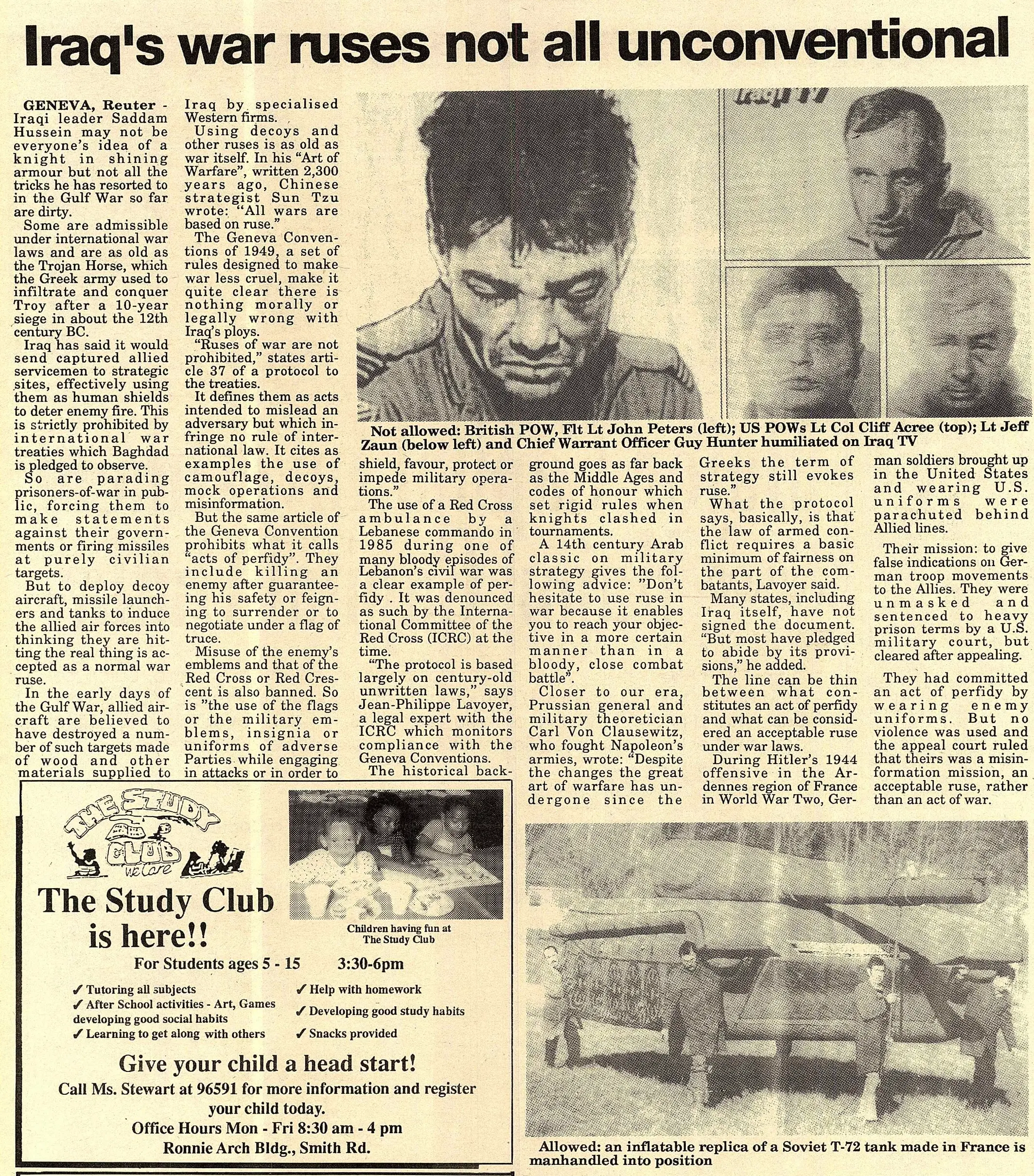
Some are admissible under international war laws and are as old as the Trojan Horse, which the Greek army used to infiltrate and conquer Troy after a 10-year siege in about the 12th century BC.
Iraq has said it would send captured allied servicemen to strategic sites, effectively using them as human shields to deter enemy fire. This is strictly prohibited by international wartreaties which Baghdad is pledged to observe. So are parading prisoners-of-war in public, forcing them to make statements against their governments or firing missiles at purely civilian targets.
But to deploy decoy aircraft, missile launchers and tanks to induce the allied air forces into thinking they are hitting the real thing is accepted as a normal war ruse.
In the early days of the Gulf War, allied aircraft are believed to have destroyed a number of such targets made of wood and other materials supplied to Iraq by specialised Western firms. Using decoys and other ruses is as old as war itself. In his "Art of Warfare", written 2,300 years ago, Chinese strategist Sun Tzu wrote: "All wars are based on ruse."
The Geneva Conventions of 1949, a set of rules designed to make war less cruel, make it quite clear there is nothing morally or legally wrong with Iraq's ploys.
"Ruses of war are not prohibited," states article 37 of a protocol to the treaties. It defines them as acts intended to mislead an adversary but which infringe no rule of international law. It cites as examples the use of camouflage, decoys, mock operations and misinformation.
But the same article of the Geneva Convention prohibits what it calls "acts of perfidy". They include killing an enemy after guaranteeing his safety or feigning to surrender or to negotiate under a flag of truce.
Misuse of the enemy's emblems and that of the Red Cross or Red Crescent is also banned. So is "the use of the flags or the military emblems, insignia or uniforms of adverse Parties while engaging in attacks or in order to. shield, favour, protect or impede military operations."
The use of a Red Cross ambulance by a Lebanese commando in 1985 during one of many bloody episodes of Lebanon's civil war was a clear example of perfidy. It was denounced as such by the International Committee of the Red Cross (ICRC) at the time.
"The protocol is based largely on century-old unwritten laws," says Jean-Philippe Lavoyer, a legal expert with the ICRC which monitors compliance with the Geneva Conventions. The historical background goes as far back as the Middle Ages and codes of honour which set rigid rules when knights clashed in tournaments.
A 14th century Arab classic on military strategy gives the following advice: "Don't hesitate to use ruse in war because it enables you to reach your objective in a more certain manner than in a bloody, close combat battle".
Closer to our era, Prussian general and military theoretician Carl Von Clausewitz, who fought Napoleon's armies, wrote: "Despite the changes the great art of warfare has undergone since the Greeks the term of strategy still evokes ruse."
What the protocol says, basically, is that the law of armed conflict requires a basic minimum of fairness on the part of the combatants, Lavoyer said.
Many states, including Iraq itself, have not signed the document. "But most have pledged to abide by its provisions," he added.
The line can be thin between what constitutes an act of perfidy and what can be considered an acceptable ruse under war laws.
During Hitler's 1944 offensive in the Ardennes region of France in World War Two, German soldiers brought up in the United States and wearing U.S. uniforms were parachuted behind Allied lines. Their mission: to give false indications on German troop movements to the Allies. They were unmasked and sentenced to heavy prison terms by a U.S. military court, but cleared after appealing. They had committed an act of perfidy by wearing enemy uniforms. But no violence was used and the appeal court ruled that theirs was a misinformation mission, an acceptable ruse, rather than an act of war.