BCCI fraud reveals use of American bank
About the article
This is a digitised version of an article from The Cayman Compass's print archive. Occasionally, the digitisation process introduces transcription errors, or other problems.
See the article in its original context from July 1991.
Brought to you by

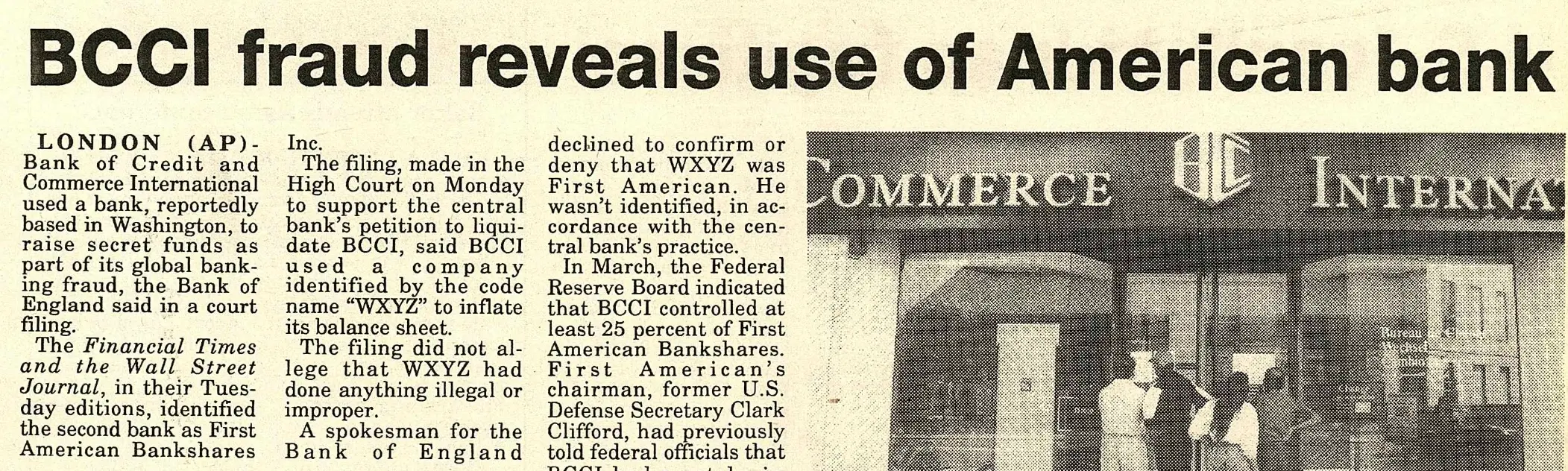
The Financial Times and the Wall Street Journal, in their Tuesday editions, identified the second bank as First American Bankshares Inc.
The filing, made in the High Court on Monday to support the central bank's petition to liquidate BCCI, said BCCI used a company identified by the code name "WXYZ" to inflate its balance sheet.
The filing did not allege that WXYZ had done anything illegal or improper.
A spokesman for the Bank of England declined to confirm or deny that WXYZ was First American. He wasn't identified, in accordance with the central bank's practice.
In March, the Federal Reserve Board indicated that BCCI controlled at least 25 percent of First American Bankshares. First American's chairman, former U.S. Defense Secretary Clark Clifford, had previously told federal officials that BCCI had no stake in the bank.
U.S. Attorney Jay Stephens in Washington confirmed last week that his office was investigating possible violations of the law involving BCCI, First American Bankshares and two other U.S. banks.
The High Court postponed a liquidation of BCCI until at least July 30 to give its majority shareholders - Abu Dhabi's ruler Sheik Zayed Al-Nahyan and its government - time to devise a rescue plan for small depositors.
BCCI was seized on 5 July by monetary authorities around the world on evidence of long-term, widespread fraud.
The Bank of England's filing said BCCI arranged for Middle Eastern investors to buy shares in the bank identified as WXYZ. The buyers of WXYZ shares were nominees who kept their stakes below 5 percent so that the holdings didn't have to be declared and BCCI's name did not appear, the filing said.
WXYZ shares were used as security for loans to the nominees. That released funds which were used to. cover unauthorized loans and bad loans, the filing said. The funds also were used to generate fictitious income, it said.
"Sham deposits and balances on loan accounts were confirmed to the auditors by persons connected with these transactions," the filing said.