Boxer's coma raises questions
About the article
This is a digitised version of an article from The Cayman Compass's print archive. Occasionally, the digitisation process introduces transcription errors, or other problems.
See the article in its original context from September 1991.
Brought to you by

"The violent punch produces an effect similar to a blancmange being whisked around in a wooden box," said one neurosurgeon. "It scrambles the brains."
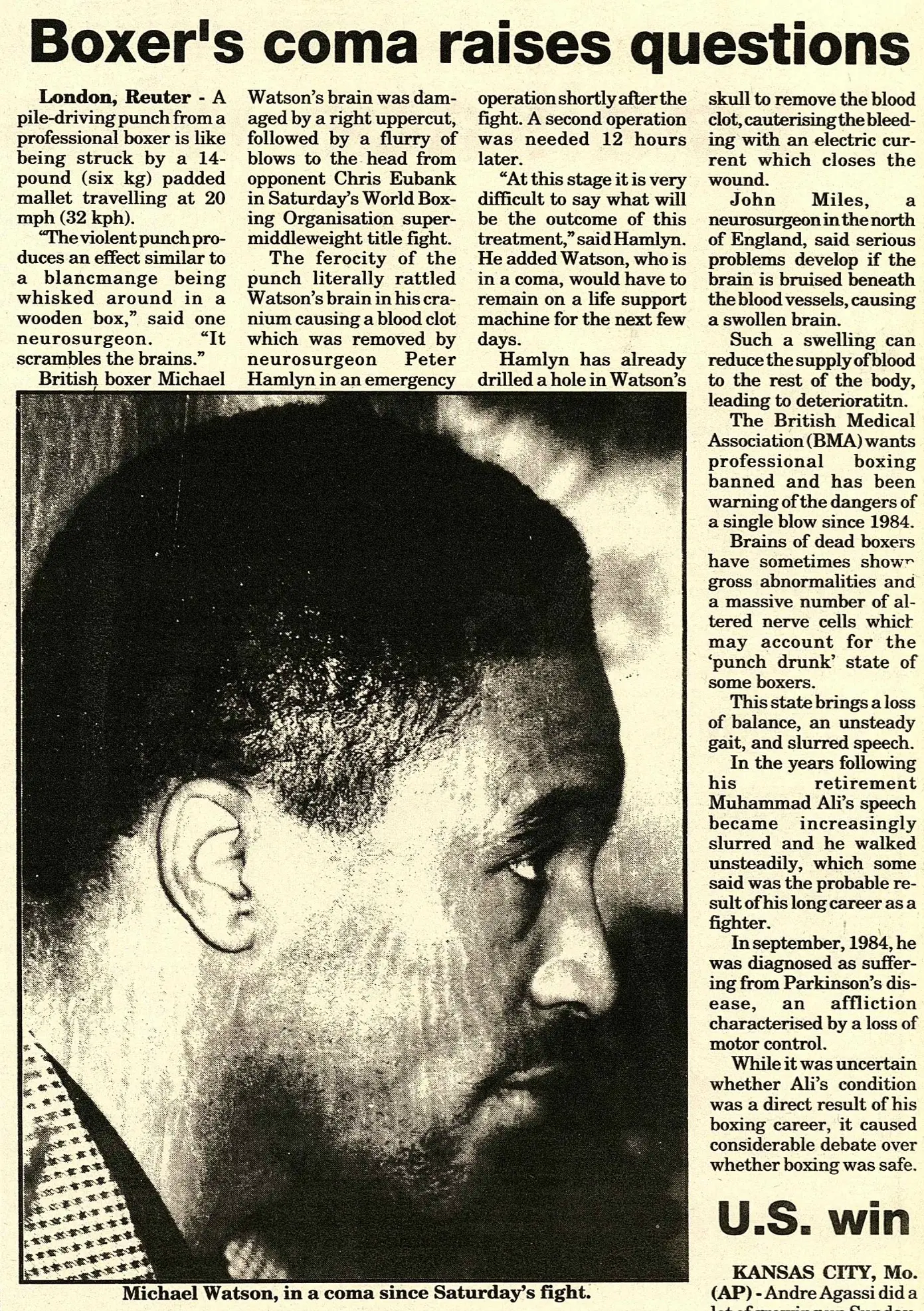
British boxer Michael Watson's brain was damaged by a right uppercut, followed by a flurry of blows to the head from opponent Chris Eubank in Saturday's World Boxing Organisation supermiddleweight title fight.
The ferocity of the punch literally rattled Watson's brain in his cranium causing a blood clot which was removed by neurosurgeon Peter Hamlyn in an emergency. operation shortly after the fight. A second operation was needed 12 hours later. "At this stage it is very difficult to say what will be the outcome of this treatment," said Hamlyn. He added Watson, who is in a coma, would have to remain on a life support machine for the next few days.
Hamlyn has already drilled a hole in Watson's. skull to remove the blood clot, cauterising the bleeding with an electric current which closes the wound.
John Miles, a neurosurgeon in the north of England, said serious problems develop if the brain is bruised beneath the blood vessels, causing a swollen brain.
Such a swelling can reduce the supply of blood to the rest of the body, leading to deterioration.
The British Medical Association (BMA) wants professional boxing banned and has been warning of the dangers of a single blow since 1984.
Brains of dead boxers have sometimes show gross abnormalities and a massive number of altered nerve cells which may account for the 'punch drunk' state of some boxers.
This state brings a loss of balance, an unsteady gait, and slurred speech. In the years following his retirement Muhammad Ali's speech became increasingly slurred and he walked unsteadily, which some said was the probable result of his long career as a fighter.
In september, 1984, he was diagnosed as suffering from Parkinson's disease, an affliction characterised by a loss of motor control.
While it was uncertain whether Ali's condition was a direct result of his boxing career, it caused considerable debate over whether boxing was safe.