Eleven aspects of fitness
About the article
This is a digitised version of an article from The Cayman Compass's print archive. Occasionally, the digitisation process introduces transcription errors, or other problems.
See the article in its original context from December 1991.
Brought to you by

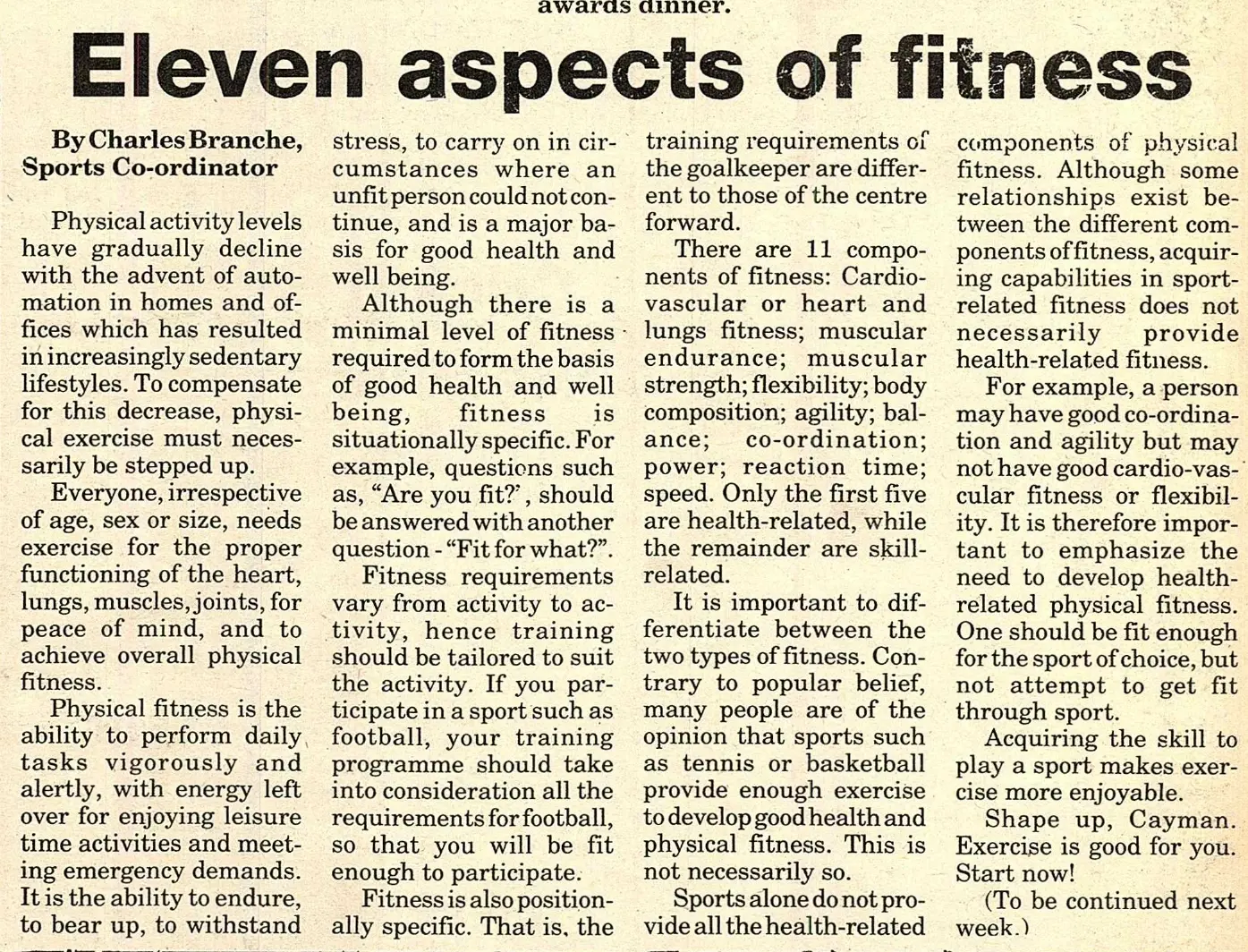
Everyone, irrespective of age, sex or size, needs exercise for the proper functioning of the heart, lungs, muscles, joints, for peace of mind, and to achieve overall physical fitness. Physical fitness is the ability to perform daily tasks vigorously and alertly, with energy left over for enjoying leisure time activities and meeting emergency demands.
It is the ability to endure, to bear up, to withstand stress, to carry on in circumstances where an unfit person could not continue, and is a major basis for good health and well being.
Although there is a minimal level of fitness required to form the basis of good health and well being, fitness is situationally specific. For example, questions such as, "Are you fit?", should be answered with another question - "Fit for what?".
Fitness requirements vary from activity to activity, hence training should be tailored to suit the activity. If you participate in a sport such as football, your training programme should take into consideration all the requirements for football, so that you will be fit enough to participate.
Fitness is also positionally specific. That is, the training requirements of the goalkeeper are different to those of the centre forward.
There are 11 components of fitness: Cardiovascular or heart and lungs fitness; muscular endurance; muscular strength; flexibility; body composition; agility; balance; co-ordination; power; reaction time; speed. Only the first five are health-related, while the remainder are skill-related.
It is important to differentiate between the two types of fitness. Contrary to popular belief, many people are of the opinion that sports such as tennis or basketball provide enough exercise to develop good health and physical fitness. This is not necessarily so.
Sports alone do not provide all the health-related components of physical fitness. Although some relationships exist between the different components of fitness, acquiring capabilities in sport-related fitness does not necessarily provide health-related fitness.
For example, a person may have good co-ordination and agility but may not have good cardiovascular fitness or flexibility. It is therefore important to emphasize the need to develop health-related physical fitness. One should be fit enough for the sport of choice, but not attempt to get fit through sport.
Acquiring the skill to play a sport makes exercise more enjoyable. Shape up, Cayman. Exercise is good for you. Start now! (To be continued next week.)