Cayman Dive Sites
About the article
This is a digitised version of an article from The Cayman Compass's print archive. Occasionally, the digitisation process introduces transcription errors, or other problems.
See the article in its original context from January 1992.
Brought to you by

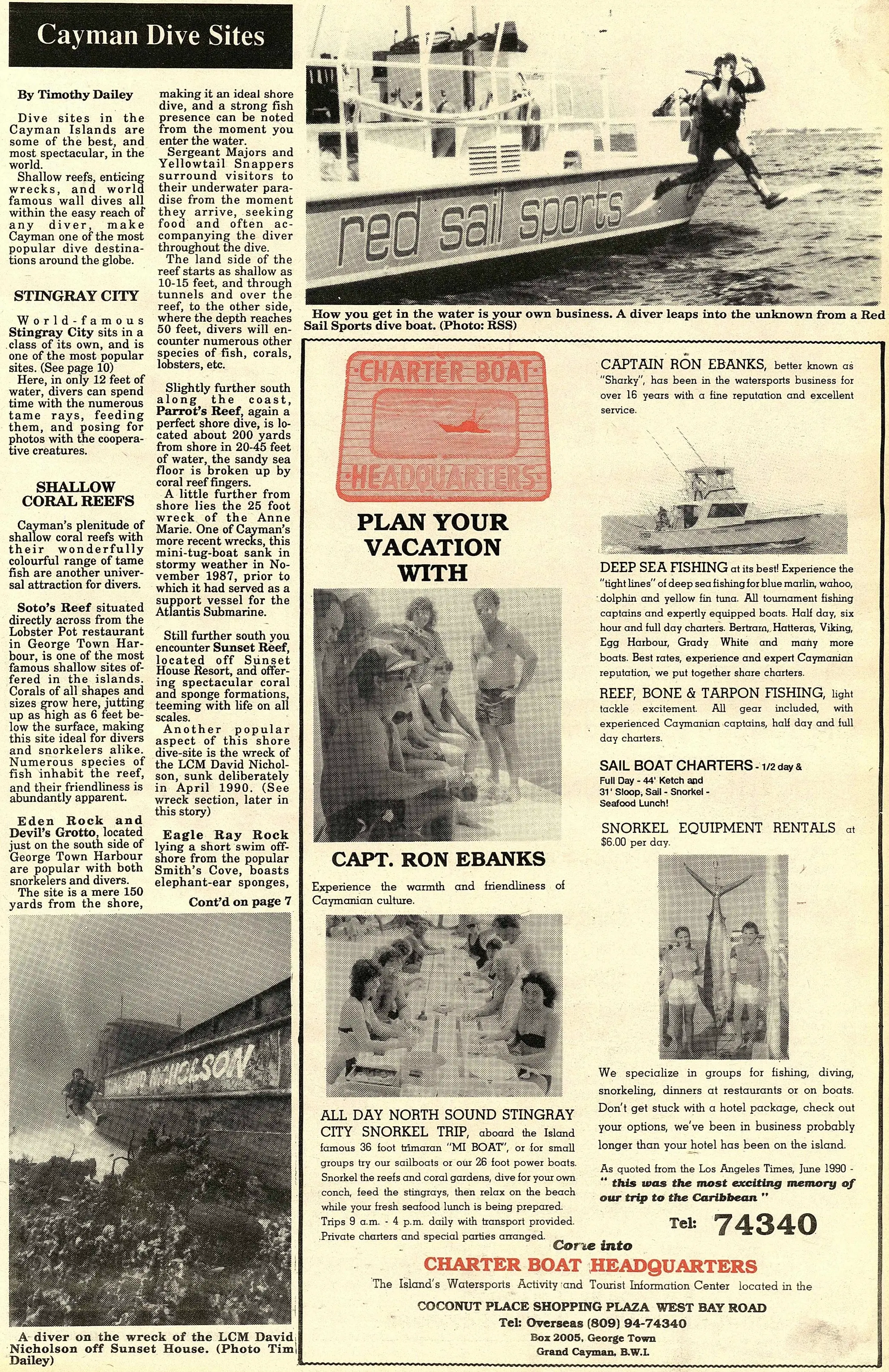
Shallow reefs, enticing wrecks, and world famous wall dives all within the easy reach of any diver, make Cayman one of the most popular dive destinations around the globe.
STINGRAY CITY
World-famous Stingray City sits in a class of its own, and is one of the most popular sites. (See page 10)
Here, in only 12 feet of water, divers can spend time with the numerous tame rays, feeding them, and posing for photos with the cooperative creatures.
SHALLOW CORAL REEFS
Cayman's plenitude of shallow coral reefs with their wonderfully colourful range of tame fish are another universal attraction for divers. Soto's Reef situated directly across from the Lobster Pot restaurant in George Town Harbour, is one of the most famous shallow sites offered in the islands.
Corals of all shapes and sizes grow here, jutting up as high as 6 feet below the surface, making this site ideal for divers and snorkelers alike.
Numerous species of fish inhabit the reef, and their friendliness is abundantly apparent. Eden Rock and Devil's Grotto, located just on the south side of George Town Harbour are popular with both snorkelers and divers.
The site is a mere 150 yards from the shore. making it an ideal shore dive, and a strong fish presence can be noted from the moment you enter the water.
Sergeant Majors and Yellowtail Snappers surround visitors to their underwater paradise from the moment they arrive, seeking food and often accompanying the diver throughout the dive.
The land side of the reef starts as shallow as 10-15 feet, and through tunnels and over the reef, to the other side, where the depth reaches 50 feet, divers will encounter numerous other species of fish, corals, lobsters, etc. Slightly further south along the coast, Parrot's Reef, again a perfect shore dive, is located about 200 yards from shore in 20-45 feet of water, the sandy sea floor is broken up by coral reef fingers.
A little further from shore lies the 25 foot wreck of the Anne Marie. One of Cayman's more recent wrecks, this minitug-boat sank in stormy weather in November 1987, prior to which it had served as a support vessel for the Atlantis Submarine. Still further south you encounter Sunset Reef, located off Sunset House Resort, and offering spectacular coral and sponge formations, teeming with life on all scales.
Another popular aspect of this shore dive-site is the wreck of the LCM David Nicholson, sunk deliberately in April 1990. (See wreck section, later in this story) Eagle Ray Rock lying a short swim offshore from the popular Smith's Cove, boasts elephant-ear sponges, cont'd from page 5 black coral trees and gently swaying sea-fans.
The highlight of this dive is a narrow, L-shaped canyon, negotiable only in single file.
The site is named for the frequent visitations by Spotted Eagle Rays which glide gracefully along the edge of the wall. Towards the East End of the island, shallow dives abound.
The Ironshore Gardens, near Cottage on the way to East End, consist of four or five sites. Spectacular coral formations, cracks and crevices teeming with life in miniature, and crystal clear water make these dives extremely pleasurable for all. Grand Cayman's sister islands also offer spectacular shallow reef dives.
Grunt Valley located close to Cayman Brac's shore, a little to the east of the Cemetery Wall site (see Wall section), is named for the large schools of Grunts and Yellowtail Snapper that frequent the area. The site sits on a gentle slope from 20-40 feet. Another popular shallow dive off Cayman Brac is the Green House, which, with an average depth of 15-35 feet, is suitable for both snorkelers and divers.
The reef lies a fair distance from shore, however, the coral fingers, lying perpendicular to the shore offer much to any visitor.
WRECKS
For those divers seeking the excitement and mystery associated with wreck diving, Cayman can also cater to your needs and desires. The Oro Verde, deliberately sunk in April 1980, lies directly off the Holiday Inn in about 50-65 feet of water.
Although considerably broken up, this site still offers close encounters with large Jew Fish, Jacks and Eels, all of whom have made the wreck their home.
Fish feeders can delight at feeding the many species that frequent the wreck and adjacent reef. This site is not accessible directly from the shore, but is offered as a boat dive by most operations on the island. Right at the entrance to George Town Harbour, sitting in only 25 feet of water, lies the wreck of the Balboa, a small, lumber carrying freighter that sank in the devastating hurricane of 1932.
In later years, the ship was dynamited in order to reduce the threat of danger to shipping in the area that it posed.
However, despite the fact that it is strewn across the ocean floor, the wreck remains a popular shore-dive at weekends and nights when over-sea traffic in the area subsides.
Slow, careful exploration of the wreck can be amply rewarding to the diver who will often encounter lobsters, and octopuses on the shallow site. The fully intact, 70 foot long wreck of the LCM David Nicholson, located in 60 feet of water just off the Sunset House Resort offers a chance for divers to swim into it and through the bridge and engine room.
This World War II landing craft was deliberately sunk, within easy swimming distance of the shore, in April 1990 in memory of veteran Sunset House diver David Nicholson. Again, the sister islands also offer wreck diving.
Cayman Brac boasts two wrecks, both sunk deliberately in 1986.
The Cayman Mariner lies by the East Chute wall dive on the north side of West End Point.
Sitting in approximately 50 feet of water, this 60 foot vessel has a resi. Cont'd on page 8 Right, close encounter with a grouper. (Photo Michael Grundy)