Paints for each and every purpose
About the article
This is a digitised version of an article from The Cayman Compass's print archive. Occasionally, the digitisation process introduces transcription errors, or other problems.
See the article in its original context from April 1992.
Brought to you by

Since then paint has undergone major changes. Paint has stopped being seen as a mere coating and has become high-tech chemistry. Many of the world's leading multinational chemical companies manufacture paint and own paint companies. They are pouring millions of dollars each year into research and development of better performance paints and coatings.
One good example of this is the US paint company Glidden, which owned by the Britain's chemical giant ICI, the largest manufacturer of decorative paints in the world by quite a long way. Glidden was founded in 1875 by Francis H Glidden as a two-man operation producing varnish, around 1,000 gallons a week. In 1917 it started on a path of acquisition, absorbing 11 other paint companies to become a national paint company. In 1967, as the third largest paint manufacturer in the US, it merge with the US chemical company SCM. SCM was acquired by the British conglomerate Hanson Trust in March 1986, being sold on to ICI in October 1986. Today, it is part of ICI's paints division which has 1,500 people alone involved in research and development on paint and its properties.
The paint companies still make good general purpose paints which can be used on more or less any surface. But they are also producing specialist paints for various surfaces. The purpose of these paints is to maximise adhesion and maximise covering power.
They produce paints in a wide variety of finishes, from high gloss, through satin to a flat matt.
What this means, as William McTaggart at Uncle Bill's on Eastern Avenue will tell you, is that you should talk to your paint dealer and tell him exactly what you are looking for and/or read the labels. A chat with the dealer will get you a paint ideally suited to your purpose, rather than just good for the purpose.
One particular reason for talking to your dealer or reading the label is not to confuse interior paints with exterior paints. The same colours have very different formulations for interior and exterior use because some pigments are affected more by sunlight than others.
If you want to test this, go along to Uncle Bill's with a colour sample. Try something with yellow in it. There they have a computer-controlled spectrophotometer which outputs formulations for matching colours, which they then mix up. Specify an exterior paint, then specify an interior paint for the same sample. The formulae given will be different, yet they will give the same colour.
As William says, the secret of a good paint job is surface preparation.
If you are painting new masonry, let it cure for at least 30 days, if not longer, and wash it down before priming to get rid of any salts that may have leached out during the curing process.
One good coat of primer should be followed by two coats of finish, followed by a further coat a year later. After this coat once every three to five years.
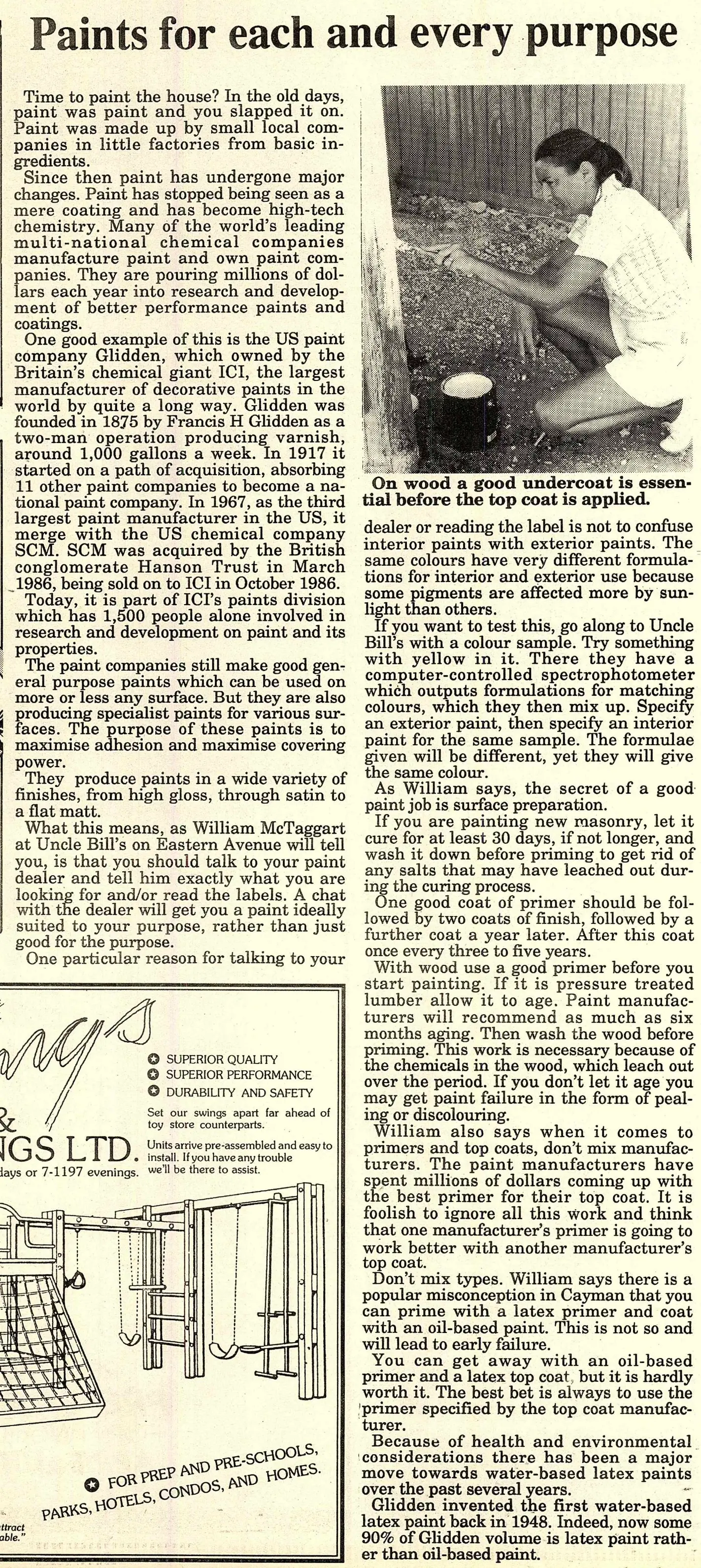
With wood use a good primer before you start painting. If it is pressure treated lumber allow it to age. Paint manufacturers will recommend as much as six months aging. Then wash the wood before priming. This work is necessary because of the chemicals in the wood, which leach out over the period. If you don't let it age you may get paint failure in the form of peeling or discolouring.
William also says when it comes to primers and top coats, don't mix manufacturers. The paint manufacturers have spent millions of dollars coming up with the best primer for their top coat. It is foolish to ignore all this work and think that one manufacturer's primer is going to work better with another manufacturer's top coat.
Don't mix types. William says there is a popular misconception in Cayman that you can prime with a latex primer and coat with an oil-based paint. This is not so and will lead to early failure.
You can get away with an oil-based primer and a latex top coat, but it is hardly worth it. The best bet is always to use the primer specified by the top coat manufacturer.
Because of health and environmental considerations there has been a major move towards water-based latex paints over the past several years.
Glidden invented the first water-based latex paint back in 1948. Indeed, now some 90% of Glidden volume is latex paint rather than oil-based paint.