1992 IN REVIEW Olympic year when dreams came true
About the article
This is a digitised version of an article from The Cayman Compass's print archive. Occasionally, the digitisation process introduces transcription errors, or other problems.
See the article in its original context from December 1992.
Brought to you by

With the end of the Cold War, the breakup of the Soviet Union and the splintering of Yugoslavia, the Olympics took on a whole new look. The Barcelona Games were the biggest ever 10,000 athletes from 172 countries, the first boycott-free Summer Olympics in 20 years. The site of Fidel Castro and Nelson Mandela at the opening ceremonies provided a fitting symbol of the new era. Some of the milestones:
- South Africa, a sporting outcast for three decades, returned to the Olympics for the first time since 1960 with a racially-mixed team. Namibia, the former South-West Africa, made its Olympic debut. Germany, reunited following the fall of the Berlin Wall, competed again as one nation. Cuba and Ethiopia were back after boycotting recent Games. The Baltic states of Lithuania, Latvia and Estonia sent their own teams after regaining their independence from Moscow. The other 12 former Soviet republics competed together for the last time, under the name of Unified Team. Athletes from newly-independent Slovenia and Croatia marched proudly behind their own flags. Even war-ravaged Bosnia-Herzegovina sent a small team to Barcelona, while the rest of Yugoslavia was allowed to compete only in individual events under the neutral name of "Independent Olympic Participant."
Barcelona had plenty of star athletes, too. The top attraction may have been the "Dream Team" of Magic Johnson, Michael Jordan, Larry Bird and Co., the best basketball team ever assembled. The American superstars enchanted the public while beating every opponent by more than 30 points en route to the gold medal.
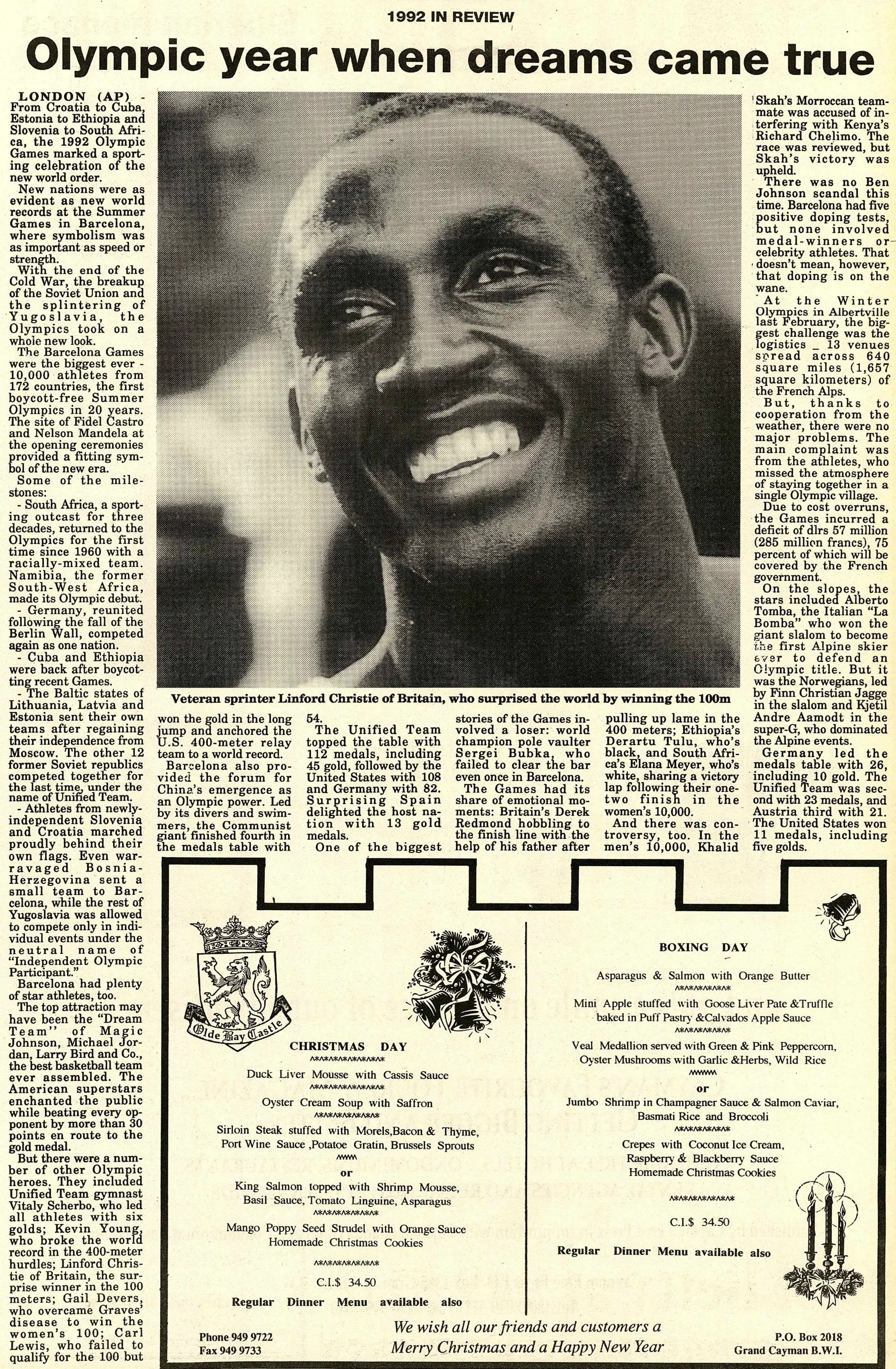
But there were a number of other Olympic heroes. They included Unified Team gymnast Vitaly Scherbo, who led all athletes with six golds; Kevin Young, who broke the world record in the 400-meter hurdles; Linford Christie of Britain, the surprise winner in the 100 meters; Gail Devers, who overcame Graves' disease to win the women's 100; Carl Lewis, who failed to qualify for the 100 but won the gold in the long jump and anchored the U.S. 400-meter relay team to a world record.
Barcelona also provided the forum for China's emergence as an Olympic power. Led by its divers and swimmers, the Communist giant finished fourth in the medals table with 54.
The Unified Team topped the table with 112 medals, including 45 gold, followed by the United States with 108 and Germany with 82.
Surprising Spain delighted the host nation with 13 gold medals.
One of the biggest stories of the Games involved a loser: world champion pole vaulter Sergei Bubka, who failed to clear the bar even once in Barcelona.
The Games had its share of emotional moments: Britain's Derek Redmond hobbling to the finish line with the help of his father after pulling up lame in the 400 meters; Ethiopia's Derartu Tulu, who's black, and South Africa's Elana Meyer, who's white, sharing a victory lap following their one-two finish in the women's 10,000.
And there was controversy, too. In the men's 10,000, Khalid Skah's Morroccan teammate was accused of interfering with Kenya's Richard Chelimo. The race was reviewed, but Skah's victory was upheld.
There was no Ben Johnson scandal this time. Barcelona had five positive doping tests, but none involved medal-winners or celebrity athletes. That doesn't mean, however, that doping is on the wane.
At the Winter Olympics in Albertville last February, the biggest challenge was the logistics 13 venues spread across 640 square miles (1,657 square kilometers) of the French Alps.
But, thanks to cooperation from the weather, there were no major problems. The main complaint was from the athletes, who missed the atmosphere of staying together in a single Olympic village.
Due to cost overruns, the Games incurred a deficit of dlrs 57 million (285 million francs), 75 percent of which will be covered by the French government.
On the slopes, the stars included Alberto Tomba, the Italian "La Bomba" who won the giant slalom to become the first Alpine skier ever to defend an Olympic title. But it was the Norwegians, led by Finn Christian Jagge in the slalom and Kjetil Andre Aamodt in the super-G, who dominated the Alpine events.
Germany led the medals table with 26, including 10 gold. The Unified Team was second with 23 medals, and Austria third with 21. The United States won 11 medals, including five golds.