Whole world mourns the death of a champion
About the article
This is a digitised version of an article from The Cayman Compass's print archive. Occasionally, the digitisation process introduces transcription errors, or other problems.
See the article in its original context from February 1993.
Brought to you by

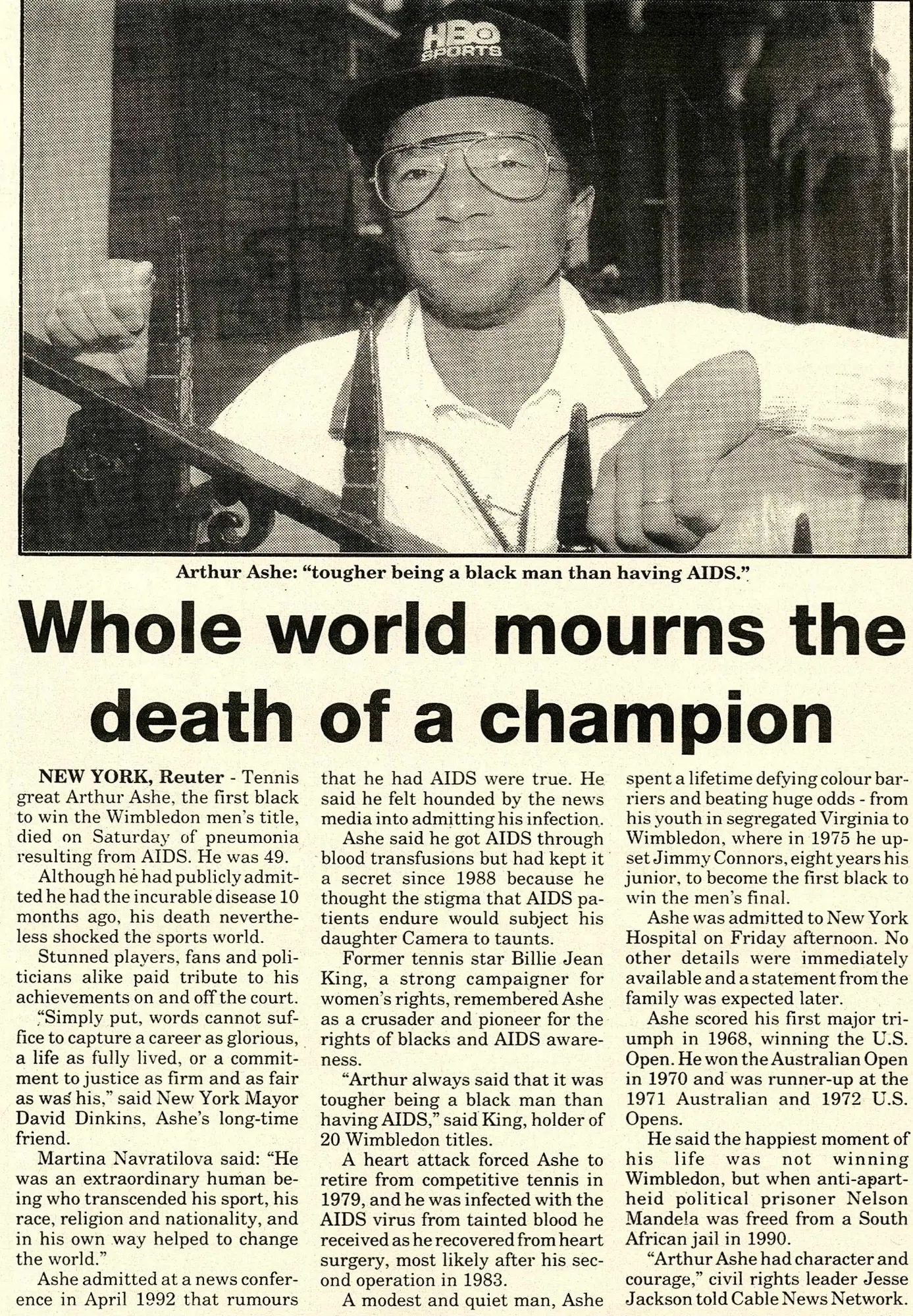
Stunned players, fans and politicians alike paid tribute to his achievements on and off the court. "Simply put, words cannot suffice to capture a career as glorious, a life as fully lived, or a commitment to justice as firm and as fair as was his," said New York Mayor David Dinkins, Ashe's long-time friend.
Martina Navratilova said: "He was an extraordinary human being who transcended his sport, his race, religion and nationality, and in his own way helped to change the world."
Ashe admitted at a news conference in April 1992 that rumours that he had AIDS were true. He said he felt hounded by the news media into admitting his infection.
Ashe said he got AIDS through blood transfusions but had kept it a secret since 1988 because he thought the stigma that AIDS patients endure would subject his daughter Camera to taunts.
Former tennis star Billie Jean King, a strong campaigner for women's rights, remembered Ashe as a crusader and pioneer for the rights of blacks and AIDS awareness. "Arthur always said that it was tougher being a black man than having AIDS," said King, holder of 20 Wimbledon titles.
A heart attack forced Ashe to retire from competitive tennis in 1979, and he was infected with the AIDS virus from tainted blood he received as he recovered from heart surgery, most likely after his second operation in 1983.
A modest and quiet man, Ashe spent a lifetime defying colourbarriers and beating huge odds - from his youth in segregated Virginia to Wimbledon, where in 1975 he upset Jimmy Connors, eight years his junior, to become the first black to win the men's final.
Ashe was admitted to New York Hospital on Friday afternoon. No other details were immediately available and a statement from the family was expected later.
Ashe scored his first major triumph in 1968, winning the U.S. Open. He won the Australian Open in 1970 and was runner-up at the 1971 Australian and 1972 U.S. Opens.
He said the happiest moment of his life was not winning Wimbledon, but when anti-apartheid political prisoner Nelson Mandela was freed from a South African jail in 1990.
"Arthur Ashe had character and courage," civil rights leader Jesse Jackson told Cable News Network.