Video Display Terminals (VDT's) and the Eye
About the article
This is a digitised version of an article from The Cayman Compass's print archive. Occasionally, the digitisation process introduces transcription errors, or other problems.
See the article in its original context from April 1993.
Brought to you by

There is no convincing scientific evidence that VDTs are harmful to the eyes. However, since complaints of eye discomfort and fatigue are becoming more common as VDT use increases, safety concerns are receiving more attention.
Extensive testing in government laboratories has established that VDTs emit little or no harmful ionizing radiation (such as X-ray) or nonionizing radiation (such as ultraviolet) under normal operating conditions. In fact, the amount of ultraviolet radiation produced by VDTs is a small fraction of that produced by fluorescent lighting. The levels of radiation from VDTs are well below those required to produce cataracts or other eye damage even after a lifetime of exposure.
Some people will temporarily notice that black and white objects appear tinged with color after viewing VDTs for an hour or more (this is called the McCollough Effect). These colours are usually complimentary (opposite) to the colours of the VDT characters, and are not a sign of an eye disease, damage to the eye, or eye strain. Can VDTs be associated with eyestrain? VDTs are associated with eyestrain. You may notice a variety of symptoms including eye irritation (red, watery or dry eyes), fatigue (tired, aching heaviness of the eyelids or forehead), and difficulty focusing. Headaches, backaches, or muscle spasms can also occur. These complaints can often be relieved by either changing the arrangement of workstation or providing proper glasses for the user.
Though eyestrain is an annoying symptom, it does not mean that continuing to work on a VDT will damage your eyes. To find relief, you should first make a systematic search for the cause. Your ophthalmologist can examine you to rule out eye disease and provide proper glasses, if you need them.
The distributor of the VDT equipment, and specialists in workstation ergonomics may also provide helpful suggestions regarding workstation modifications to prevent the symptoms. How can eyestrain be prevented?
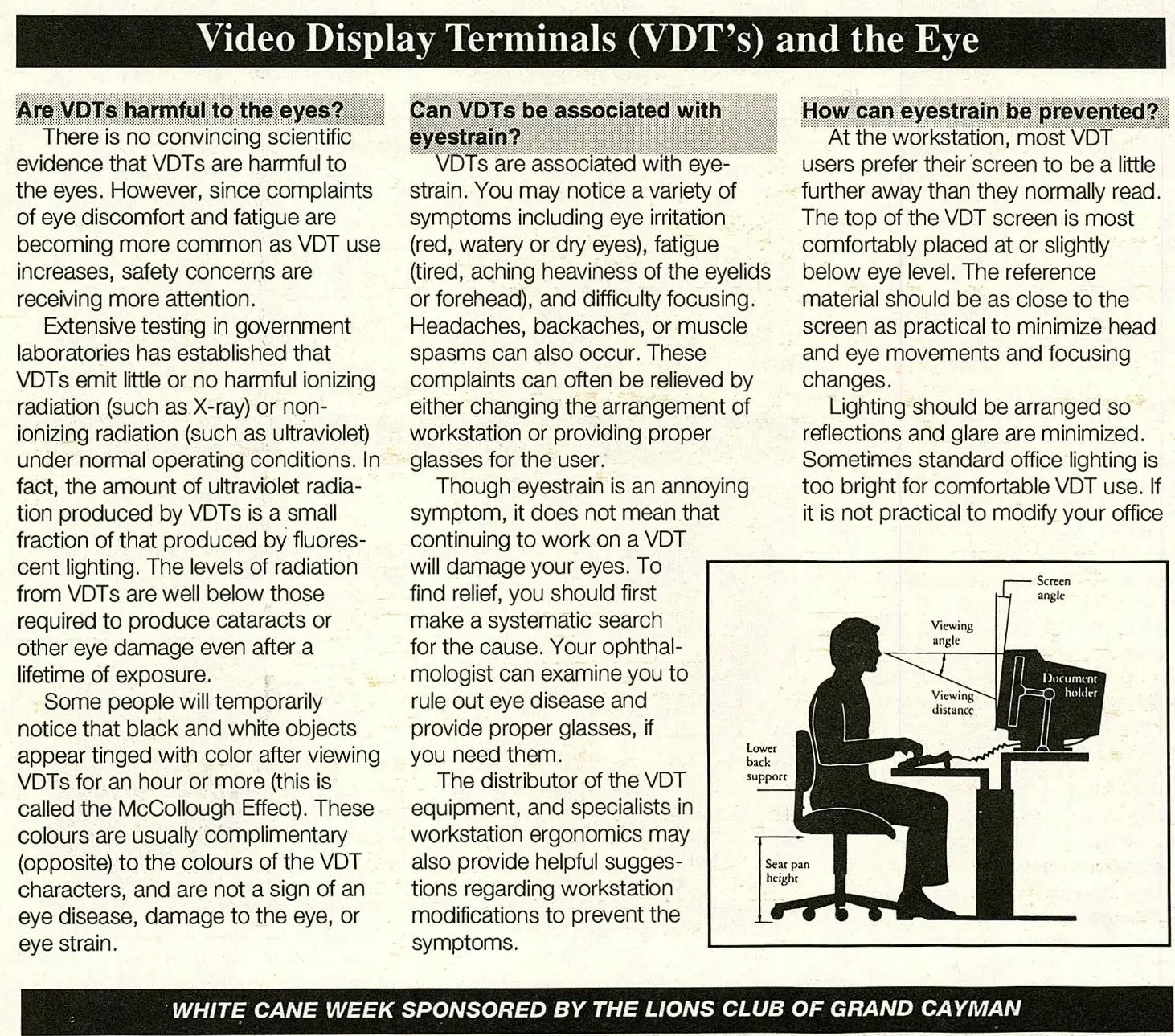
At the workstation, most VDT users prefer their screen to be a little further away than they normally read. The top of the VDT screen is most comfortably placed at or slightly below eye level. The reference material should be as close to the screen as practical to minimize head and eye movements and focusing changes.
Lighting should be arranged so reflections and glare are minimized. Sometimes standard office lighting is too bright for comfortable VDT use. If it is not practical to modify your office WHITE CANE WEEK SPONSORED BY THE LIONS CLUB OF GRAND CAYMAN