Chad massacre charges
About the article
This is a digitised version of an article from The Cayman Compass's print archive. Occasionally, the digitisation process introduces transcription errors, or other problems.
See the article in its original context from May 1993.
Brought to you by

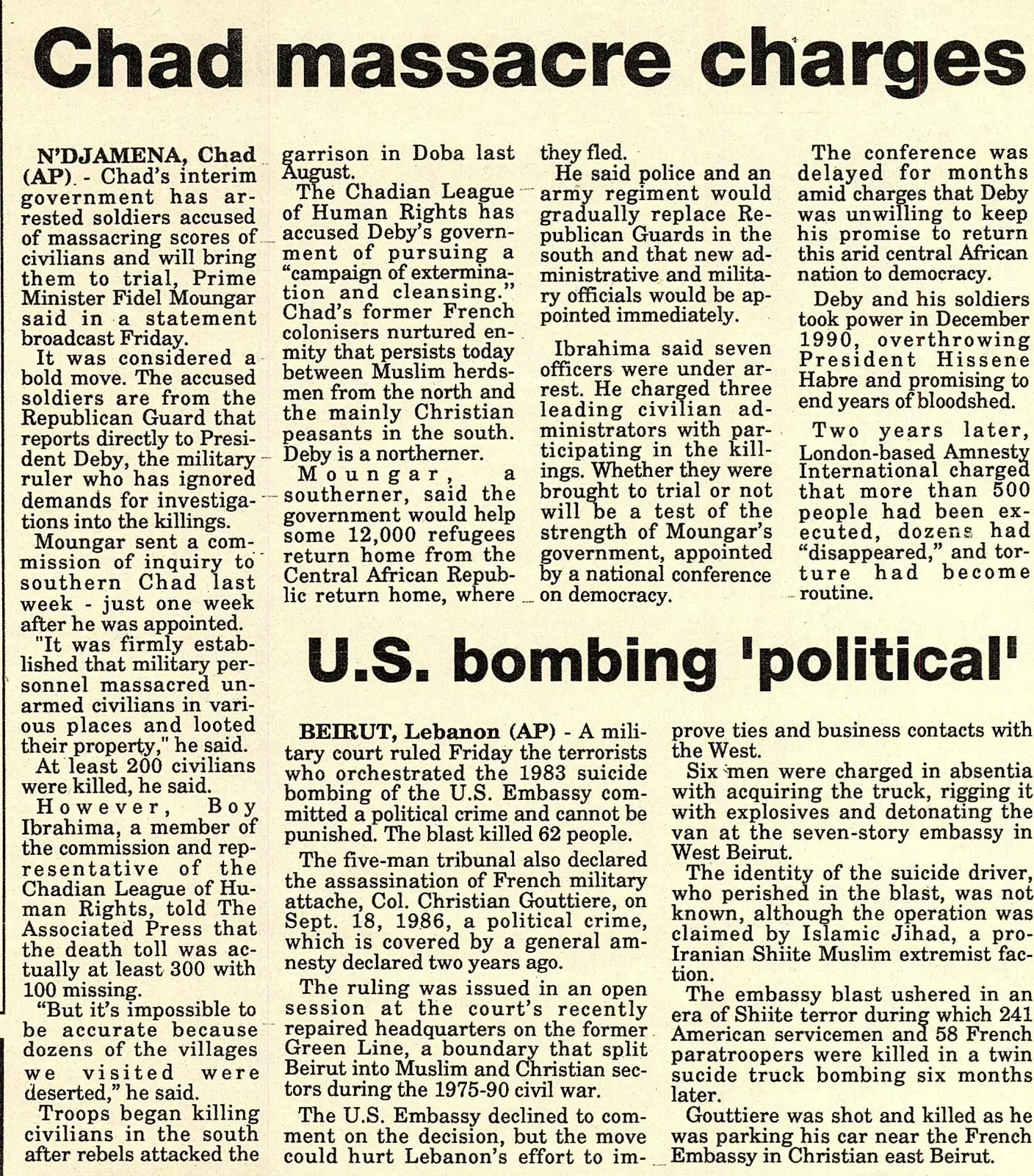
It was considered a bold move. The accused soldiers are from the Republican Guard that reports directly to President Deby, the military ruler who has ignored demands for investigations into the killings.
Moungar sent a commission of inquiry to southern Chad last week just one week after he was appointed. "It was firmly established that military personnel massacred unarmed civilians in various places and looted their property," he said. At least 200 civilians were killed, he said.
However, Boy Ibrahima, a member of the commission and representative of the Chadian League of Human Rights, told The Associated Press that the death toll was actually at least 300 with 100 missing.
"But it's impossible to be accurate because dozens of the villages we visited were deserted," he said.
Troops began killing civilians in the south after rebels attacked the garrison in Doba last August.
The Chadian League of Human Rights has accused Deby's government of pursuing a "campaign of extermination and cleansing." Chad's former French colonisers nurtured enmity that persists today between Muslim herdsmen from the north and the mainly Christian peasants in the south. Deby is a northerner.
Moungar, a southerner, said the government would help some 12,000 refugees return home from the Central African Republic return home, where they fled.
He said police and an army regiment would gradually replace Republican Guards in the south and that new administrative and military officials would be appointed immediately. Ibrahima said seven officers were under arrest. He charged three leading civilian administrators with participating in the killings.
Whether they were brought to trial or not will be a test of the strength of Moungar's government, appointed by a national conference on democracy. The conference was delayed for months amid charges that Deby was unwilling to keep his promise to return this arid central African nation to democracy.
Deby and his soldiers took power in December 1990, overthrowing President Hissene Habre and promising to end years of bloodshed. Two years later, London-based Amnesty International charged that more than 500 people had been executed, dozens had "disappeared," and torture had become routine.