Coral: suffering the human touch
About the article
This is a digitised version of an article from The Cayman Compass's print archive. Occasionally, the digitisation process introduces transcription errors, or other problems.
See the article in its original context from June 1993.
Brought to you by

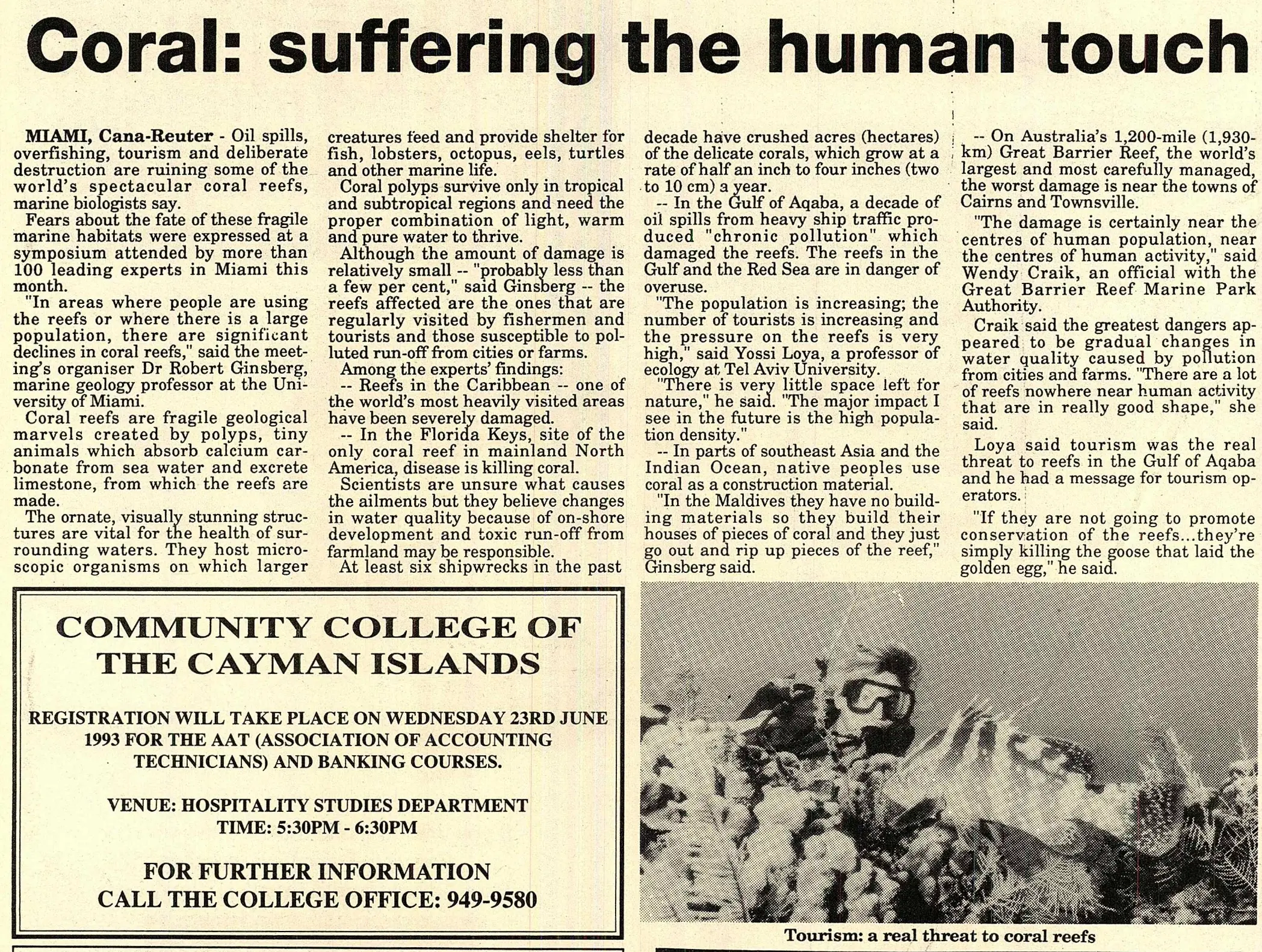
Fears about the fate of these fragile marine habitats were expressed at a symposium attended by more than 100 leading experts in Miami this month.
"In areas where people are using the reefs or where there is a large population, there are significant declines in coral reefs," said the meeting's organiser Dr Robert Ginsberg, marine geology professor at the University of Miami.
Coral reefs are fragile geological marvels created by polyps, tiny animals which absorb calcium carbonate from sea water and excrete limestone, from which the reefs are made.
The ornate, visually stunning structures are vital for the health of surrounding waters. They host microscopic organisms on which larger creatures feed and provide shelter for fish, lobsters, octopus, eels, turtles and other marine life.
Coral polyps survive only in tropical and subtropical regions and need the proper combination of light, warm and pure water to thrive.
Although the amount of damage is relatively small -- "probably less than a few per cent," said Ginsberg -- the reefs affected are the ones that are regularly visited by fishermen and tourists and those susceptible to polluted run-off from cities or farms.
Among the experts' findings: -- Reefs in the Caribbean -- one of the world's most heavily visited areas have been severely damaged. -- In the Florida Keys, site of the only coral reef in mainland North America, disease is killing coral.
Scientists are unsure what causes the ailments but they believe changes in water quality because of on-shore development and toxic run-off from farmland may be responsible.
At least six shipwrecks in the past. decade have crushed acres (hectares) of the delicate corals, which grow at a rate of half an inch to four inches (two to 10 cm) a year.
-- In the Gulf of Aqaba, a decade of oil spills from heavy ship traffic produced "chronic pollution" which damaged the reefs. The reefs in the Gulf and the Red Sea are in danger of overuse.
"The population is increasing; the number of tourists is increasing and the pressure on the reefs is very high," said Yossi Loya, a professor of ecology at Tel Aviv University.
"There is very little space left for nature," he said. "The major impact I see in the future is the high population density."
-- In parts of southeast Asia and the Indian Ocean, native peoples use coral as a construction material. "In the Maldives they have no building materials so they build their houses of pieces of coral and they just go out and rip up pieces of the reef," Ginsberg said. -- On Australia's 1,200-mile (1,930-km) Great Barrier Reef, the world's largest and most carefully managed, the worst damage is near the towns of Cairns and Townsville.
"The damage is certainly near the centres of human population, near the centres of human activity," said Wendy Craik, an official with the Great Barrier Reef Marine Park Authority.
Craik said the greatest dangers appeared to be gradual changes in water quality caused by pollution from cities and farms. "There are a lot of reefs nowhere near human activity that are in really good shape," she said. Loya said tourism was the real threat to reefs in the Gulf of Aqaba and he had a message for tourism operators. "If they are not going to promote conservation of the reefs...they're simply killing the goose that laid the golden egg," he said.